John Sentamu To End All War

SentamuNever one to shy away from self-promotion, the Archbishop of York, ‘the most reverend and right honourable’ John Sentamu, has begun a week-long fast and prayer vigil for world peace. The Archbishop reckons this will show ‘solidarity with the suffering people of our world, particularly in the Middle East.’

How, I hear you ask, will it do this? How will John’s fasting and praying – ‘on the hour, every hour’ – be any more effective than, say, his cutting up his dog collar in 2007 in protest at Mugabe’s presidency of Zimbabwe (seven years later and Mugabe is still there.) What will all the prayers and the fasting accomplish, other than thrusting the Archbishop briefly into the limelight once again?

Does God need Sentamu’s prayers to alert him to what is going on in the world? Doesn’t God know already? Will his pleading prick God’s conscience so that he intervenes and brings to an end the bloodshed in Syria, Iraq, Afghanistan and Palestine? Why doesn’t God do something anyway?

And isn’t all of this rather arrogant, this assumption that God will only act if problems are pointed out to him by fallible human beings? (Even Jesus thinks this is how it works in Luke 11.5-8.) What sort of God is this, who is unaware of how things are here on Earth and is unable or unwilling to do anything about them until important show-offs men like the Honourable Rev. let him know?

Maybe though, the Archbishop is less ambitious. Perhaps he just wants to demonstrate to those caught up in the world’s conflicts that he stands with them – though only metaphorically. But if that’s it, what exactly is he saying in all those prayers, on the hour, every hour?

Whatever it is, there will be no divine intervention. There is no God to take action, as evidence throughout history has shown us time and time again. Religion is part of the problem not its solution.

The Great Escape

EscapingSometimes I miss my religion. I miss my days of thinking I knew what life was all about, of living in accordance with God’s will, of believing I was in a relationship with Jesus. It was comfortable and secure, and maybe a little bit anxiety inducing too: what was God telling me to sort out in my life now? What sin had I not confessed? How had I let him down this time?

My faith defined my life for me, set its parameters, told me what to believe about other aspects of life – like the role of men and the place of women, parenthood, abortion, homosexuality, evolution, the end of the world (always coming soon! You need to be ready for it!) – and defined my values. God would guide me when making decisions in life, which may be why I made so many bad ones, and even gave me a special set of spiritual words with which to talk about him. I don’t mean speaking in tongues, though there was that, but words like ‘saved’, ‘redeemed’, ‘born again’, ‘witness’ ‘rapture’, ‘seeking the Lord’. (Now there’s a blog post; the surrealism of Christian-speak.)

There was an entire sub-culture to enjoy too; Christian music (some of it – certainly not all of it – as good as anything in the ‘world’), hymns and choruses to sing, devotional books, Bible study notes to tell you what the scriptures really meant, magazines (Buzz, anyone?), conventions like Spring Harvest and Filey where you could go for a spiritual charge (buzz, anyone?) and hear what the Lord had to say to his people – usually that he expected more of them. Church too, of course, which was the means of reinforcing collective beliefs and ensuring conformity, and where there were friends and some really genuine people (some difficult people too, but they probably weren’t ‘real’ Christians.)

Most of all I miss the cosy, fuzzy feeling that came from being a Christian. This was generated by the sure and certain knowledge that I was saved and Jesus loved me. However things might appear, God was in control; everything happened for a reason, which he knew about even if I didn’t. What’s more, and best of all, he would welcome me and everyone else who was genuinely born-again into Heaven when we died. What more could I want?

How about:

  • a healthy dose of reality;
  • shedding a false persona to be the person I was meant to be;
  • using my brain to have views and values of my own;
  • recognising that the Bible is wrong about so much;
  • understanding we have relationships with living people not long dead ‘prophets’;
  • coming to terms with the fact that there’s no-one out there listening to our every thought and answering our prayers;
  • embracing the fact that life is gloriously random and messy;
  • accepting myself and everyone else as they are (also random and messy);
  • knowing this life is all there is, and
  • enjoying everything it makes possible.

Would I change any of this to return to the delusional comfort and stability of Faith? Certainly not. Any belief system that puts mythical beings ahead of real people and espouses principles that its adherents would kill or die for, is, I now see, inherently wicked. As we witness each and every day now, all of the world’s major religions – including Christianity – are inclined towards the heartless extremism that belief in the supernatural engenders. I want nothing to do with them, other than speaking out against them whenever and wherever possible.


In Support Of Cliff Richard

CliffThis post takes a little diversion from the usual topics…

Suddenly, after their failure over many years to detect and prosecute Jimmy Savile for his serial abuse of others, the police have taken to investigating historical claims of sex abuse with a vengeance. Now, with each new celebrity accused of assault, a peculiarly public pillorying takes place. An allegation from twenty, thirty, forty years ago is not only listened to but broadcast far and wide.

It’s true that some of these accusations have led to convictions – Rolf Harris, Max Clifford, Stuart Hall – because it turned out there was evidence or a consensus of voices that served as corroborative evidence. But equally there have been arrests for activities which aren’t even illegal – Jim Davidson’s threesome with two other consenting adults, for example – and witnesses who are forced unwillingly to provide evidence, as in the Nigel Evans’ case.

Then there are isolated allegations which come with no corroborative evidence, just, perhaps, a date and a location, which are not evidence at all but merely part of the accusation.

Very quickly afterwards, the individual making the allegation is turned – by the police, the media and the CPS – into a ‘victim’, often on no other basis than the uncorroborated accusation. An accuser is not, however, a victim, and the accused is not a perpetrator, unless the courts decide he or she is. Moreover, the accuser has the privilege of remaining anonymous, while the accused celebrity, even if there’s no court case or even an arrest, has their reputation sullied as soon the allegation is made public. Trial by media invariably follows and the accused is seen as guilty by association, because, as we all know, there’s no smoke without fire. (Unless you’re a 1980s politician – in which case the ‘historic’ nature of the supposed offences is sufficient to ensure a prosecution is replaced with an enquiry that won’t report for months, if not years – or a member of the Catholic clergy who, for the most part, have also abused with impunity.)

The latest celebrity to be the focus of police interest is, it can’t have escaped your attention, Cliff Richard. Somehow the singer is expected to demonstrate that he did not sexually assault an under-age ‘boy’ – we haven’t been told his actual age – at a Billy Graham rally on a given date nearly thirty years ago. I don’t know about you but, even though it was my tenth wedding anniversary, I can’t remember a single thing I did on 28th June 1985. And I certainly couldn’t demonstrate it wasn’t something criminal. It wasn’t, but I can’t prove it, because it’s impossible to prove a negative. Could you, if you were accused of it, demonstrate satisfactorily that you didn’t indulge in, and get away with, a little light shoplifting on that date? No, you couldn’t. How then can Cliff Richard prove he didn’t do what he has been accused of doing? He can’t. All he has is denial and his hitherto unblemished character and integrity. While I don’t share his religious views, Cliff is also devout; his faith determines how he lives his life in a way that honours the God he believes in. On this basis, it is hard to imagine him doing anything like the crime he has been accused of. And unless it can be proven he did, then he most emphatically did not.

This is not enough for the police, of course, who have made their investigation of the star a very public affair in the hope that ‘others will come forward’ and make similar accusations. They can then claim they have their corroboration. So far, despite saying they have received ‘many’ calls related to their enquiry, they have not confirmed they have any such corroboration. You can bet your life they would if they had.

The fact the police don’t operate in this manner in any other context should immediately alarm us. Yes, they normally seek witnesses for incidents – an alleged physical attack, say – but what they don’t do is broadcast the names of those involved so that other people might ‘come forward’ with stories about entirely different incidents. So why do they regard it as legitimate to operate like this when a celebrity is accused of sexual impropriety? And why are they allowed to? The goodly folks of 17th century Salem, not to mention Senator McCarthy, would surely approve.

Ah, but what about the victim, I hear you ask. As I’ve already explained, without evidence or corroboration there is no victim. There is only an accuser and an accuser is not the same as a victim. In the States, the statute of limitations restricts the time after an event when legal proceedings may be initiated. For sexual offences, this limit varies according to the nature of the alleged offence and from state to state but it is generally in the region of ten years. This prevents the flood of historical accusations that we have seen in the UK following Savile’s death. I am not advocating that real victims, like those we have seen in some of the other cases, be disregarded, but that there must come a time after which allegations can no longer be made, or if made, acted upon. There is precedence: rightly or wrongly, those suspected of ‘historical’ bombing campaigns in Northern Ireland, bombings that destroyed lives, can no longer be prosecuted. Such a statute would prevent innocent individuals like Cliff Richard (and he is innocent until proven otherwise) from enduring uncorroborated accusation, the sullying of reputation and unnecessary public approbation.

Meanwhile, I plan to get out my Cliff Richard CDs to listen to them until the hounding of the singer is called off, and the police are called to account for the unreasonable way they have handled the sole allegation against him. I hope you’ll be doing the same.


Update:

‘Ere, Sarge – another of those reports about wide-scale child abuse on our patch.

Just put it with the others, son. We’ll shred them all later.

Shouldn’t we do something, Sarge?

No son, that’s not the way it works. We’re going after a celebrity instead.

A celebrity? You mean that famous singer?

Yes, son. That’s the one.

But we’ve no evidence he’s done anything, Sarge.

And when has that ever stopped us before?



Idiotic Stuff Jesus Said 3: Whoever Is Not With Me Is Against Me

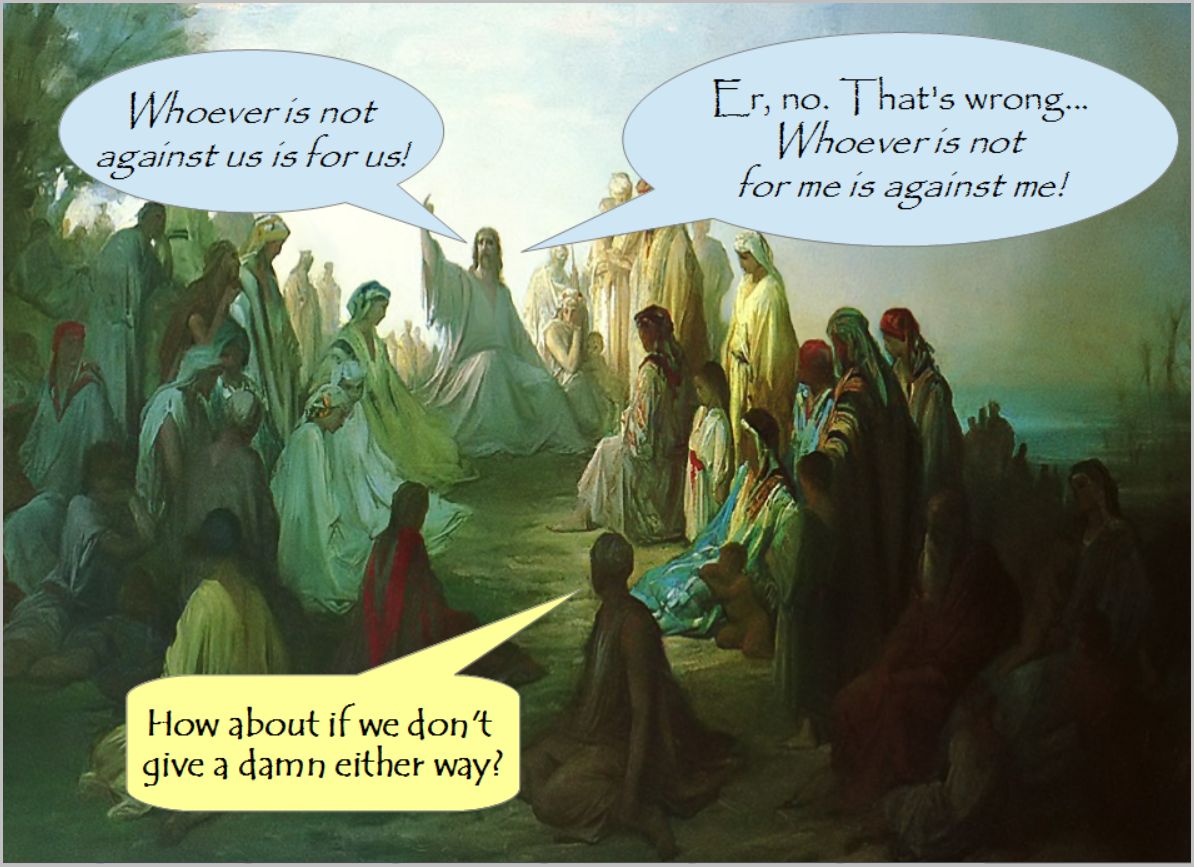
ForUsJesus is reported as saying both that ‘Whoever is not against us is for us’ (Mark 9.40)
and ‘Whoever is not with me is against me’ (Luke 11.23). What he doesn’t seem to realise is that these two statements, each ridiculous in its own right (there is always the third option of not caring either way), mean exactly the opposite of each another. The first is inclusive and relatively friendly. The second is hostile and exclusive; it says, in effect, ‘If you don’t give me your unquestioning devotion you are my enemy.’

This is not the claim of a fully-realised divine being, but of a paranoid megalomaniac. As with much of what he said – or is reported as saying (which is not the same thing) – Jesus reveals himself to be very human; flawed and completely egotistical.

He sets up, as all cult leaders do (and, indeed, as all human groups have a tendency to do) an ‘Us and Them’. Elsewhere, Jesus describes Insiders and Outsiders, with all the rustic charm of a first-century peasant, as the sheep and the goats (Matthew 25.32). It’s still a favourite pastime of Christians to segregate themselves and others into these two categories. They do it with real sophistication these days, of course (I mean, ‘sheep and goats’… c’mon) but it still comes down to Us and Them:

If you’re a mainstream evangelical you’re Saved, while those who don’t subscribe to your brand of Christianity are Lost or Of This World.

If you’re a Bible-believing fundamentalist you’re Regenerate but others are Unregenerate (or Degenerate).

If you’re a Jehovah’s Witness you’re one of the True Church; other believers are part of a False Christianity.

If you belong to the cult formerly known as the Children of God, you’re of The Family and everyone else is part of The System.

If you’re a Roman Catholic you’re the Only True Christians, while all others are Damned.

and so on, throughout all of the 34,000 different Christian sects and denominations.

It is an essential part of the Christian faith to regard yourself as belonging to the only True Church. Everyone else – from those who don’t buy into religion at all to every other faith group – is wrong. They’re an enemy of Jesus because, not being for him or with him in quite the right way (your way) they are, according to the warped logic he expresses here, against him.

The so-called Prince Of Peace proudly declares that he came to bring strife and division into the world (Luke 12.51), which, to this day, remains his greatest achievement. His idiotic words about being either for or against him have proven to be a gift to every sect, cult and church that has ever existed.

Our touchy Loving Father is pissed off (again)

DoctorIn 1665, the great plague overtook London and killed about a sixth of its population. The church and other authorities believed the plague was a punishment from God for the sins of those who lived in the city.

Such a view is understandable among people who lived in a pre-scientific era (just) and had no other way of explaining natural phenomena other than from a religious perspective. Their ignorance is perhaps forgiveable.

Speed forward to 2014 and the outbreak of the Ebola virus in Liberia and other parts of Africa. Ebola causes an incurable disease with a 90% fatality rate. And guess what? Those of arrested development, whose thinking is still stuck in the seventeenth century, attribute it to God. More than that, they predict a plague on a scale next to which the 1665 plague looks like little more than a minor skin irritation. And all because of the sins of other people (naturally). According to Liberian church leaders:

God is angry with Liberia. Ebola is a plague. Liberians have to pray and seek God’s forgiveness over the corruption and immoral acts (such as homosexualism, etc.) that continue to penetrate our society. As Christians, we must repent and seek God’s forgiveness.

The usual suspects – atheists, secularists, those pesky homosexuals, pornography, abortionists and women who have abortions – are bringing the judgement of God to Africa, and far more importantly, according to American evangelical leaders, to America itself. There’s an even a lunatic fringe there who welcome it:

Everybody who stands up and embraces sodomy, BE THOU CURSED WITH EBOLA! Cursed be ye for embracing this!’

rants Harlem Pastor James Manning.

As ever God’s judgement, if that’s what we’re dealing with, will be indiscriminate. It will strike down the weak, the elderly, the vulnerable, and, yes, Christian missionaries (the two American medics who have contracted the disease are just that.) Because God’s like that; when he’s in his Hulk-smash mode, he doesn’t care who gets in his way.

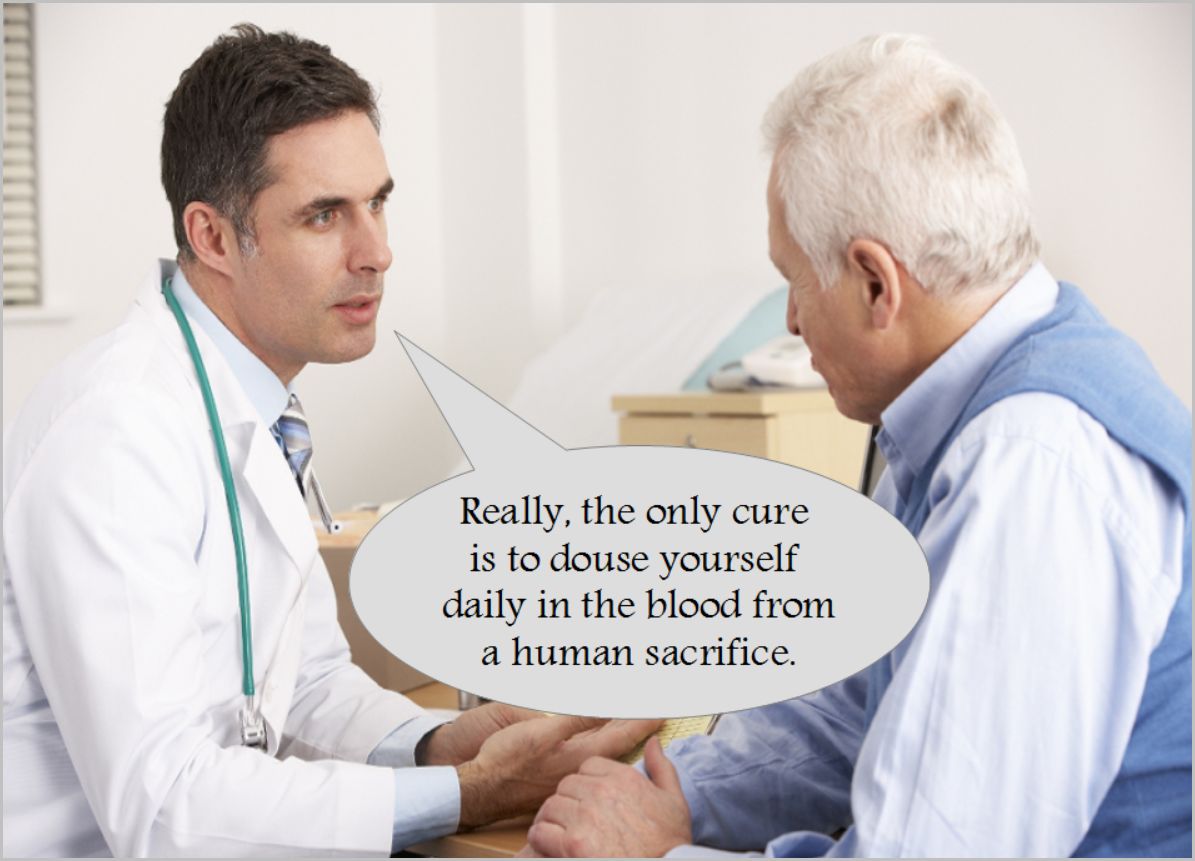
There is a cure though. Just as the scientifically illiterate in 1665 thought prayer would spare them from the plague, the way to survive the coming Ebola pandemic is, according to Pastor Rick Wiles, to be covered in the blood of Jesus:

Now this Ebola epidemic could become a global pandemic and that’s another name for plague. It may be the great attitude adjustment that I believe is coming. Ebola could solve America’s problems with atheism, homosexuality, sexual promiscuity, pornography, and abortion…
If Ebola becomes a global plague, you better make sure the blood of Jesus is upon you. You better make sure you been marked by the angels so that you are protected by God. If not, you may be a candidate to meet the Grim Reaper.

Yes, only true believers who have the blood of a long dead Jewish preacher ‘upon’ them, and angels hovering over their heads, will survive the coming plague (so those Christian missionaries are safe after all – they needn’t bother with the medical care they’re currently receiving back in the States).

This isn’t even seventeenth century thinking; it’s straight from the bronze age.

Will there be a world-wide Ebola plague? It seems unlikely, but who knows; life is more precarious than we sometimes like to admit. If there is, it won’t be because a vengeful, pissed-off God is inflicting it on us… because there’s no such entity. Nor is there a nice, loving, daddy God either – but then he doesn’t figure in this particular scenario anyway.

In spite of what the Bible promises (James 5.14-15), there’s no supernatural protection from Ebola, nor from any other disease. The poor souls who died of the plague in seventeenth century England found that out the hard way. Praying to God and sloshing about in the blood of Jesus, metaphorically or otherwise, protects no-one.

Idiotic stuff Jesus said 2: You need never have another bad hair day

ThePlanDon’tcha just love him?

Jesus says that whatever else happens, Christians will never, ever have a bad hair day. They may have limbs lopped from their bodies and they may be crucified just as he was, but – blessed assurance! – not a single hair on their heads will come to harm. Isn’t that fabulous?

Here’s how he puts it:

…they will arrest you and persecute you; they will hand you over to synagogues and prisons, and you will be brought before kings and governors because of my name… You will be betrayed even by parents and brothers, by relatives and friends; and they will put some of you to death. You will be hated by all because of my name. But not a hair of your head will perish. By your endurance you will gain your souls. (Luke 21.12, 16-18)

Of course, this particular part of Jesus’ script was written long after he died (wasn’t it all) when there was some mild persecution of Christians under the emperor Nero. Jesus’ promise was designed to be of comfort to those in trouble because of their faith. It turns out to be cold comfort, however, and a blatant lie. Jesus’ own brother and leader of the church in Jerusalem, James was tortured and executed round about 62CE, as were several of the disciples and the self-appointed apostle, Paul (circa 64CE). And we can be fairly certain that whatever hair they had on their heads ‘perished’ when they did.

Perhaps Jesus suffered from male pattern baldness, which might explain his fixation with hair, because as well as promising that not a single hair on believers’ heads would perish, he’s made to declare, equally improbably, in Matthew 10.30 that all the hairs on the disciples’ heads are numbered.

God really does have too much time on his hands. You’d have thought he could use it to prevent the deaths of the 25,000 African children who die each day because of malnutrition and the innumerable diseases he’s seen fit to create. But no. He counts hairs instead.

Consequently and predictably, Christians have tied themselves in tangled knots trying to explain Jesus’ bizarre claim that not a single, numbered hair would be lost. What he meant, some of them tell us, is that the souls of persecuted believers will be unharmed, safe in God’s care, whatever they endure. But hair, it has to be said, is an unlikely metaphor for the soul, and isn’t one that the gospel writers or other New Testament authors use anywhere else.

So maybe, Christians argue, because hair is a part of the physical body, Jesus means it to stand for the whole body, and yes, this might be put to death, but it will live again as a resurrected super-body. God will then reinstate even the hair of those who have died for Jesus’ sake. Which means there are going to be a lot of hirsute people in the Kingdom when all the hair they’ve ever possessed is returned, post-mortem, to their heads. This is what Jesus promises.

Paul, though, says in 1 Corinthians 11.14 that long hair degrades a man, while Augustine argues that, come the resurrection, any excess hair will be incorporated somewhere in the body (extra pubes maybe?). Perhaps, though, God doesn’t intend acting as divine hair-restorer at all, but plans to keep all the hair ever lost, alive and vibrant, in a special heavenly hair-museum.

Or maybe Jesus’ guarantee that even Christians’ hair will be saved is, like the rest of his promises, nothing more than total and utter BS.


Meet the new boss, same as the old boss

PersecuteThe Reverend Andrew White, vicar of the Anglican church in Baghdad, was interviewed on BBC Radio 4 this morning about the persecution of Christians in Iraq. Undoubtedly, appalling things are being done to these people – beheadings, torture, theft of their possessions – just because of what they believe. The Sunni Muslim militia doing the persecuting are routinely referred to in the UK media as ‘Islamists’ or ‘extremists’, in a vain PC attempt to distinguish and distance them from other of Mohammed’s followers. Whatever we call them though, men, women and children who follow a different long-dead prophet are suffering at their hands.

It is a sad fact that whichever religious group holds the reins of power, it persecutes those who hold different beliefs. History is replete with examples and because Christianity has, for most of the last 2000 years, held the whip hand, it is Christians – the church – that has invariably meted out the persecution. And still does.

There are Christians today who, in God’s name, think that atheists, women and homosexuals should be supressed, denied their rights, deported and even imprisoned. In the West, God’s gentle people (‘Christianists’? ‘Extremists’?) tend not to get their way, but in countries where Christianity still holds sway, they do. Christians persecute minorities, in Uganda, Nigeria, the Gambia, Cameroon and elsewhere, as they themselves are persecuted in predominantly Muslim countries. It’s all so terribly human, as they eagerly jettison the command to treat others as they themselves would like to be treated in favour of a ‘holiness’ that drives them to deprive their victims of life and liberty. Christians have been and are no better than the fanatics who turn on them when the boot is on the other foot.

Perhaps they don’t go in for beheadings quite so much these days, though there are still Christians who advocate stoning as a preferred method of purging society of sinners. Others take it upon themselves to campaign against the human rights of those they’ve taken a dislike to. Recently, the Family Foundation of Virginia announced a forty day fast that it thinks will impress God enough he’ll destroy same-sex marriage in the States. It’s a fast with a difference though – those taking part can eat during it: ‘We are asking the entire Body of Christ to join us for this fast,’ the group says. ‘Giving up physical food isn’t necessary – but feeding on the spiritual food provided is vital.’

I don’t know about you, but I always understood that fasting meant doing without food. A fast isn’t a fast otherwise.

This laughable nonsense beautifully encapsulates religious belief; take on the outer aspects of a faith, including its language and its rituals, and reinterpret them in whatever way suits you. That way, showing the love the saviour commands means treating others with contempt; fasting to get God to do what you want really means filling your belly; following Jesus means ignoring most of what he said and doing what you like.

It’s all so empty, so human, so meaningless – so very hypocritical. If only it weren’t quite so dangerous for those on the outside.

New series! Idiotic stuff Jesus said!

This one’s gonna run and run!

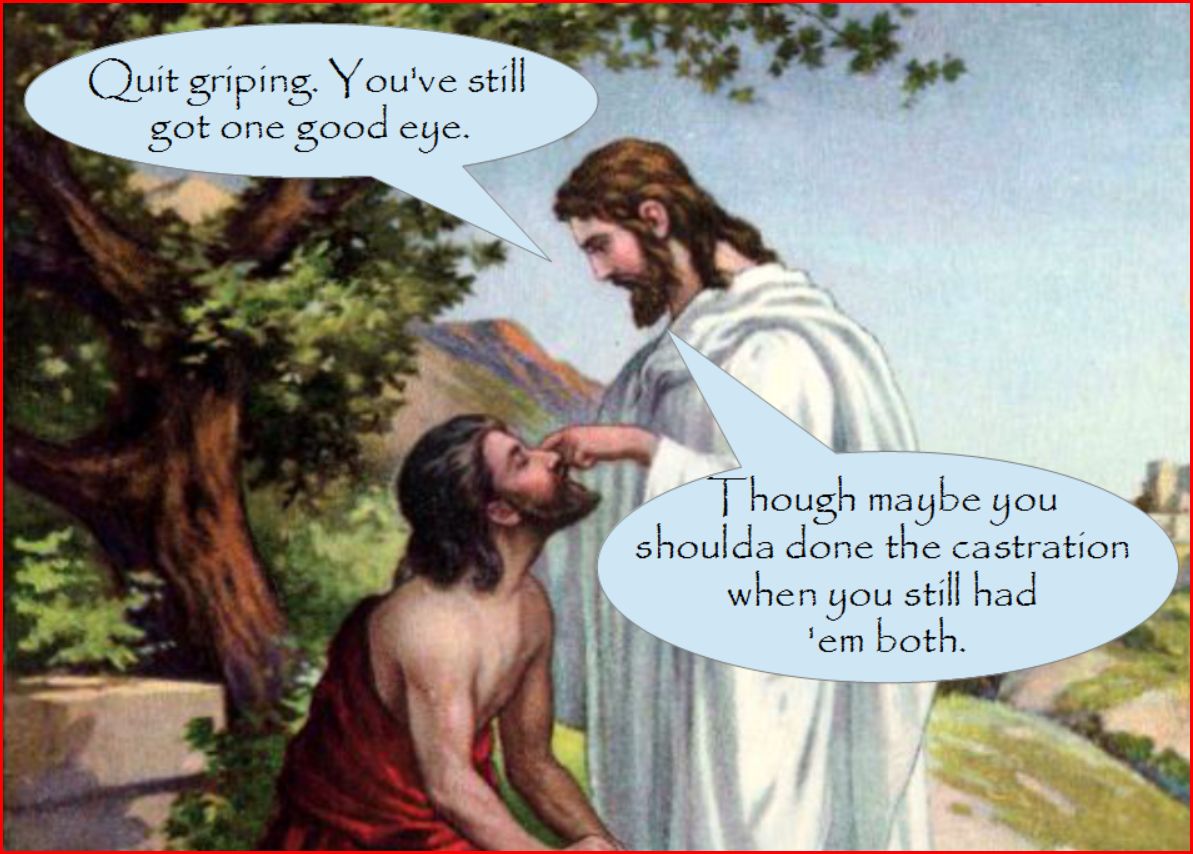
EyesYou hear the one about the blind Christian bloke with only one hand and no balls? And he did it all to himself! Cut off his hand, gouged out his eyes and castrated himself. When asked why he’d done it the man explained, ‘I’m a follower of Jesus and when he tells me to do something, I do it. My self-mutilation is my witness to what a great guy he is. He wouldn’t steer me wrong.’

Sure enough, the normal people who heard him were incredulous, until one of them looked in the Bible and found the very instructions to which the eyeless, testicle-free, one-handed believer referred.

In Matthew’s gospel chapter 5, Jesus is talking about lusting after a woman, which in his eyes (he still had both of his) is as bad as having sex with her. Course it isn’t, not by a long way, but he tells his followers, ‘If your right eye causes you to sin, tear it out and throw it away; it is better for you to lose one of your members than for your whole body to be thrown into hell’ (Matthew 5.29).

A bit drastic perhaps, but there it is; the Son of God is clear about how to avoid the sin of checking out a member of the opposite sex. That’s why you see so many one-eyed Christians around the place because they all take his admonition very seriously.

Except… you don’t. Either Christians ignore him entirely on this one or they never look at the opposite sex with an eye to sexual congress. We all know they’re like the rest of us in this respect – some, as Jimmy Carter once famously did, are honest enough to admit it – and some even act on it; the divorce rate among Christians is not the same as it is for everyone else just because they get tired of being married.

Perhaps though Jesus is being metaphorical when he proposes that gouging out one’s eyes is the best way to deal with lust. Not surprisingly, Christians prefer this possibility. In The Method and Message of Jesus’ Teachings, Robert Stein argues that:

what Jesus was seeking to convey to his listeners by this use of overstatement was the need to remove from their lives anything that might cause them to sin… Jesus is saying in effect, “Tear out anything in your life that is causing you to sin and keeping you from God”.

If that was his intention, Jesus might have actually used these words. If he wants to say ‘in effect’ that the believer should jettison anything from his life that causes him to sin then why doesn’t he?

But eyes are not enough. You gotta get rid of that wanking* hand too (the context of Jesus’ comments is specifically sexual and entirely male orientated throughout these verses): ‘And if your right hand causes you to sin, cut it off and throw it away; it is better for you to lose one of your members than for your whole body to go into hell’ (Matthew 5.30). This must be why we see so many one-handed Christians…

The difficulty with interpreting these and other verses metaphorically is that Christians want to claim that the Bible is the literal ‘word of God’ and then want select parts of it to be metaphorical – and guess who they think should do the selecting. But they can’t have it both ways. Even if they could, how would they know which parts to interpret literally and which symbolically? Perhaps the Holy Spirit tells them, or maybe, and more likely, it’s just their personal preferences. After all, who wants to lose eyes and hands just for being human?

If that’s not enough, Jesus encourages other mutilations for the sake of his Kingdom when he reveals in Matthew 19.12 that ‘there are eunuchs who have made themselves eunuchs for the sake of the Kingdom of heaven. Let anyone accept this who can’. No Christians today seem able to ‘accept’ this recommendation, either; what a truly feeble bunch they are, putting their testicles before the Kingdom!

It seems likely that, given he believed the end of the age was fast approaching, Jesus actually meant what he said, counting on the probability (as he saw it) that anyone who followed his ridiculous suggestions would not be eyeless or handless for long. They would, at the resurrection, be fully restored to live in the Kingdom where, according to Matthew 22.30, they would not be troubled by either impure thoughts or marriage itself (and so wouldn’t need those testicles anyway).

Whichever way you cut it (off) – literally or metaphorically – Jesus words in these verses are remarkably idiotic. Throughout history there have been some individuals, like the dude we started with, who have indeed made themselves eunuchs for the cause. But the vast majority of male Christians have always dismissed this advice or have decided JC was only speaking metaphorically (as he always is when they don’t like what he’s telling them to do).**

So next time True Believers start thundering on about the evils of same-sex marriage and gay sex, tell them to get their own house in order first. A little amputation is all that the Lord requires.


* ‘Jerking off’, for any Americans reading.

**Read more in my (five star reviewed!) book Why Christians Don’t Do What Jesus Tells Them To …And What They Believe Instead, available from Amazon.


Christian Love in Action

CrossI’ve been banned from a ‘Christian’ web-site. From Barbwire, in fact, the extreme mouthpiece of extreme mouthpiece Matt Barber and his chums; Scott Lively, self-confessed ‘father’ of Uganda’s anti-gay movement; Bryan Fischer, bigoted evangelical shock-jock; Laurie Higgins, gay-sex obsessed ‘marriage defender’ and Bradlee Dean, third-rate rockstar-cum-provocatuer, amongst others.

My ban is not because I was abusive. Actually, I’m not sure what prompted it though I’m not alone in having my comments deleted and my name blocked. Others who’ve challenged the bigotry and distortions regularly paraded on Barbwire have been too. Dissent will not be countenanced by ‘Christian’ bullies whose faith is weak and arguments even weaker.

I hope my comments were reasoned and reasonable, even if sometimes flippant; above all, I hope they were challenging. I tried to challenge both those ‘names’ who write for the blog as well as those who comment there, to react and respond as their Saviour commands them to; to treat others as they would want to be treated; to attend to the log in their own eyes before the speck in their neighbours’; not to judge lest they be judged and to show compassion for those with different views.

Have I as a non-believer any right to expect Christians to behave like this? I think so – I think we all have. After all, they’re the ones who’ve bought into Jesus’ demands; the ones who proclaim him as messiah and potential saviour of the world; the ones who feel compelled to tell us about him at every turn. They’re the ones who believe they’re born again as new creatures, filled with the Holy Spirit, who now live transformed lives as Christ-like beings. It’s not unreasonable to expect to see them reflect all of this in how they deal with other people; loving their neighbour, not casting the first stone… and all the rest of it.

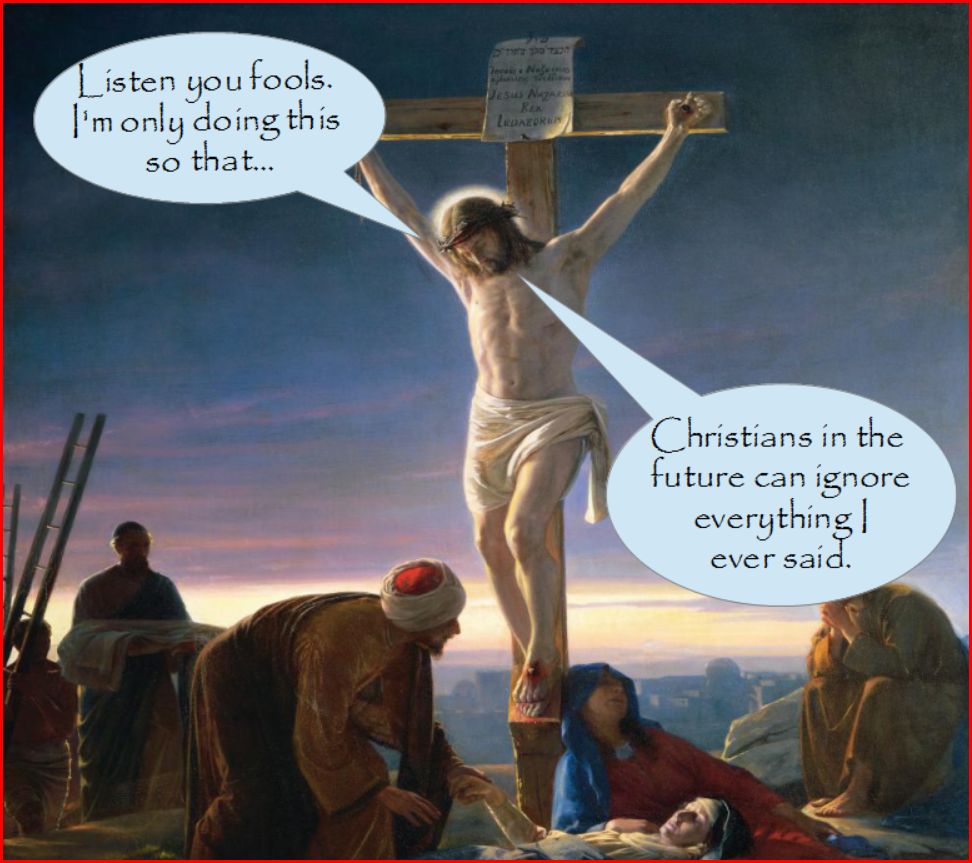
So how do they deal with dissenters on Barbwire? They call them ‘morons’, and ‘fools’ and ‘pervs’ and ‘sodomites’ and ‘idiots’. Now, it could well be that I’m all of these things and the good Lord has chosen to reveal it to his gentle people on the site, if not to me. But when you call out these supposed Christians on this less than loving behaviour – pointing out that Jesus says in Matthew 5.22 not to call others fool, let alone all those other things – what happens? You get more abuse, and lots of edging around Jesus’ words (he only meant not to call other Christians fools) and claiming his commands don’t apply to them because he was really only speaking metaphorically – as he always is when they don’t want to do what he says.

And then you, the one on the receiving end of their Christian Love™, are blocked, banned and deleted, while those with the slurs and insults remain, because it’s what Jesus would want, leaving them free to move on to new targets.

ScreenDoes it matter? Not really; as long as for a brief period there are others opposing the bigotry and hatred that spills, in Jesus’ name, from Barbwire and sites like it. Christians such as Matt Barber and, here in the UK, Stephen Green, are relatively powerless individuals, after all. They’re loud bullies who justify their extremism by claiming it is the standard demanded by a mythical being. But all the same, they and their cronies are influential. Witness the sycophantic commenters who commend every scurrilous word these bullies say about non-believers, fellow Christians, gay people, politicians, immigrants and those they imagine ‘persecute’ Christians here and in the States. The articles on Barbwire encourage and reinforce the prejudices, bigotry and small-mindedness of ‘Christians’ like these, helping shape the way they treat people in the real world.

I’d encourage you to take look at Barbwire and to become a commenter yourself, opposing the hatred and bigotry, not to mention the irrationality and stone-throwing, that you’ll find there. If you do, you won’t have to do it for long because, sooner rather than later, you’ll be banned, as the voices of reason and compassion invariably are there.

Then again, there are worse reasons for being thrown out of a sewage plant.


The fool says in his heart…

Celia2If you get into a discussion with Christians about their faith and you tell them, often reluctantly because you just know where it’s going to lead, that you don’t share their belief in a deity on account of there being no evidence for one outside of the human imagination, it isn’t long – if they haven’t done so already – before they start quoting ‘scripture’ at you.

Among their favourite verses, along with ‘For God so loved the world…’ (John 3.16) and ‘for a man to lie with a man… is an abomination’ (Leviticus 20.13) is Psalm 14.1: ‘The fool hath said in his heart there is no God’. And having cited it, they stand back in smug triumph, having put you firmly in your place and clinched the argument.

But the Bible would say this, wouldn’t it? It’s in its interest, and in the interest of those who wrote it and believe in it, to rubbish those who don’t buy into its fallacies. Christians who quote this verse, and others, are wilfully refusing to accept that you don’t recognise the ‘authority’ of their magic book. What they are really saying is, ‘You don’t believe in my God or the Bible, but I’m going to use it anyway to ‘prove’ my point.’

Why do they do this? Can they not see the futility of it? It’s like my quoting from ‘Twas The Night Before Christmas to demonstrate that, whether they like it or not, Santa Claus is watching over them to see if they’re naughty or nice. But referencing one make-believe source does not prove the existence of another. You have to believe in Santa Claus to begin with, as children often do, to believe the poem is an accurate account of his activities. So it is with the Bible. It only has significance if you already believe that God exists. It won’t of itself convince you that he does.

The Koran has its own ‘the fool hath said in his heart’ verses. Loads of them. Christians might like to consider whether a Muslim telling them ‘the vilest of animals in Allah’s sight are those who disbelieve’ (Q8:55) would persuade them that Allah is the one true God, and that they’re idiots for thinking otherwise. It wouldn’t, of course, so perhaps they’d kindly stop wasting their own time, and ours, doing the same to atheists.

The best response to a believer who tells you ‘the fool hath said in his heart there is no God’?

‘If even a fool can see it, why can’t you?’