A Reply to a Slave

I’ve discovered this new gizmo that lets me look stuff up on the Interweb. Goober or somesuch. I used it to find the meaning of ‘doulos’ that the absence of dictionary prevented you from doing. All of the results Goober brought up described doulos thusly:

Doulos (Ancient Greek: δοῦλος, Greek: δούλος, Linear B: do-e-ro) is a Greek masculine noun meaning “slave”. Wikipedia

Doulos (a masculine noun of uncertain derivation) – properly, someone who belongs to another; a bond-slave, without any ownership rights of their own. Biblehub (Christian site)

…anyone could become a slave, in a sense. However, once someone was sold into slavery, they remained a slave for life, and all of their offspring automatically became slaves as well. The only standard way of obtaining freedom was to earn enough money to pay your owner back as much as he had paid for you in the first place. This was a nearly impossible task to accomplish because slave owners did not often facilitate their slaves ability to earn money on the side. As such, most slaves, and their offspring remained slaves for the totality of their lives. Slavesandsons (Christian site)

Doulos is a Greek word in the Bible that has only one true historical option for accurate translation into English, which is slave. It literally means to be owned by someone for a lifetime. This word is found at least 127 times in 119 verses in the New Testament scriptures. It is used in the context of human slavery, which, sadly, was very common throughout the ancient Roman Empire for hundreds of years. Recorder.com (Christian site)

You’ll see none of them say what you say, Don. None think slavery was a nice amicable arrangement. Christian sites especially emphasise how slavery was a downright awful thing so’s they can sermonise about how Jesus saves us from slavery to sin.

If you’re going to reduce real world, God-approved slavery to something akin to a nice comfortable arrangement, you diminish the metaphor of Christ’s redemptive work to… not much at all. (Which of course it isn’t.) I noticed you didn’t comment on this point when I mentioned it in an earlier post and here you are digging yourself in deeper with your ‘slavery wasn’t really all that bad’. Good work, Don!

You’re certainly enslaved to all this Christian mumbo-jumbo. To Christ though, not really. There’s no such being and you certainly don’t give the impression of being a slave in any real world sense. Perhaps that’s because you have no understanding of what slavery was and is.

Jesus Shows How To Treat Slaves

Jesus’ parable of the talents

Three slaves are given money by their owner, two invest it while the third buries his share. He is castigated by his master (yes, it’s Jesus as his favourite metaphor: slave master) who says to him on his return:

I tell you that to everyone who has, more will be given, but from the one who has not, even what he has will be taken away. But as for these enemies of mine, who did not want me to reign over them, bring them here and slaughter them before me. (Luke 19:26-27)

I know, that last sentence doesn’t fit the rest of the story, but it tells us what a despicable s**t Jesus was, quite happy to see those who didn’t want a peasant with delusions of grandeur lording it over them exterminated. Thank God the Romans got to him first (if indeed he existed.) No-one likes a dictator, specially not another dictator.

How about the conclusion to the actual parable, the one about the slaves and the money? The talents are evidently a metaphor for something or other. According to Christianity.com, it’s that the third slave, ‘didn’t take joy in the promise of the master’s return but instead wasted his time, his opportunities, and the master’s money.’

In other words, it’s fanatic talk aimed at those with a lack of commitment to the cult and its beliefs, including the ‘master’s’ imminent return, when wastrels will be in big trouble. As Christianity.com puts it:

Those who are not (faithful) may face the harsh reality of being called a wicked and lazy servant. Worst of all, they may not share in the joy of their master’s presence when he returns.

And there we have it, the softening of Jesus’ dictatorial original: ‘will’, as in ‘will lose everything’ becomes the hedging-your-bets ‘may’ while ‘slave’ (doulos again) becomes the watered-down ‘servant’. After all, we wouldn’t want to draw attention to how much of a cruel bastard Jesus was originally conceived as being. (Because, yes, these stories were invented by the early Jesus cult.)

The cult took no prisoners; in terms of commitment. It was all or nothing. Waiver in that commitment and you risked expulsion when the slave-master returned. So much for being redeemed unto salvation, so much for salvation by grace alone. If you weren’t utterly committed you stood to lose it all. What the original cultists weren’t to know, of course, was that the master would never return. The whole sorry parable was as irrelevant then as it is now.

The Son of Man

I started wondering why, if his creators believed him to be the Messiah, they have gospel Jesus habitually refer to saviour-figures in the third person? He does it Matthew 23 which we looked at couple of weeks ago, when he talks about there being ‘one instructor: the Messiah’, and he does it repeatedly in all four gospels when he refers to ‘the Son of Man’. The term comes from Daniel 7:13 where it is rendered as ‘one like a son of Man’.

In my vision at night I looked, and there before me was one like a son of Man, coming with the clouds of heaven. He approached the Ancient of Days and was led into his presence.

The interpretation of which, supplied in Daniel 7:27, is that:

The sovereignty, power and greatness of all the kingdoms under heaven will be handed over to the holy people of the Most High. His kingdom will be an everlasting kingdom, and all rulers will worship and obey him (my emphasis).

The phrase used for ‘son of Man’, bar enash, means simply ‘human being’ and is used to contrast with the ‘beasts’ of nations that the ‘prophecy’ says will rule prior to this. However, as Daniel explains, the human being in question is the nation of Israel – the holy people of the Most High – who will finally triumph over the four beastly nations that will dominate the Earth first. The nation of Israel will metaphorically emerge from the clouds and join the Ancient of Days to rule from Heaven. There is no mention anywhere in the Daniel dream-prophecy of a Messiah or individual human being who will accomplish any of this.

As Neil Godfrey puts it:

The coming of this “Son of Man” is within the realm where one expects deities to travel. The coming is, moreover, to another station within the clouds, namely the throne of the Ancient of Days. The context again explains that this “coming” is effecting a change of rule on earth. A kingdom is falling, and freedom is given to “the saints of the Most High”.

Nevertheless, it is this title – the now fully capitalised ‘Son of Man’ – that Mark has Jesus assume. The other three gospel writers copy it from him. Paul, writing decades before them, seems not to know that Jesus used it. Evidently the celestial Christ he encountered in visions and revelations didn’t feel the need to mention it. (Hardly surprising when Mark is freely inventing years later.)

So what does this tell us about Jesus, or, more specifically, about how the Jewish Christians of Mark’s community viewed him?

A number of scholars (e.g. Ehrman, Carrier, Goodacre, Westar Institute) have argued (as have I in my own amateurish way) that gospel Jesus is constructed from ‘prophecies’ lifted from Hebrew scriptures. Other commentators have demonstrated how he is, in the first two gospels at least, the personification of the nation of Israel*. This isn’t just because he identifies with the son of Man figure in Daniel. He also equates himself with the Suffering Servant of Isaiah 53 and elsewhere. Strictly speaking, he is made to identify with the Suffering Servant by Mark and the other gospel authors, particularly Matthew, who all copy Mark’s original idea. As Isaiah 53 makes clear, God’s Suffering Servant is not a person: it is Israel.

Not only is Jesus identified with Daniel’s son of Man and Isaiah’s Suffering Servant – the personification of the Jewish nation – but Isaiah 53 is used as a template for his trial, mockery, crucifixion and resurrection. It is the nation that is God’s servant which, as Mark was writing, was going through trials, tribulation, suffering and apparent death: the destruction of Jerusalem and its temple, with thousands of Jewish people being crucified by the Romans.

So it will be Israel, Mark hints in his extended parable, that will emerge resurrected and who will ascend metaphorically through the clouds to sit at the right hand of God to rule the nations. He leaves out the details of this resurrection and ascension from the end of his gospel because at the time of his writing they had yet to happen. But, he tells his readers and listeners, they will. They have to because Daniel and Isaiah say so: after suffering comes God-assured victory. Mark’s Jesus story, then, is an allegory of the history of the Jewish nation and its projected future. The allusions to Abraham, Moses, the Exodus, Elijah, Isaiah’s Suffering Servant, Daniel’s son of Man and the accompanying ‘prophecies’ make this more than apparent.

Gospel Jesus is a metaphor (or indeed a simile, one who is like a son of Man/the Jewish nation), his life made to conform in every respect with the history of that same nation. He is an allegory as Mark makes clear throughout his gospel. 

The clues are there for all to discern and as Mark advises, ‘he who has ears, let him hear’.

*See Watts: Isaiah’s New Exodus and Mark and numerous Christian apologists who make the same point: Google ‘Jesus and Israel’.

Redeemed: From Slavery to… erm, Slavery

Thanks be to God, who delivers me through Jesus Christ our Lord! So then, I myself in my mind am a slave to God’s law, but in my sinful nature a slave to the law of sin. (Romans 7:25)

Do you not know that if you present yourselves to anyone as obedient slaves, you are slaves of the one whom you obey, either of sin, which leads to death, or of obedience, which leads to righteousness? (Romans 6:16)

(We are) justified freely by his grace through the redemption that is in Christ. (Romans 3:24)

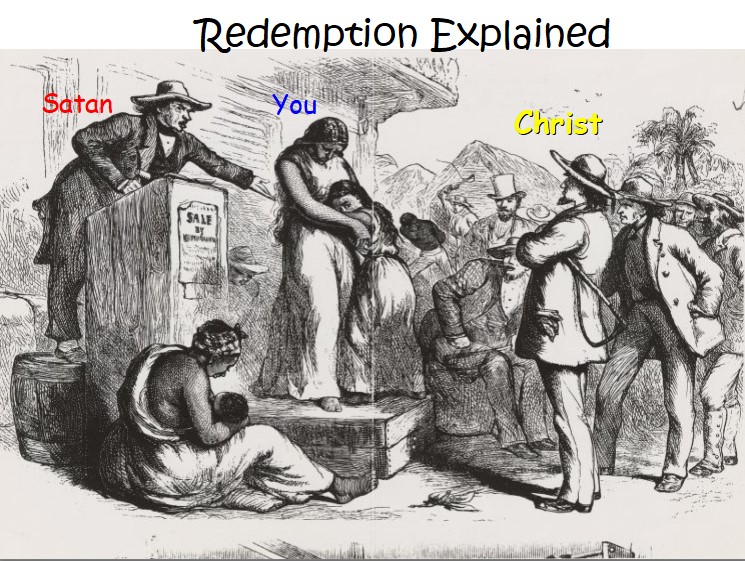
When a slave had served sufficient time and had accumulated sufficient wealth or found a benefactor, he or she could buy their freedom. This seems particularly egregious when their servitude was already, in the case of debt, the means of paying back what was owed. In effect the enslaved individual was paying twice for their freedom. Be that as it may, the act of buying oneself out of slavery was known as redeeming oneself; redemption. Likewise, a third party buying your release was also known as redeeming. We still use the term in this sense today: a pawned item can be redeemed, bought back, for a greater amount of cash than the pawnbroker originally paid for it. The related term ‘ransom’, in Mark 10.45 has the same sense; paying money to secure the release of a captive.

The principle of buying oneself out of captivity and slavery underscores the Christian idea of redemption. It is the analogy Paul and other New Testament writers use, to explain Christ’s paying the price, through his sacrificial death, for the slave’s release. He redeems (or will do at some future point depending on which fantasist you’re reading) in exactly the same way a slave was redeemed, from a life of captive slavery to sin/the Law/Satan and his minions. 

There’s a catch. If a slave was redeemed by a third party, he was likely to find himself not free at all but the property of whoever had redeemed him. His debt having been paid off to his first owner, he might very well find himself in hock to a new one. So it is with Christian redemption. Christ may have paid off your perceived debt to your original owner (sin, Satan or whoever) but now you’re indebted to him. You’re his slave, as we saw in the previous post.

To downplay slavery as it was practised in the centuries before the cult adopted it as an analogy, is to undercut redemption as Paul and early cultists perceived it. Arguing that slavery was a relatively benign practice removes the basis of Christian redemption; if being a slave wasn’t really too bad then neither can being a slave of sin/the Law/Satan be too serious either. There’s really no great need to be redeemed and what Paul says in Romans and elsewhere counts for nothing.

But we knew that anyway.


God’s Agents?

Christians are agents of God or so we’re informed. I’ve tried to locate where in the Bible it says that the Lord appoints fallible humans to be his 007s, but alas, I can’t find it anywhere. The best I can do are the claims in the fourth gospel that Jesus was God’s agent on Earth, but that’s not the same thing.

What about the idea then, also touted by Christians, that they are somehow God’s ‘partner’? No, that’s not there either. God regards himself as so far above us, his creators, that it would be like you or I partnering one of the ants crawling around in our gardens.

So how does the Bible describe the Christian’s relationship with God? It refers to it as master and servant. The word usually translated as ‘servant’ however, is doulos, which actually means ‘slave’. God doesn’t want you as an agent, partner or servant. He expects you to be his slave. Christian blogger, Sam Storms, explains what this means:

I, in the totality of who I am, have been purchased by Jesus Christ. He literally owns me. I belong to him, body, soul, spirit, mind, affections, abilities, talents, heart, will, and emotions. There is nothing in me or about me that belongs to me.

As a slave of God you are stripped of the very agency other Christians claim they gain from aligning themselves with the divine despot. And when you’ve done all he requires of you he’ll barely acknowledge you. As Jesus puts it in Luke 17:5-10:

Suppose one of you has a slave (doulos) ploughing or looking after the sheep. Will he say to the slave when he comes in from the field, ‘Come along now and sit down to eat’? Won’t he rather say, ‘Prepare my supper, get yourself ready and wait on me while I eat and drink; after that you may eat and drink’? Will he thank the slave because he did what he was told to do? So you also, when you have done everything you were told to do, should say, ‘We are unworthy slaves; we have only done our duty.’”

Whatever you do as God’s or Jesus’ slave won’t be enough, they’ll still regard you as a worthless slave.

I didn’t know about you, but this isn’t for me. I have more self-respect than to submit to a life as a slave. So have you. So in fact has everyone.

Most Christians agree. Almost all of them disregard the expectation that they become slaves. We know this because –

  • The majority don’t act as if they’re slaves, serving their fellow human beings till they’re fit to drop (Matthew 25 etc).

  • Most seem unaware even that Jesus insists they must be slaves when successive translators have deliberately altered the unsavoury ‘slave’ to the more palatable ‘servant’.

  • Those who are aware of his expectation seem to regard it as a metaphor; always a good get-out. And doesn’t Paul remark in his letters that believers are sons of God? That’s much more acceptable.

  • They omit the slavery element from their evangelising because no-one is going to be attracted by the offer of life-long servitude; far better to present Jesus as a would-be friend, big brother and all round good guy with whom people can be in ‘partnership’ or a fellow special ‘agent’.

  • They talk about free will when a slave, either of sin (John 8:34) or of Christ’s, has no freedom and no free will to exercise.

  • They convince themselves that sitting at a computer arguing with atheists online is the kind of slavery Jesus had in mind.

  • They turn a blind eye to the fact that the Bible teaches slavery is what they can expect not just now but for all eternity (Revelation 22:3-4).

It’s almost as if they don’t really believe such self-abasing, masochistic nonsense themselves.