There May Be Trouble Ahead…

Prophets, from left to right: Elijah, Julie Stephens,
Cindy Jacobs and er... Ed Miliband

Prophets don’t exist. A bunch of people intoxicated by religious fervour who think God has given them a special message that they must deliver to whoever will listen, are not prophets; they are a collection of extremists intoxicated with religious fervour.

We know this because no God exists. He can’t, as a result, drop messages, special or otherwise, into the heads of fanatics.

That’s it, really. No more to be said.

But so-called prophets exert quite an influence on our modern world. According to Abraham (I know, he’s a mythical figure but bear with me), God selected an ancient Jewish tribe to be his favourite buddies, so long as they did whatever he demanded of them, including hacking off their foreskins and that of their sons. What sort of prophet – what sort of God – comes up with this kind of lunatic fetishism?

Later the creators of a new prophet, whom they called Moses, came up with a story in which their hero encountered God in a bush (the symbolism is lost on us today.) This time he wanted his special buddies to invade their neighbour’s territory, slaughter them and take their land for themselves. This his favourite, de-foreskinned tribe did (modern genetic analysis of the peoples in the region suggests this isn’t what happened.)

After these fictional madmen came some potentially real fanatics who thought God had assigned them to lambast their fellow Jews for their shortcomings. These prophets promised the rubes rewards if they behaved as the prophets thought they should. These guys also came up with the idea that God would send a warrior Messiah to help his special little tribe take over the world. This is what happens when fanatics are allowed to get a hold of things.

A couple of centuries later, another self-proclaimed prophet turned up (or is invented) who seemed to think he’s the most special-est of all the prophets so far. This guy, called Yeshua (meaning ‘salvation’, so obviously not in any way symbolic) prophesied that the Messiah would be arriving real soon to sort the world out. He’d then hand it over to the Jewish people to manage. This guy’s script writers weren’t sure if Yeshua was talking about himself or some other supernatural character called the Son of Man. It doesn’t matter really. Nothing he prophesied happened when he confidently predicted it would: there was no Messiah who flies down from heaven, no final judgment, no great reset for the Earth. He was an absolute failure as a prophet; evidence, if more is needed, that those who claim to speak for God don’t know what they’re talking about. Don’t worry, though, this guy was recast as a resurrected Godman, just like the ones in pagan myths.

A few other prophets appeared around about the same time. In fact, the extremist who changed his name to Paul seemed to think that just about anyone could become one so long as they ‘edified’ the brethren. It was a few years though before the next really big so-called prophet came along.

In the 8th century, a guy called Muhammad said he was told by an angel who represented a different version of God that, amongst other things, Islam would spread worldwide and there would be an increase in senseless murders. These rather nebulous and self-fulfilling predictions are even now coming to pass. Muhammad’s future followers are indeed spreading Islam across the globe while senseless murders continue being committed, a good many of them by Muslims themselves.

While Muslims have made it clear that Muhammad is the final prophet, history has blessed us since with a few more. Joseph Smith in the 1880s was commanded by a different God (or maybe by the same one who’s changed his mind again) to start a new church and to obliterate anyone who stood in his way. He was successful in this enterprise, despite managing to get himself killed in the process.

You’d think, wouldn’t you, that given their abysmal success rate and the number of people who have suffered or perished as a result of their endeavours that we’d have had enough of prophets. While churches cannot agree on whether ‘genuine’ prophecy still exists, the prophets keep coming. Fanatics the world over, every bit as barmy as their predecessors, appoint themselves some deity’s spokesperson, and the ‘prophetic’ pronouncements begin: meaningless theobabble spattered across the Internet.

Conclusions

So what do we see when we arrange the books of the New Testament in chronological order?

  1. In all probability, Jesus was first experienced in visions experienced by a few Jewish zealots looking for the arrival of the Messiah. His name – Yeshua – is symbolic and means ‘The Lord is Salvation’.

  2. These visions led to ‘revelations’ that convinced these zealots that the Messiah would soon arrive on the Earth to set God’s plans in motion.

  3. A small number of Jews were convinced of the veracity of these claims and sought to spread the message that the Messiah/Jesus was soon to arrive on Earth.

  4. A few years later, a Hellenized Jew who called himself Paul, argued that the Messiah – ‘Christ’ in Greek – had died in the heavenly realm and been raised from the dead by God. His sacrifice, Paul insisted, was a propitiation for human sin, both Jew and Gentile.

  5. Also according to Paul, the Christ’s arrival would trigger the resurrection of the dead, prophesied in Daniel 12:1-3 and Isaiah 26:19-20, the final judgement (Daniel 7:22) and the establishment of God’s kingdom on Earth, governed by God’s Chosen (Daniel 7:27). Regrettably, he drew most of these conclusion from a book, Daniel, now known to be fake.

  6. Paul ‘proved’ that the Messiah-figure he’d seen in his visions really was the Messiah prophesied in Jewish scripture by quoting from them extensively.

  7. Soon after Paul died, the original group of visionaries, who had had their differences with Paul, were all but wiped out when the Romans destroyed Jerusalem.

  8. Around the same time, an unknown cultist took it upon himself to write an allegorical history of the Christ’s activities. He based this allegory on Paul’s teaching about the Christ as well as events from Jewish scripture. He set his story in Galilee some forty years earlier and has his fictional Christ, Jesus, prophesy the arrival on Earth of the real Messiah whom he calls the Son of Man, after Daniel 7:13-14.

  9. Two other cultists set about altering and improving this original history. One re-establishes the Christ’s Jewish credentials, and extending references to and allegorising aspects of Jewish scripture.

  10. A completely imaginary history of the early cult was created by one of these writers, smoothing over the differences between the beliefs of the earliest visionaries and Paul.

  11. Other writers, including some pretending to be the late Paul, continue to write of Jesus the Christ as a celestial saviour.

  12. A fourth history of the Christ was created, this time providing Jesus with a bodily resurrection (contrary to Paul) and discarding some of the cult’s earlier beliefs, the imminence of God’s kingdom on Earth included. The authors of this account imply that dead believers will awaken to new life in heaven (John 14:2)

  13. The idea that the Messiah will arrive imminently was, however, kept alive by other writers. One anticipated the Christ would soon purge the world of evil-doers and bring a holy, bejewelled Jerusalem down to Earth.

  14. Others soon abandoned the idea that any of this would happen soon. The arrival of the Christ was postponed indefinitely.

  15. The notion the Son of Man/Messiah/Jesus had yet to appear was also dropped as the church adopted the allegorical gospels as real history. It began to expel those who disputed the gospels’ veracity and denied that Jesus was the Christ incarnate.

  16. While the term is not used in the New Testament the Christ’s delayed arrival was, from the early second century, thought of as a second coming.

  17. The church, once well established went on to embellish doctrine, adding the Triune God; eternal life in Heaven; the elevation of Mary and the saints; the New Testament as the Word of God and the infallibility of the Bible as a whole. Some of these were, and are, in direct contradiction of the beliefs of the earliest Christians.

  18. Believers today, if they read the New Testament at all, take its traditional order at face value, which distorts the evolution of its ideas. They allow their preachers to smooth over what now appear to be random contradictions (hermeneutics).

  19. Today’s Christians believe primarily in the heavenly Christ, who forgives their sins and guides their lives from Heaven. They also hold on to the belief that he was manifested as a human, and vociferously oppose the idea he was and is only an imagined supernatural being.

  20. At the same time they prioritise Paul’s teaching about him over anything he is made to say in the gospels .

That how I see it anyway. The more time I spend looking at the New Testament books in their correct order, as well as what this reveals about the beliefs of early Christians, the more I’m driven to these conclusions. They’re the only ones that make sense of all that we find in their writings. I realise this is contentious. Mythicism is not widely accepted but it is the only position that explains the recorded facts as we have them. The original Jesus was seen (in the mind of the first visionaries and by many later) as a heavenly Messiah. While the gospels were generally accepted as historical many decades after they were written, they are anomalies in the expression of the early faith. They can only be seen as allegories of the living, dying and rising of a cosmic saviour, a sequence not uncommon in the mythologies of the ancient world.

I recognise too that there may well be other problems with this position, which I’ll get to soon.

Eggs, Bunnies and Dead Bodies

88

Easter rolls round again. The spring festival, which in English is named after a pagan fertility Goddess (hence the eggs and bunnies), was usurped by the church in the second century as a celebration of a dead man rising.

Sometime in the first century, a few desperate men had visions of a Yeshua – his name meaning ‘to deliver’ – shortly after his death (if indeed he existed). The visions, which were entirely in their heads, were so vivid, it seemed to these men that Yeshua was alive again. They began looking for his (re)appearance in the sky when they thought he would establish God’s Kingdom on Earth. It was a preposterous idea, but in preparation for his appearance, the men encouraged others to adhere to Jewish law so that they would find a place in the New Age.

A short while after, a different fanatic had his own vision. Saoul, who transitioned into Paûlos, thought he heard Yeshua speaking to him. Yeshua told him the conditions that needed to be met in order to secure a place in the new order: all anyone had to do was believe and they would live forever. This was all entirely within Paûlos’ head of course but nevertheless enough people took notice of his preposterous idea and decided to worship Yeshua.

Later still, the Romans destroyed Jerusalem, which was the centre for those who’d come up with the original version of the preposterous idea. Almost all of them were eliminated. Not because of their preposterous idea but because the Romans were indiscriminate in slaughtering those they regarded as rebellious Jews. Their elimination cleared the way for Paûlos’ preposterous idea to flourish unopposed.

Around this time, a literate acolyte of Paûlos’ idea, who later became known as Mark, set about creating a back story for Yeshua. He based it on Paûlos’ teaching and on stories from Jewish scripture that he thought predicated Yeshua, though in fact they didn’t.

Two other cultists liked this idea but didn’t think Mark had done a very good job of it. They set about rewriting his story, adding even more preposterous elements. Finally, about 60 or 70 years after the whole thing had begun, a fourth chap, later called John, reimagined the Yeshua story. His version bore little relationship to Mark’s tale but this didn’t really matter as all the versions of Yeshua’s life story were made up. In any case, no-one would notice the discrepancies provided the four stories were never collected together.

And so Christianity was born, created from visions and false hopes, reinventions and fanciful fictions. The preposterous idea in its different forms appealed to people, now as then, because of its false promise of eternal life and as the means of avoiding an imagined God’s wrath.

This is the idea the church is celebrating, preposterously, this weekend.

As for me, my days of fertility are long gone, but I might, nevertheless, indulge in a little bit of chocolate egg.

Hasa Diga Eebowai*

Blog378

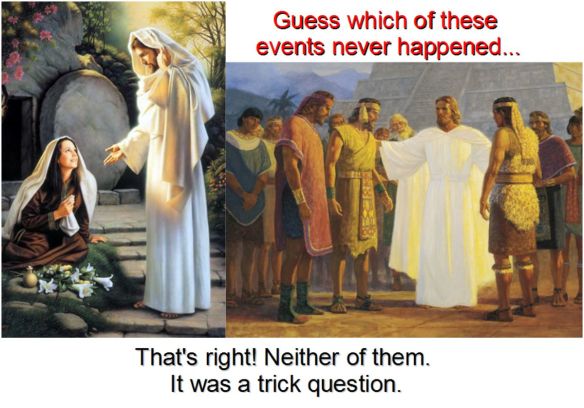
I went to see The Book of Mormon at the weekend. It’s offensive, blasphemous (if there is such a thing) and very funny. I recommend it. I’d say that, by and large, it represents the Mormon faith pretty accurately, mocking the Latter Day Saints’ belief that Jesus visited America about a year after his resurrection. Beaming into the proto-U.S.A, he converted the Nephite civilisation and turned them white, while the Lamanites, who were ‘so wicked’, God eventually curses ‘with (a) dark and benighted and loathsome condition’ (he made them black.) Sadly, all the archaeological evidence for these two civilisations has since been lost.

Three centuries later one of their number, a fictional character guy called Mormon, wrote down their adventures with Jesus on some gold plates that happened to be lying round. After Mormon died, his son Moroni buried these plates for safe keeping, as you would. 1500 years later still, Jesus prompted a chancer called Joseph Smith to dig them up again and, with the help of the returning Moroni and some magic stones, Smith translated them from the original Gibberish into stilted English. The plates and stones were never seen again, but every true Mormon knows that he/she will be resurrected after they die, provided, of course, they are wearing their special underwear. According to some, they’ll then be given their very own planet to rule.

Ludicrous, right? How could anyone invent such twaddle, let alone believe it and allow it to determine their lives? Yet, they do. But is it any more far-fetched than the fantasy on which it’s based? A guy called Yeshua goes round spouting platitudes and proclaims himself king of the New Age that’s coming soon. He gets killed and after 36 hours comes back to life, walks through walls and takes off into the sky. Not long after, a crank who never met him, decides this Yeshua must really have had super powers, and that all anyone has to in order to live forever is believe in a magic spell he, Paul, just made up! More than this, he’s convinced Yeshua will visit the Earth soon, when he’ll condemn most of its inhabitants to an eternity of hellish torture. Unbelievable! Literally unbelievable, and yet millions do believe it.

Joseph Smith’s hokum deserves all the mockery The Book of Mormon and others heap on it, but the original story is every bit as preposterous. Why can’t mainstream Christians see it?


*The phrase ‘Hasa Diga Eebowai’ appears in The Book of Mormon. It definitely doesn’t mean ‘no worries’.