The Real Jesus

Dear Christian,

When you became a Christian, did you meet the man who wandered around Galilee 2,000 years and who, according to ancient stories, died on a Roman cross? Was it an actual human being you met at the moment you ‘saw the light’ (the clue’s in the term)? Or was it something – an emotional experience perhaps – that you interpreted as the presence of a heavenly, supernatural being? If you’re honest you’ll acknowledge you didn’t meet a real person but felt something that you took to be one.

When you pray to Jesus, exactly who are you praying to? Is it the man who drifted around Galilee 2,000 years ago? Are your thoughts magically transported back in time so he hears you, somehow or other, in his head? No? So do you pray to a supernatural, celestial Jesus who for the past 2,000 years has been sitting at the right hand of God in a mythical never, never land? I’m guessing you’ll say this is the Jesus you commune with (while disputing my calling heaven never, never land).

When you worship Jesus are your honeyed words whisked back 2,000 years to sustain a man who meandered around Galilee spouting profundities before getting himself killed? Or do you envisage your prayers reaching a supernatural figure living out there in space or maybe in another dimension? (C’mon, you know it’s the latter.)

When you say Jesus was present at the creation of the world as described at the start of Genesis, do you mean the man who, billions of years later, would roam around Galilee? Or do you mean a celestial  Jesus who was a part of the Godhead in some mysterious, inexplicable way? (I’m guessing, again, it’s this latter.)

When you say Jesus will judge the living and the dead at the End of the Age, do you refer to the man who lived 2,000 years ago, trudging around Galilee? Or do you mean some mystical manifestation of this character who’s eager to separate the sheep from the goats while hovering in the sky prior to massacring the goats? (It’s this version, isn’t it.)

In the Bible, did Paul meet the flesh-and-blood man who had slogged around Galilee a few years earlier? Or did he hallucinate a celestial being as a flash of light? (It was the latter, wasn’t it.)

When you speak of the Jesus who died on the cross to save you from your sins, do you quote the individual who supposedly drifted round Galilee 2,000 years ago? Or do you more often reference Paul, who never met him and knows nothing of his supposed earthly life? (You know which.)

Yet despite your belief in mystical, spiritual versions of Jesus, you are adamant he was not a mythical being. Not at the start of time, not at the end, nor in Paul’s writings; not in your own conversion, not in your prayers or worship and especially not in your own inner experience of him. No, he was, according to you, a very real person.

Yet there are no signs you believe in this historical Jesus, the man who allegedly roamed around Galilee two millennia ago. You ignore him and his teaching if favour of a celestial superman. How do we know you ignore him? All the examples above for a start, but there’s also the way you don’t do what he says. You don’t love your neighbour and enemies alike, you don’t sell all you have to give to the poor, you don’t give to everyone who asks, you don’t despise riches, you don’t refrain from judging others. You rarely turn the other cheek or go the extra mile and you are not prepared to forgive endlessly. You don’t accept that this man believed the End of Age was coming in his own time (or at least that his script-writers did) nor that he was disastrously wrong. It’s the cosmic super-being you go for every time.

How very strange. Cognitive dissonance is a powerful phenomenon, don’t you think?

Judgement Day

Franklin2

And the Lord said to them, ‘Let’s have a look how you got on. You fed the hungry, right?’

And they answered, ‘Well, we gave some money to charity a couple of times and we’re pretty sure the charity fed the hungry for us.’

‘Okay,’ he said, ‘I suppose I can give you some credit for that, though I have to say I was looking for something a little more… hands on. How about when people were naked – you know, needing their material needs met. How’d you get on then?’

‘The charities did that too, we think. Maybe.’

‘And the sick and imprisoned? You bother with them?’

‘Not so much,’ they answered. ‘Look, Lord, if people can’t take care of their own health needs or choose to live lawless lives, then that’s up to them. It’s really not up to us to help them out, now is it.’

‘I see. So how about the stranger, the homeless, the immigrant? You take any of them in? You cared for them?’

‘Well, no. I mean, if you’d said that’s what you wanted doing we would’ve done it, wouldn’t we. But you didn’t make it clear.’

‘I thought I had,’ he said. ‘Maybe it got lost somewhere in translation. Selling all you have to give to the poor, then? Surely some of you did that.’

‘One or two extremists maybe, but look where it got them. Obviously that daft instruction was meant only for the guy you were talking to – you know, the rich young ruler or whatever he was.’

‘Well, not exactly. I said it so many times in so many ways you’d have thought you’d have got the message.’

‘We’re not socialists, you know, even if you are,’ they said.

‘So how about turning the other cheek, then? Or going the extra mile? Giving to all who ask? Surely you managed those?’

‘Well, no. We felt you were speaking metaphorically when you said all that. You didn’t seriously expect us to do such ridiculous things, did you? I mean, we’re not doormats.’

‘So what is it you did in my name?’

‘Well, we accepted you as Lord and Savior. That’s all that’s required, isn’t it?’

‘Not really,’ he said. ‘Not if you didn’t do as I asked.’

‘Lord, Lord,’ they said, becoming exasperated. ‘We’re washed in the blood of the lamb. Sanctified and redeemed.’

‘You’re what?’ he said.

‘Sanctified and redeemed. Made spotless. You know, like Saint Paul explained.’

‘Saint who?’ the Lord said.

‘We worshipped you and praised your holy name,’ they went on. ‘Filled with your Holy Spirit we witnessed unto you and defended your Holy Word.’

‘But you didn’t actually do as I commanded?’ he said. ‘And you think that’s good enough?’

‘We stood up for you and for family life. We spoke out against unbelievers and sodomites and all those who were unholy, lest they bring down the Father’s wrath on all of us.’

‘You didn’t consider that to be judging, then?’ he asked. ‘Something else I told you not to do?’

‘Oh no, Lord, not really. We decided what you really meant was it was okay to judge so long as it was done righteously. We always judged righteously, so that was fine.’

‘Well,’ he said, ‘what can I say? You came up with a much better agenda than the one I left you with. Come in and dwell in the house of the Lord forever. You’re my kind of people.’

And, lo, the self-righteous stepped forward, ready to surge into heaven.

But he stopped them in their tracks. ‘Now you just hold on,’ he said, ‘I was being metaphorical there,’ and he stood up to his full height and cleared his throat. ‘Here’s the deal,’ he said, ‘Not everyone who keeps saying to me, ‘Lord, Lord,’ will get into the kingdom from heaven, but only the person who keeps doing the will of my Father in heaven… So, get away from me, you who practise evil. I never knew you.’

‘What?’ they said. ‘We didn’t think you really meant that. We’re washed in the blood of the lamb, you know.’


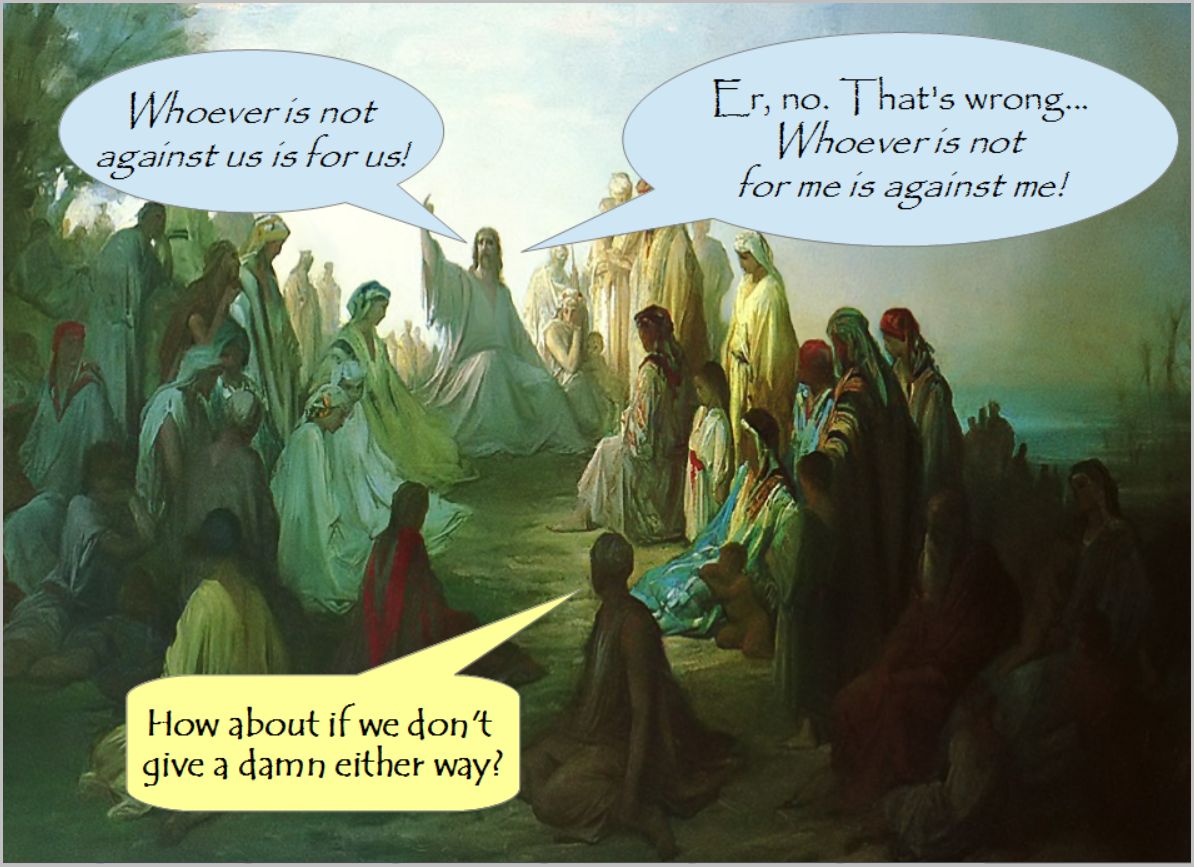
Idiotic Stuff Jesus Said 3: Whoever Is Not With Me Is Against Me

ForUsJesus is reported as saying both that ‘Whoever is not against us is for us’ (Mark 9.40)
and ‘Whoever is not with me is against me’ (Luke 11.23). What he doesn’t seem to realise is that these two statements, each ridiculous in its own right (there is always the third option of not caring either way), mean exactly the opposite of each another. The first is inclusive and relatively friendly. The second is hostile and exclusive; it says, in effect, ‘If you don’t give me your unquestioning devotion you are my enemy.’

This is not the claim of a fully-realised divine being, but of a paranoid megalomaniac. As with much of what he said – or is reported as saying (which is not the same thing) – Jesus reveals himself to be very human; flawed and completely egotistical.

He sets up, as all cult leaders do (and, indeed, as all human groups have a tendency to do) an ‘Us and Them’. Elsewhere, Jesus describes Insiders and Outsiders, with all the rustic charm of a first-century peasant, as the sheep and the goats (Matthew 25.32). It’s still a favourite pastime of Christians to segregate themselves and others into these two categories. They do it with real sophistication these days, of course (I mean, ‘sheep and goats’… c’mon) but it still comes down to Us and Them:

If you’re a mainstream evangelical you’re Saved, while those who don’t subscribe to your brand of Christianity are Lost or Of This World.

If you’re a Bible-believing fundamentalist you’re Regenerate but others are Unregenerate (or Degenerate).

If you’re a Jehovah’s Witness you’re one of the True Church; other believers are part of a False Christianity.

If you belong to the cult formerly known as the Children of God, you’re of The Family and everyone else is part of The System.

If you’re a Roman Catholic you’re the Only True Christians, while all others are Damned.

and so on, throughout all of the 34,000 different Christian sects and denominations.

It is an essential part of the Christian faith to regard yourself as belonging to the only True Church. Everyone else – from those who don’t buy into religion at all to every other faith group – is wrong. They’re an enemy of Jesus because, not being for him or with him in quite the right way (your way) they are, according to the warped logic he expresses here, against him.

The so-called Prince Of Peace proudly declares that he came to bring strife and division into the world (Luke 12.51), which, to this day, remains his greatest achievement. His idiotic words about being either for or against him have proven to be a gift to every sect, cult and church that has ever existed.