On Climate Change

The climate is not having a crisis. I’ve consulted it and it assures me it feels perfectly fine about everything. It explained that every now and then it goes through a few fluctuations, much as we all do in life, and that this isn’t anything new.

I ask the climate whether it is concerned that the changing weather conditions it is imposing on us now are something it has any concern about. It laughs icily and says it couldn’t care less what anyone thinks about what the weather is doing.

It is, it reminds me, only we who are anxious about its recent activities. Frankly, it intones brightly, it doesn’t give a damn. When I put to it that we humans may have contributed to its recent, erratic behaviour it guffaws intemperately and says we’ve merely contributed to the inevitable. It scoffs at our hubris in thinking we can somehow change or even ‘reverse’ the course it has set for itself. It points out that even if the entire world were to stop using oil and fossil fuels right now – which China, Russia, India and the USA aren’t ever going to do – it would make no difference. The weather would continue to do just what it wanted to do.

Maybe I shouldn’t have confused climate and weather as essentially the same thing. After all, scientists tell us they’re not, even as they show us ‘freak’ weather conditions to prove that the climate is indeed having a crisis. Oddly, they don’t seem to accept as evidence environments where the weather is much the same as its always been, only where it’s grown ‘worse’ by human reckoning. They blame events like flash floods and forest fires on climate change when a little research suggests that while these are the consequence of human activity – building on flood planes,  straightening rivers while neglecting to dredge them, failing to clear brush from forest floors to create fire breaks (not to mention the idiots who start fires either deliberately or carelessly) – they are the result of more general stupidity. 

The weather/climate merely chuckles warmly at such folly. It reminds me, it says briskly, of the three hundred years in the Middle Ages when the climate was the same as or even warmer than today’s, and the time in the 14th century when severe storms destroyed large swathes of East Anglia, England. And, it asks coldly, what about the Little Ice Age that affected Europe for 600 years between the 13th and 19th centuries? Remember, it says, when the River Thames froze over on a regular basis so that Frost Fairs could be held on it? All conveniently forgotten now because they occurred before ‘reliable’ records began. The weather reminds me that, despite this, it now kills 95% fewer people with its extremes than it did 100 years ago. And what thanks do I get for it? it demands airily.

The weather storms off, leaving an assortment of climates in its wake. I get the impression it will continue on its own sweet way regardless of anything we can do. It will fluctuate, as it put it, delivering ‘extremes’ of heat and cold, storms, clement and inclement weather (as we might see it) because that is what it has always done, indifferent to those living under its tyranny.

Featuring the Battle of the Century! Doomsday v. Panacea!

Human beings love doomsday scenarios. We have perpetually convinced ourselves that the circumstances in which we live are the most dreadful ever and, to quote The Beatles, can’t get no worse, The earliest Christians thought it: things were so bad that the end was surely to come. YHWH would tolerate the awful state of affairs no longer. But to the surprise of no-one he did.

Those alive in 17th century Europe couldn’t conceive of a worse time, what with the plague and all, and persuaded themselves that the world was ending. During the Covid lockdown we were told that the human race faced being annihilated by the virus and that whatever we’d previously regarded as normal would never return. Today we’re assured that the planet faces extinction if we don’t stop using fossil fuels. At the same time others claim that democracy/the West/civilisation are in such decline that the world will soon disintegrate into anarchy. Who knows, perhaps one day one of these modern doomsday scenarios will come to pass. Even a stopped clock is right twice a day.

Equally though, we are adept at devising panaceas, universal remedies to our problems. We have an unshakeable belief that by making a few simple changes – a new government/president/policy/ invention/initiative/innovation – we will avert disaster and resolve the challenges we face.

How have the panaceas of the past fared? The Jesus’ cult’s promises of new life and heaven of earth collapsed in the first century when God failed to rescue those who identified as his Chosen Ones from the wickedness that surrounded them. Nevertheless, Christianity bullied its way on to the present day, still offering the same tired solutions to age-old problems. Religion, in all its forms, only makes matters worse.

Revolution is no solution either, as the socially aware songs of the 1970s advised us. The French, American, Russian and Chinese revolutions changed situations but they didn’t usher in an age of peace and prosperity or remedy everything their instigators said they would. History demonstrates again and again that violence fails to improve anything. The freedom and independence that the Baltic states now enjoy came not from revolution but from the foresight of Mikhail Gorbachev who knew Russia could no longer afford to sustain its satellite states. Putin however knows better and seeks to reabsorb them back into his own soviet union.

Other panaceas of the past have similarly failed to deliver. The so-called industrial revolution created our modern world, led to the end of slavery and gave us the standard of living those of us in the West enjoy. Now we must deal with what many perceive as its legacy: world pollution, climate change, dwindling resources. Eliminating these is the new panacea. Once these challenges have been met, or so we’re told, the world will find itself on a much better footing, on course to recover from the damage we’ve caused it. Hence Just Stop Oil and Extinction Rebellion. It’s as simple as that. Except we know that surely it isn’t when the biggest polluters – China, Russia, India and potentially the US (Trump says he will pull out of climate change agreements if returned to the White House) – are not wholly on board.

We are a very long way from eliminating the use of oil: for a long time to come it will be needed to lubricate machinery, engines and windfarms, and for the production of plastics (a panacea in their own right not that long ago), computers, mobile phones and building materials. That’s not to mention the need for oil in the nation’s defence: the navy’s ships, the air force’s planes and the army’s tanks. We do not yet have the means of replacing the oil which fuels and lubricates modern life. We can be sure too that when we do, this new panacea will also have its own drawbacks, which will only become apparent once we have committed to them. We know this already with nuclear power which, once fossil fuels are eliminated, will be the principal means of producing electricity in the enormous quantities required to supply to industry, for heating, lighting and transport, including electric cars, which, if politicians have their way, will be the only kind available. We are already using environmentally-damaging methods’ to extract the rare minerals used for the manufacture of batteries, a process which also, ironically, creates more CO2 than the manufacture of a petrol car (itself a panacea not too long ago): According to MIT’s Climate Lab, one ton of mined lithium emits almost 15 tons of CO2’.

While there are those who claim that EVs cause less environmental damage than petrol (gas) vehicles, damage is still damage. It is not net zero. The dream of worldwide net zero is impossible. The only way it is even approachable is for the car and other forms of transport to disappear altogether – and we all know that isn’t going to happen. Even  hypocritical eco-warriors use the car and other forms of transport dependent on fossil fuels to get themselves to whichever work of art or ancient monument they plan to deface. 

China, which produces two thirds of the world’s electric car batteries, accounted ‘for 95% of the world’s new coal power construction activity in 2023.’ Then there’s the disposal of spent batteries: do we have policies for doing that in an environmentally friendly way? Is there an environmentally friendly way?

As you can probably tell, I’m not a believer in panaceas, whether religious or politically devised. They don’t work and never have. In years to come, the West will be wringing its hands at its plundering of the Congo for cobalt and South America for lithium for electric car batteries. ‘How could we get it so wrong?’ we will cry. ‘There must be a better way, a better panacea. Meanwhile, we must do penance and make reparations.’ I don’t have the answers, but extremist approaches like the half-baked schemes of Ed Miliband, the UK’s Secretary of State for Energy Security and Net Zero (yes, really), and pursuing impossible dreams do not seem to me to be the solution.

On Climate Change

Climate Change is happening.

But, like young Sheldon, I have questions.

The UK’s carbon emissions are, according to the government’s official figures, 1.1%, while China, USA, India, Russia and Japan produce 58% between them: will the UK reducing its output by 1.1% to zero make any substantive difference to carbon levels and the climate?

Why, as Tony Blair asked last week, are ordinary households being expected to foot the bill for the UK government’s net zero measures? Why not those who produce the most carbon?

When China alone produces 28% of the world’s emissions, and is doing nothing to reduce these – in fact it is increasing them year on year – what use will it be if the UK impoverishes itself in its drive to net zero?

Why does the UK government feel the need to regard itself as a world leader in the drive to net zero when no-one cares what the UK is doing?

Is net zero achievable when the generation of power always produces some level of pollution? How is global net zero achievable when powers like China and Russia refuse to reduce their carbon emissions?

If there is widescale changeover to electric vehicles by 2030 (a UK target for new cars) will there be enough electricity to power them? How will all this extra electricity be generated?

Given most carbon emissions worldwide are from electricity plants, why is the population being ‘encouraged’ to change from oil powered vehicles to electric ones that require electricity plants to create their fuel?

Why do Just Stop Oil and other eco-activists travel to their demonstrations in transport powered by oil and other fossil fuels? Why do they heat their homes using these same fuels? Why do they have mobile phones made from plastic derived from oil, to communicate with each other? Why don’t they demonstrate themselves the kind of behaviour they demand from everyone else?

Why does one of Just Stop Oil‘s leading spokespersons, Dr Grahame Buss, take a £1 million pound pension from Shell Oil while demanding ‘the masses’ must be the ones to make radical changes?

Why do politicians travel by private jet and in motorcades to Climate Change conferences? Why don’t they demonstrate themselves the kind of behaviour they demand from everyone else?

Why, when climate is defined as weather over prolonged periods of time, does the media show us pictures of isolated weather conditions to illustrate climate change?

Do forests spontaneously and naturally combust?

Did the recent wildfires in Greece and elsewhere spontaneously combust as the direct result of high atmospheric temperatures or were they, as the evidence suggests, started either deliberately or through human carelessness? If so, why does the media portray them as examples of the effects of climate change?

Who decided that scrub and undergrowth in forests should no longer be cleared? Why did they, when layers of scrub and undergrowth, once alight, ensure fires spread more rapidly?

If, according to NASA, there has been a decrease in the total number of square kilometers burned each year (and) between 2003 and 2019, that number has dropped by roughly 25 percent’, why are recent, highly localised fires being represented – even by NASA! – as an increase attributable to climate change? 

According to UN Secretary General António Guterres, ‘the era of global warming has ended. The era of global boiling has arrived’. What exactly is it that is ‘boiling’? Is it oceans, rivers and lakes? Soil and rocks? Animal bodies? If so, where is the evidence that this is happening? Is such alarmist hyperbole persuasive or remotely helpful in combatting climate change? Or does it lead ‘the masses’ to believe politicians exaggerate the extent of climate change?

Can we slow down or even reverse climate change when it is a natural, inevitable part of nature’s cycle and, in terms of our own contribution, the biggest polluters are not interested?

Are we all doomed?  

Throwing stones

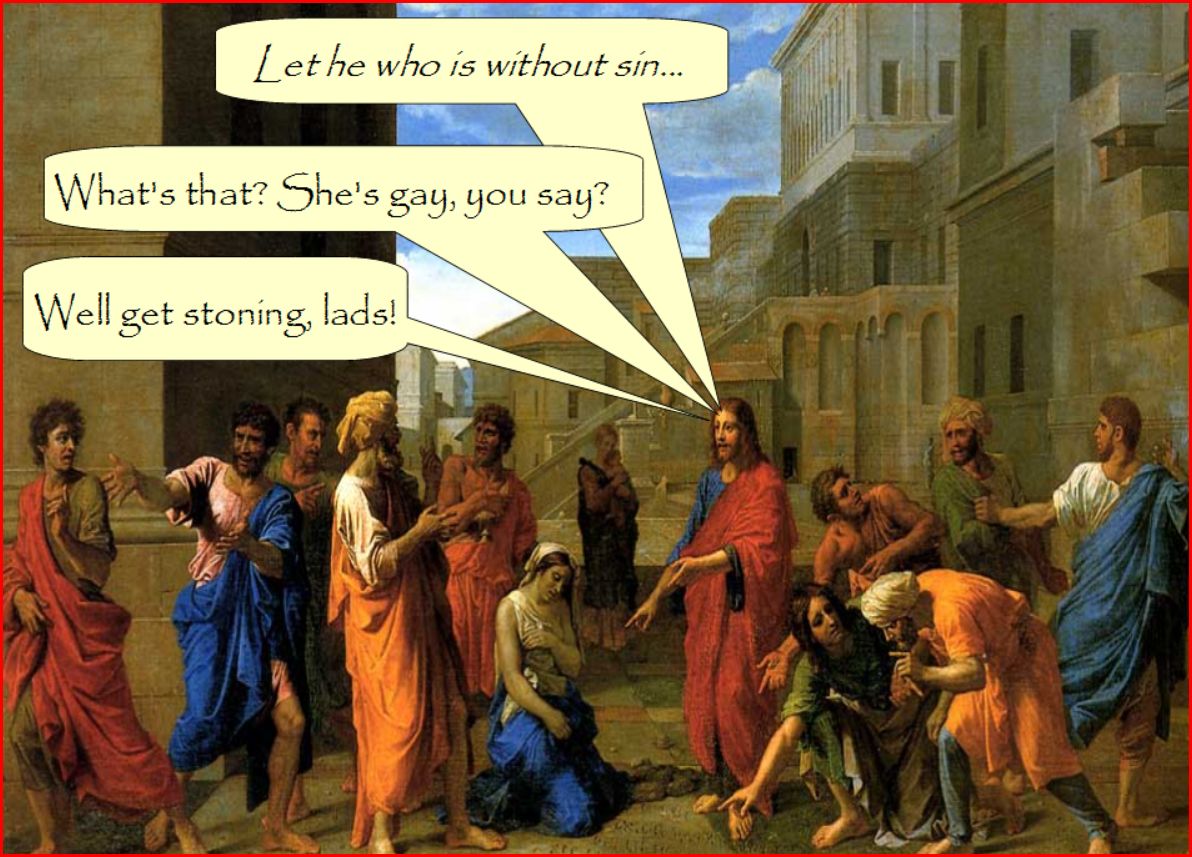
WomanNew laws in Putin’s Russia have seen a wave of persecution directed at gay people. Christian websites have been quick to condemn the torture, beatings and murders that have taken place in recent weeks, pointing out that this isn’t the way to treat others (Matthew 7.12) or to show love for one’s neighbour (Mark 12.31) or to support a minority group (Matthew 25.45).

Oops. I interrupt this post for a reality check.

Needless to say, no Christian website has done this. Some have come out in support of Russia’s punitive new laws, because – well – God hates all that gay stuff, and, as we know, the odd Bible verse that grumbles about it trumps anything Jesus had to say about being nice to each another. Other Christian sites have ignored the subject entirely.

Our very own Christian Voice, while avoiding any mention of the Russian situation, has posted yet another anti-gay piece. Two thirds of their posts are on the subject, because this is what ‘the gospel’ is really all about. Upset that same-sex marriage is now law – even though they prayed really, really hard to the baby Jesus to stop it – Stephen Green’s sidekick, Robin (had to be really) points out that our bodies matter and, though it will come as some surprise to them, gay people don’t understand this.

You can read the full thing here, where you’ll note C.V. tries to avoid the word ‘gay’ and always puts inverted commas around same-sex ‘marriage’; pathetic doesn’t even begin to describe it .

I’ve attempted to comment on the article on the Christian Voice site, but so insecure are the dynamic duo in their faith, they can’t bring themselves to publish dissenting views. So here, with some slight amendment, are the points I made:

Oh, if only those pesky homosexuals were more like heterosexuals – always monogamous, faithful and never divorcing or remarrying.

If only all gay people were Christians, then the morality you espouse – but which not all Christians live by – might apply to them. As it is, it doesn’t.

If only they could have an encounter with Jesus then they’d be cured of their same-sex attraction.

If only there was some proof of this magical cure or that homosexuals need to be ‘cured’ in the first place.

If only gay people could be celibate, because that worked out so well for the Catholic Church.

If only they’d marry a person of the opposite sex and involve them in living a lie.

These are the options. So what is it you want homosexuals to do, Robin?

What indeed? I suspect he and the other Christians who rant about gay people would be happy only if they disappeared from the face of the Earth or if the great Jehovah were to smite them out of existence. What so many Christians seem unable to do is accept and show the love to their gay brothers and sisters that Jesus demands of them.