
The Missionary Position

Dear Missionary friend,

Why is it you have to tell everyone about what you believe? Whether you’re on the bus, in the middle of town or online, you are compelled, it seems, to tell everyone about your faith. Why is that? You think we’ve never heard of Jesus, Jehovah, Krishna or Muhammed? Let me tell you, we have and most of us are not interested in your mumbo jumbo in whatever form it takes. I guess you think if you can ‘plant a seed’ or draw at least one unsuspecting soul into listening to you, you’re doing the Lord’s work. It’s vital of course that everyone hears your version of the good news. You don’t want even one lost soul to go to hell on your watch.

Well, that’s what you’d say, or something like it. But I think you go around preaching for entirely different reasons. I think you’re compelled to proselytise because you’re indoctrinated by your church to do it. Your minister tells you you must do it, because Jesus or some other prophet commands it. It is a commission. I know this because I was once where you are now. Your standing in your congregation depends on your ‘witnessing’. It also means you can say you’ve done your bit. Those who don’t listen to you, who don’t commit to your religion, have only themselves to blame when they face holy judgement and are thrown in the Lake of Fire/Hell/Jahannam.

But these are not the only reasons. Your church/mosque/meeting house needs more members to keep its coffers full and to maintain its credibility; we can recruit! That and the fact you and those in your church/sect/cult are insecure. Yes, that’s right, you’re insecure in your faith. You need others to validate what you’ve chosen to believe. You need new converts to join you because there’s safety in numbers. They allow you to feel it isn’t just you who’s fallen for whatever malarkey you’re wrapped up in. There are people as gullible as you: what a relief!

So please, next time you feel moved by the Spirit/prophet/saviour to share your beliefs with unsuspecting passengers on the bus, shoppers, passers-by in the street and people minding their own business in their own homes, we’ve got your number. We know what you’re up to.

Yours in Christ alone knows,

The Apostle Neil
 

Less religion, not more

Welby

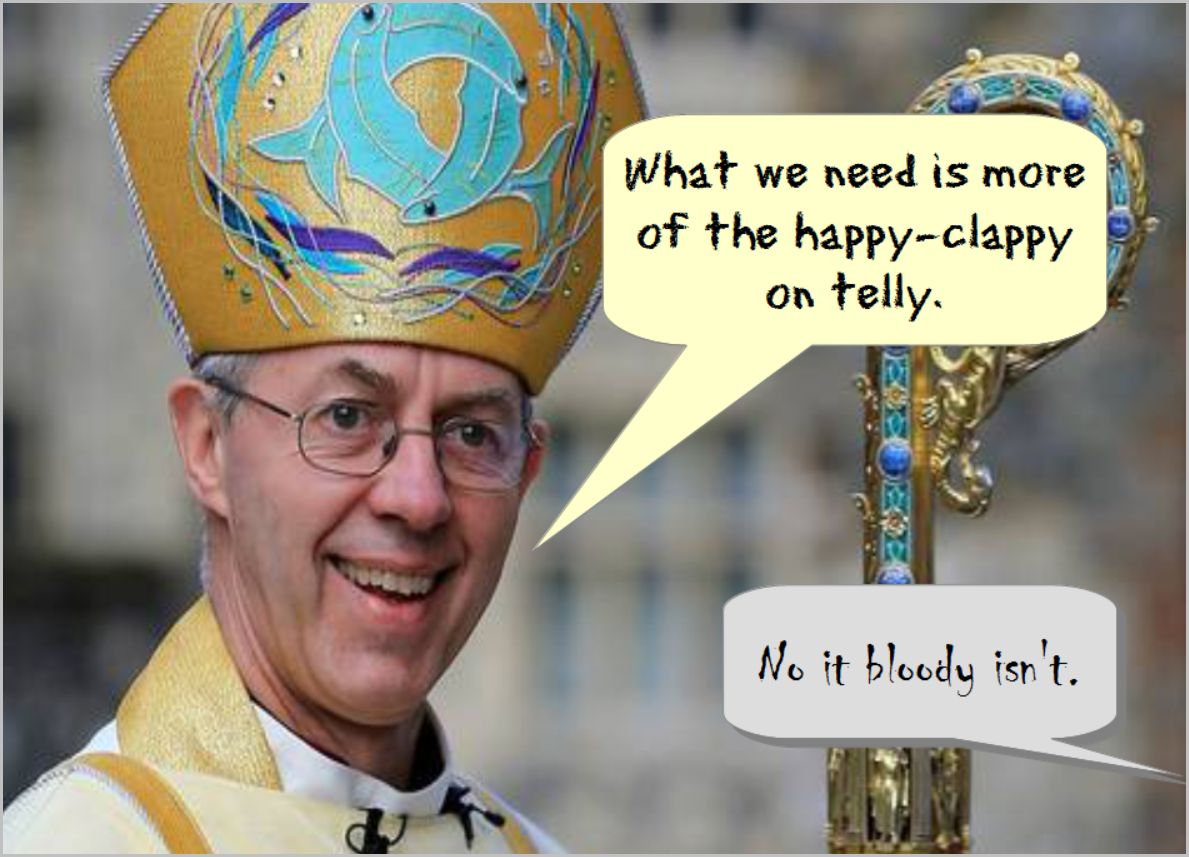
A bloke in a pointy hat and posh frock thinks there should be more religion on television and radio. Justin Welby, Archbishop of Canterbury, says that religion merits as much air time as politics, sport and drama.

The Archbish makes it sound like there’s nothing at all on TV and radio already about religion. In fact, in the last few months in the UK we’ve had a full schedule of Easter programmes; Simon Reeves’ The Ganges on BBC2 (looking at India’s religious heritage); Channel 4’s Unreported World and Dispatches, which regularly consider religious issues; Clare Balding’s trite Good Morning Sunday on Radio 2; the weekly broadcast of church services and daily Thought For the Day on Radio 4; the weekly dollop of worship on Songs of Praise on BBC1 and the 24-hour Christian ‘ministry’ of Trinity Broadcast Network and other God channels for those who just can’t get enough mumbo-jumbo.

Maybe that’s not as much as sport, but then there’s hardly anything on TV that has as much coverage as sport. (Bad news too for those of us with little interest in watching others running, jumping and hitting things; there’s even more to come in the shape of Wimbledon, Euro 2106 and the Olympics.)

Do we really want religion to have the same level of coverage? Are people really as interested in belief systems as they are in sport? Or music? Or art? Or comic book franchises? Even if there are, why is it up to television – the Archbish singles out the BBC as the broadcaster he thinks should indulge his fantasies – to provide it? Isn’t it, rather, up to churches, mosques, temples and other centres of superstition to promote their own particular brand of nonsense?

Make no mistake about it, this is what Justers is proposing; the promotion of religion – ‘religious literacy’ he calls it. He is not, we can be fairly sure, looking for programmes that are critical of religion (unless it’s other people’s). He wants, he says, to see more programmes that give us a better understanding of religious belief. What he means by this are proselytising programmes that create greater empathy for those who subscribe to delusion.

He isn’t advocating, for example, documentaries that explore the irrationality of faith, or ones that show the slap-dash, deceptive ways in which holy books came to be compiled or ones that demonstrate how most adherents to faith fail to live out its exacting demands. Nor is he suggesting programmes that focus on the appalling misery religion brings to some, or shows that give a sympathetic hearing to cults, sects and extremists. I would have no objection to programmes like these (except those that are sympathetic to extremists) because the ugly underbelly of religion deserves to be exposed, like Channel 4’s The Untold History of Islam of a few years ago, taken off air after its presenter was threatened with violence by those who didn’t like its critical perspective.

But these are not the kind of programmes the Archbishop is proposing. The religious literacy he wants us to have is of the cuddly side of faith, the supposed deep spirituality of the obsessive and what he regards as the positive contribution religion makes to the world; a one-sided picture already more than adequately covered by the nation’s broadcasters.

Thankfully, despite the recent political interference in the BBC, the Corporation is still required to present balanced and impartial views of its subject matter. If the Archbishop, who sits in the House of Lords and so is not without influence, is successful in forcing the BBC and other broadcasters to increase their coverage of his obsession, then we should also be able to look forward to programmes that are critical of religion too.

No broadcaster is obliged to promote religion nor to proselytise on its adherents’ behalf. Shame on the Archbishop, with his smiles and pointy hats, for suggesting they are.