
Again he entered the synagogue, and a man was there with a withered hand. And they watched Jesus, to see whether he would heal him on the Sabbath, so that they might accuse him. And he said to the man with the withered hand, “Come here.” And he said to them, Is it lawful on the Sabbath to do good or to do harm, to save life or to kill?” But they were silent. And he looked around at them with anger, grieved at their hardness of heart, and said to the man, “Stretch out your hand.” He stretched it out, and his hand was restored. The Pharisees went out and immediately held counsel with the Herodians against him, how to destroy him. (Mark 3:1-6)
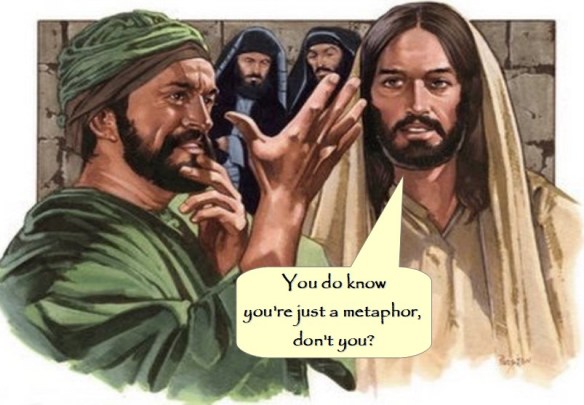
Greetings, my beloved Brethren. Today we are going to look at God’s Holy Word as revealed to our dear brother in the Lord, the one who will one day be called ‘Mark’. We’re looking specifically at the passage above, because some of you have expressed difficulty in discerning the full import of the text. I have to say I’m surprised at this. You only have to bear in mind Mark’s rule of thumb that everything in his gospel is a metaphor, which, when looked at with discernment, reveals a previously hidden mystery:
To you has been given the secret of the kingdom of God, but for those outside everything is in parables, so that “‘they may indeed see but not perceive, and may indeed hear but not understand, lest they should turn and be forgiven’” (Mark 4:11-12, referencing Isaiah 6:9)
Our passage today begins with the Lord healing a man with a withered hand, which should straight away alert us to the fact we are dealing with metaphor. All of the healings in the gospels are. They stand for something more significant than any actual healing.
Some of you might already have made the connection between the use of ‘withered’ here, with its use in another story (Mark 11-12-14), where Jesus withers an unfruitful fig tree. Of course, no actual fig trees were harmed during this miracle. The fig tree and its withering are metaphors.
The tree, you see, is a metaphor for the Jewish system of worship, the old Covenant of the Law. This had reached the end of its life. It was fruitless and God was done with it. He was in the process of replacing it with salvation through Grace. All of this is represented metaphorically by Jesus cursing the fig tree and causing it to wither.
So it is in our passage today, except this time, God offers healing to the Jewish nation. He is nothing if not gracious, reaching out and offering acceptance into the new Covenant, expressed here as the healing of a withered hand. You won’t have missed the fact – again symbolic – that the healing occurs in the synagogue, the Jews’ place of worship. We might also remember Deuteronomy (6:8) where the Lord God instructs the Jews to wear his Law on their foreheads and, more significantly, to tie them to the backs of their hands. But now their hands have, metaphorically speaking, withered away, just as the fig tree will.
God knows of course that few will accept his proffered healing, insisting instead of labouring blindly under the old Covenant. The rest of the story reflects this stubbornness and the incalcitrant attitude as the Pharisees – metaphors for the Jews as a whole – round on Jesus and castigate him for breaking the Sabbath laws in healing the man – in spiritual reality the Jews themselves. That Jesus heals on the Jews’ sacred day is metaphorical too, demonstrating as it does that all the old laws are now surpassed. Jesus, and more importantly his followers – you, my dear brethren – are no longer under the yoke of that law but have new freedom serving Jesus under his new yoke, which is easy to bear. At the end of the story, the Pharisees – the Jewish leaders of our own time, lest we forget – leave to plot against the Lord; in reality against us. With his help we will of course bear this persecution stoically.
So you see my brothers, this story was written for you, to remind you that you are saved. You are the New Covenant. The Old has passed away. You can follow Jesus’ example and do good, yea, even on the Sabbath. You need not fear the Jews or others who might persecute you because the Lord is with us. The Jews, on the other hand, will soon be cast into outer darkness when he comes in person. Even so, Lord Jesus, come quickly.
I hope this has made clear to you the mystery hidden in this part of Mark. I know there will be some of you who are not sufficiently advanced in their understanding of the mysteries, being still babes in Christ, and may yet object to this exposition of the deeper secrets of the Lord. So be it. But don’t say you haven’t been made aware of the Truth.
Next time, if there are those who need to know more of the mysteries hidden in God’s new revelation, we can look at the next part of Mark, though I trust that you are, by now, developing sufficient spiritual insight to discern for yourselves the hidden mysteries embodied by the gospel’s metaphors.
 rejectingjesus,