Later ‘evidence’

The Didache is an early Christian manual discussing ethical behaviour and outlining liturgical practice. Scholars disagree about when it was created, most opting for a date around 100CE. Despite referring to itself as ‘The Teaching of the Lord Through the Twelve Apostles to the Gentiles’ in the only extant complete copy, the Didache doesn’t mention Jesus by name nor refer to any of the historical details of the kind provided in the gospels. Instead, it refers to ‘the Lord’ or ‘the Messiah’, the same terms Paul uses for his angelic Christ, and makes use of ‘teaching’ similar to that in the (invented) gospels, from which it almost certainly draws.

We’re now heading into a period when the gospels were in wider circulation and any reference to Jesus cannot be regarded as independent from them. We need, consequently, to be suspicious of any ‘evidence’ that appears to affirm his historical existence. Documents that appear after the gospels is unlikely to be from independent sources (not that they always reference their sources) but are merely relying on gospel data as filtered through contemporary Christian believers. Hence the Roman historian Tacitus, who wrote in his Annals circa 115CE:

Nero fastened the guilt (for the fire in Rome in 64CE) and inflicted the most exquisite tortures on a class hated for their abominations, called Chrestians by the populace. Chrestus, from whom the name had its origin, suffered the extreme penalty during the reign of Tiberius at the hands of one of our procurators, Pontius Pilatus, and a most mischievous superstition, thus checked for the moment, again broke out not only in Judæa, the first source of the evil, but even in Rome, where all things hideous and shameful from every part of the world find their centre and become popular.

Chrestians? Chrestus?

Pilate as procurator instead of prefect? Christianity as a ‘mischievous superstition’?

Actually, this last I can see. The other peculiarities are a problem for those who claim this is evidence for an historical Jesus. Written some 85 years after Jesus was supposedly active, this first extra-biblical reference to something approaching an historical figure is simply too late. Likewise everything after it.

We’ve exhausted the paltry references to ‘the Christ’ or ‘the Lord’ that exist prior to and just after the gospels. An historical Jesus there is not, in any of them. What does this all mean? 

Conclusions

So what do we see when we arrange the books of the New Testament in chronological order?

  1. In all probability, Jesus was first experienced in visions experienced by a few Jewish zealots looking for the arrival of the Messiah. His name – Yeshua – is symbolic and means ‘The Lord is Salvation’.

  2. These visions led to ‘revelations’ that convinced these zealots that the Messiah would soon arrive on the Earth to set God’s plans in motion.

  3. A small number of Jews were convinced of the veracity of these claims and sought to spread the message that the Messiah/Jesus was soon to arrive on Earth.

  4. A few years later, a Hellenized Jew who called himself Paul, argued that the Messiah – ‘Christ’ in Greek – had died in the heavenly realm and been raised from the dead by God. His sacrifice, Paul insisted, was a propitiation for human sin, both Jew and Gentile.

  5. Also according to Paul, the Christ’s arrival would trigger the resurrection of the dead, prophesied in Daniel 12:1-3 and Isaiah 26:19-20, the final judgement (Daniel 7:22) and the establishment of God’s kingdom on Earth, governed by God’s Chosen (Daniel 7:27). Regrettably, he drew most of these conclusion from a book, Daniel, now known to be fake.

  6. Paul ‘proved’ that the Messiah-figure he’d seen in his visions really was the Messiah prophesied in Jewish scripture by quoting from them extensively.

  7. Soon after Paul died, the original group of visionaries, who had had their differences with Paul, were all but wiped out when the Romans destroyed Jerusalem.

  8. Around the same time, an unknown cultist took it upon himself to write an allegorical history of the Christ’s activities. He based this allegory on Paul’s teaching about the Christ as well as events from Jewish scripture. He set his story in Galilee some forty years earlier and has his fictional Christ, Jesus, prophesy the arrival on Earth of the real Messiah whom he calls the Son of Man, after Daniel 7:13-14.

  9. Two other cultists set about altering and improving this original history. One re-establishes the Christ’s Jewish credentials, and extending references to and allegorising aspects of Jewish scripture.

  10. A completely imaginary history of the early cult was created by one of these writers, smoothing over the differences between the beliefs of the earliest visionaries and Paul.

  11. Other writers, including some pretending to be the late Paul, continue to write of Jesus the Christ as a celestial saviour.

  12. A fourth history of the Christ was created, this time providing Jesus with a bodily resurrection (contrary to Paul) and discarding some of the cult’s earlier beliefs, the imminence of God’s kingdom on Earth included. The authors of this account imply that dead believers will awaken to new life in heaven (John 14:2)

  13. The idea that the Messiah will arrive imminently was, however, kept alive by other writers. One anticipated the Christ would soon purge the world of evil-doers and bring a holy, bejewelled Jerusalem down to Earth.

  14. Others soon abandoned the idea that any of this would happen soon. The arrival of the Christ was postponed indefinitely.

  15. The notion the Son of Man/Messiah/Jesus had yet to appear was also dropped as the church adopted the allegorical gospels as real history. It began to expel those who disputed the gospels’ veracity and denied that Jesus was the Christ incarnate.

  16. While the term is not used in the New Testament the Christ’s delayed arrival was, from the early second century, thought of as a second coming.

  17. The church, once well established went on to embellish doctrine, adding the Triune God; eternal life in Heaven; the elevation of Mary and the saints; the New Testament as the Word of God and the infallibility of the Bible as a whole. Some of these were, and are, in direct contradiction of the beliefs of the earliest Christians.

  18. Believers today, if they read the New Testament at all, take its traditional order at face value, which distorts the evolution of its ideas. They allow their preachers to smooth over what now appear to be random contradictions (hermeneutics).

  19. Today’s Christians believe primarily in the heavenly Christ, who forgives their sins and guides their lives from Heaven. They also hold on to the belief that he was manifested as a human, and vociferously oppose the idea he was and is only an imagined supernatural being.

  20. At the same time they prioritise Paul’s teaching about him over anything he is made to say in the gospels .

That how I see it anyway. The more time I spend looking at the New Testament books in their correct order, as well as what this reveals about the beliefs of early Christians, the more I’m driven to these conclusions. They’re the only ones that make sense of all that we find in their writings. I realise this is contentious. Mythicism is not widely accepted but it is the only position that explains the recorded facts as we have them. The original Jesus was seen (in the mind of the first visionaries and by many later) as a heavenly Messiah. While the gospels were generally accepted as historical many decades after they were written, they are anomalies in the expression of the early faith. They can only be seen as allegories of the living, dying and rising of a cosmic saviour, a sequence not uncommon in the mythologies of the ancient world.

I recognise too that there may well be other problems with this position, which I’ll get to soon.

Getting Things in the Right Order

It’s difficult to find the probable chronology of the New Testament online. The Christians have taken over, many insisting the order of the books as we have them today is correct. I’ll work from one originally devised by Bart D. Ehrman in The New Testament: A Historical Introduction (accessed here). While there are apologists who insist improbably on earlier dates and scholars who argue for later ones, there is general consensus amongst scholars for the order of the books as they’re shown here:

The first book of our reordered New Testament, if we had it, would describe the visions of Cephas, and possibly others, who believed they’d seen the heavenly Jewish Messiah. Apparently, this envisioned Messiah told them he was coming to the Earth real soon to usher in God’s kingdom. This is all we know of the beliefs of these original Christians and we know it only from Paul. They themselves left no writing of their own. And why would they? The Messiah had appeared to them (in their heads), which could only mean he’d be coming to the Earth imminently. It was all too urgent to bother writing a treatise about it. It was going to happen any day!

Paul opposed these early Jewish cultists over their very concept of the Messiah. After his own visions converted him to a belief in Jesus, he profoundly disagreed with them over their insistence that the Messiah was coming from Heaven to rescue only his own people, the Jews. They held, as Paul did not, that Jewish rites and traditions must therefore be maintained. These ‘so-called pillars of the church’ as Paul snidely calls them in Galatians 2, were probably wiped out when the Romans destroyed Jerusalem and most of its inhabitants in 70 CE.

Following this representation of pre-Pauline cultists, our reordered New Testament would next have Paul’s letters. Written between 49 and 59 CE or thereabouts, the letters derive from the visions Paul claimed he’d had of the Jewish Messiah and what he thought these meant: his so-called revelations from the Lord. He decided the Messiah had made the ultimate sacrifice in order to offer salvation to all people, not just Jews. While the letters in chronological order reveal Paul’s evolving theology they have nothing to say about a human Jesus who wandered around Galilee a couple of decades earlier. Either Paul knew nothing about this character or he didn’t care about him. Or there was no earthly Jesus for him to know about. Paul boasts several times that he devised all of he knew about ‘the Christ, Jesus’ from his visions and subsequent contemplation.

The first gospel (‘Mark’) was written circa 70 CE. Whoever created it transplanted Paul’s Heavenly Messiah into a geographical and historical context. He structured his story around Paul’s ideas, predictions about the Messiah from Jewish scripture and sayings from those same scriptures. He also incorporated cult beliefs and rules from his own time. The original ‘so- called pillars of the church’ he cast as Paul viewed them – as boneheaded disciples who failed to understand the significance of what they were experiencing. He didn’t, curiously, include any resurrection appearances.

Next comes the second letter to the cult in Thessalonica and the first of the letters supposedly by Peter. Both are considered to be forgeries for all the reasons Ehrman discusses here and here.

2 Thessalonians concentrates on the vengeance Jesus will wreak on those who have rejected him. Like in the real Paul’s letters, there’s nothing about any historical Jesus. 2 Thessalonians and 1 Peter demonstrate that possibly as early as 70 CE, cultists were happily making stuff up and passing it off as written by cult heroes (who’d also made stuff up.)

Matthew, Luke and Acts follow. Again, these books were written anonymously only acquiring their traditional attribution many years later. Matthew takes 80% of Mark, adds some material of his own derived from the Jewish scriptures, and presents his new gospel as the definitive account of the Jewish Messiah’s time on Earth. Matthew’s gospel takes the use of allegory and metaphor that he’s picked up from Mark to extremes.

Luke likewise plagiarises Mark, adds some Matthew (though he’s not keen on Matthew’s Jewish emphasis so eliminates it) and creates material of his own based on Paul and Josephus. 

Buoyed by the success of his story, Luke ploughs straight on into an account of the early church and Paul’s doings. There are multiple problems with Acts, not least that Paul’s theology in the book is nothing like that of the real Paul. It is not history but a fabrication, reworking parts of older stories, such as the Odyssey, in several places.

A couple more forgeries follow: Colossians and Ephesians, both written between 80 -100 CE, long after Paul’s death in 64/65 CE. The two books make no mention of an earthly Jesus, despite at least three accounts of his supposed life that were, by the time Colossians and Ephesians were written, in circulation among the various sects of the new cult. Instead, Jesus is depicted as a heavenly super-being. Because they’re forgeries, they really don’t belong in our new New Testament; they muddle Paul’s already muddled thinking.

Well, we’re only half way through and I figure we all need a break. We’ll pick up on the second half of Putting The New Testament In The Right Order next time.

The Lyin’, Cheatin’ Book

The Bible is a lyin’, cheatin’ book. And no, that isn’t the title of a long lost country song. The Bible was compiled by men who allowed themselves to be deceived and who were more than willing, perhaps unwittingly (to give them the benefit of the doubt), to dupe others. They included letters claiming to be by Paul and Peter that we know were not. They took the imaginary history of the early church, Acts, at face value, and the invented stories about Jesus – the gospels – as historical. They put them together in a way that made it look as if the gospels were written first, followed by Acts, Paul’s letters and the bulk of the forgeries. Paul’s letters they arranged, not in any sequential or thematic way, but from longest to shortest.

In fact, as far as Paul and the gospels are concerned, this is pretty much the reverse of the order in which they came into being. Of the documentation that made it into the New Testament, Paul’s genuine letters were first, starting with 1 Thessalonians in the late 50s and ending with Philippians in the early 60s. Only after Paul was dead did the first gospel appear (circa 70 CE), the anonymous account later attributed to ‘Mark’. After yet two more attempts to get the Jesus story right, came Acts, the notoriously inaccurate account of the early days of the cult and Paul’s adventures lifted from other sources. The fourth gospel followed much later, between 90 – 100 CE. Written by a sect of the late first century it offered a complete reimagining of the Jesus story. Along the way, numerous forgeries appeared as well as the lunacy that is Revelation, written circa 96 CE.

What would happen if we rearranged the books of the New Testament so they followed the order in which they were written? It would make them less duplicitous for a start and would also give us a more realistic picture of how Christianity arose. We would still be lacking a picture of what the earliest cultists believed prior to Paul but we can make a rough guess of what that might have been from what he says about those who preceded him.

We’ll do this next time and see what the newly ordered New Testament tells us about early Christian beliefs.

And now, the Conclusion

It’s a game you can play all day.

  • First, choose a story – any story – from the gospels.
  • Look for all the metaphors in the story.
  • Note its allegorical elements.
  • Find either the myth from Jewish scripture and/or the part of Paul’s fantasy that the story is based on.
  • Read the story in light of these insights.

Once you’ve done this a few times – which you can, literally, till Kingdom come – you’ll realise that all the stories in the gospels are literary inventions. Stories that are replete with metaphor, reliant on earlier mythical sources and that read like allegory would be considered, in any other context, to be fiction.

And what will you conclude from this?

That just because the stories are from the gospels doesn’t grant them a free pass. Stories that fulfil all the criteria of fiction, as the gospel stories do, are elsewhere considered to be fiction: think Romulus, the non-canonical gospels, King Arthur, the Book of Mormon, the Chronicles of Narnia. So why not here?

That calling the stories ‘pericopes’, in an attempt to elevate their status, merely disguises the fact they are just stories.

You’d acknowledge that History, as in the recording of past events, is not written as allegory. It doesn’t depend on metaphor and symbolism to reveal hidden meanings. Historians reject or are highly sceptical of any accounts that depend on such literary techniques. They usually conclude these are not history, whatever else they might be.

You could, I suppose, try arguing that history in ancient times wasn’t the discipline it is now and did indeed incorporate elements from fiction. But you’d be wrong. Historical accounts of the first century have survived and do not confuse historical fact, however interpreted, with fiction. Writing that relies on allegory and hidden meanings is not considered to be history. You would then have to concede that the gospel narratives do not qualify as history. You would then be in agreement with the majority of scholars who think this.

Then you’d ask, why? Why, if Jesus was such an incredible guy, did so much have to be made up about him? You could, I guess, argue that an itinerant first-century preacher successfully manipulated events so that he fulfilled ‘prophecy’, complied, at least in Mark, with Paul’s (future) teaching and managed to make himself some sort of living breathing metaphor. Or you could conclude, applying Occam’s razor, that the stories are simply made up. And if you did, you’d be agreeing with Mark when he reveals that ‘everything is in parables’ (Mark 4:11).

You’d then ask yourself: if the miracles, the healings, the profundities, hyperbole, nativity tales, angels, demons, zombies, the transfiguration and much else besides are all fiction, then why not too the resurrection? Is it one of only a few episodes in the gospels – the crucifixion is often cited as another – that isn’t fiction? Is it the one of only a few stories in that’s factual and true? The empty tomb, the angels, the sightings by Mary, the disciples and Thomas, the fish breakfast, the ascension: are these historical when everything else is not? You’d have to ask on what criteria you were salvaging this particular story as historical when all that precedes it patently is not.

Then you’d have to start wondering if there really was a Jesus. The versions of him who appear in the gospels are constructs, characters created from metaphor, Old Testament stories and the teaching of the early Christian cult. If there really was a man who trailed around Palestine with an apocalyptic message, he is long gone. Indeed, he had vanished by the time the stories about him that we know as the gospels came to be written.

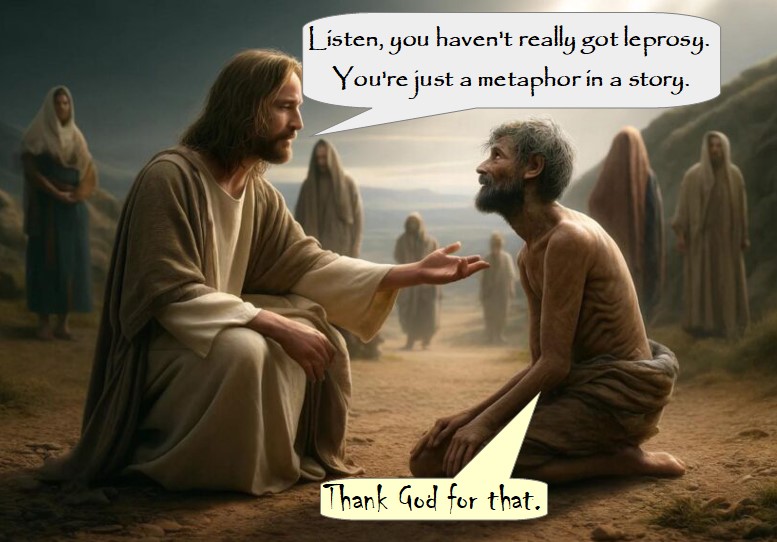
Jesus and the Leper

I thought we might share a couple of Bible studies these next couple of weeks. Some of you will remember these from your Christian days, when you’d gather with other eager believers so that a self-appointed expert could tell you what a particular story in the Bible really meant. I’m no expert, just someone who subjected myself to such indoctrination while all the time wondering if what I was being told was really what the passage was about. Doubts, however, were ‘of the devil’ so any such critical thinking needed to be suppressed. Since my eyes were opened to the allegorical nature of much of what is in the Bible and in the gospels in particular, I now see these same passages in a completely different light. I hope you’ll allow me to share my insights with you.

First off, it’s Mark 1:40-45, in which Jesus (seemingly) heals a leper:

 A man with leprosy came to him and begged him on his knees, “If you are willing, you can make me clean.” Jesus was indignant. He reached out his hand and touched the man. “I am willing,” he said. “Be clean!” 

Immediately the leprosy left him and he was cleansed. Jesus sent him away at once with a strong warning: “See that you don’t tell this to anyone. But go, show yourself to the priest and offer the sacrifices that Moses commanded for your cleansing, as a testimony to them.” 

Instead he went out and began to talk freely, spreading the news. As a result, Jesus could no longer enter a town openly but stayed outside in lonely places. Yet the people still came to him from everywhere.

The giveaway phrase here is ‘make me clean’. The man does not ask Jesus to heal him which, suffering from a debilitating disease as he was, would have been the most obvious, most pressing request to make. Instead, he asks to be ‘cleansed’ with all its ritual connotations, the word used here, καθαρίζω (katharizo), also meaning ‘purify’. According to Leviticus 4: 11-12, leprosy was a condition that was spiritually unclean. Only by making the prescribed offerings – the usual doves, lambs and ‘crimson stuff’ – could a leper who was already healed become ritually pure.

Who, according to the New Testament, replaces all the sacrificial offerings of the old covenant? Why, it’s Jesus himself of course (1 Corinthians 11:25, Ephesians 5:25-26 etc). Jesus cleanses and purifies the leper in the story, just as he is able to cleanse and purify sinners. This is what the early cult believed: ‘Ask Jesus, the heavenly Christ, to cleanse you of your sins and, just like he does for the leper in this parable, he’ll do it for you. As a penitent believer, you are the leper. Not only are you cleansed of your sin, you are purified.’

This also explains why Jesus is ‘indignant’ when the leper first approaches him. On the surface it makes little sense for him to be indignant with the man, which is why some translations change this verse to say Jesus ‘felt compassion for him.’ Jesus’ metaphorical annoyance is for those who have allowed the man’s spiritual condition to have deteriorated to a state comparable with leprosy. The Jewish priestly system, symbolised anachronistically in Mark as the Scribes and Pharisees, the later arch-enemies of the new cult.

Jesus commands the leper to visit the Jewish priest to demonstrate that he, Jesus, is the new cleanser of sins, replacing the priesthood itself. Instead, the leper goes against Jesus’ and the early cult’s wishes. My God, how could the cult remain secret and exclusive if newly cleansed converts behaved like this!

So there you have it. The leper is a metaphor for the sinner in need of the heavenly Jesus’ cleansing. His leprosy is a metaphor for the sin itself. The healing is a metaphor for the penitent’s spiritual purification. The man’s by-passing of the Jewish law is a metaphor for Jesus replacing the law. The cleansed leper’s shouting about it is a metaphor for the early cult’s desire to keep its rituals and teaching secret. Its parables like this one were designed to enlighten cult members while obfuscating and confusing the unbeliever (Mark 4:11-12).

As a literary creation, an allegory replete with metaphor, this event need never have happened in reality. Given its literary nature, it’s highly unlikely it did.

An Anonymous Author Writes…

A little while ago I came across a group of enthusiasts who met locally to celebrate the chap who’d founded their group a few decades back. I paid them a few visits to see what they were about and when they learnt I was capable of stringing a few sentences together, asked if I would write a short biography of their Founder. Being an obliging sort, I said I would, not realising the challenges that lay ahead.

For a start, none of them had actually known the guy. He’d died soon after the group had started and none of the current membership had ever met him. Worse, they weren’t even sure what his real name was. Some said ‘Josh’, some ‘Jess’ and others ‘Manny’. They thought a guy who had known him was still alive, but couldn’t remember his name either. ‘Rocky’, they said, or maybe ‘Tiny’.

All the same, I’d said I’d have a go at the biography and didn’t want to disappoint them so I set about searching the Web. I soon discovered that both ‘Rocky’ and ‘Tiny’ had passed away, about the same time six or so years earlier. There was nothing online about any Rocky but there was quite a bit about Tiny. Or rather by him. He’d left a whole series of posts, mostly about he’d been contacted by the founder from beyond the grave. He said over and over that he could prove it really was the Founder he was channelling because, apparently, it said so in some old stories. He quoted these all over the place.

All weird stuff, but all I had to go on.

So I set to. I tried to make as much sense as I could of Tiny’s writing. I made stories out of his rambling, imagining what the Founder must’ve been like from the things Tiny claimed he’d told him. Like Tiny, I used old stories to fill out the narrative and included loads of metaphor. People love finding hidden meanings in things. I stopped short though at having the Founder come back from the dead at the end, not even metaphorically. Tiny insisted he had done but no-one in their right minds would believe it.

In the end, I thought I’d made a good job of it. The guys in the group thought so too. They were so pleased they suggested I publish it on Amazon, which I did. To my surprise, it started selling really well and got some very good reviews (and only a couple of poor ones.) To my annoyance, though, it wasn’t not long before a bunch of opportunists took to writing novellas about the Founder themselves, and (the nerve of it) lifting whole chunks of my story and ‘correcting the errors’! Errors? How could there be errors in something I’d made up? They even used my technique, lifted from Tiny, of borrowing bits from older books and making them fit their version. Their ‘Founder’ turned out to be different from mine, though not, I’m convinced, anywhere near as good.

I’ve decided I was going to retire from this writing lark. It’s too competitive and there are too many plagiarists around. Let them get on with their inferior sequels. Everybody will remember I was the first, and the best. Won’t they?

If the Gospels were History…

If the gospels were written by eye-witnesses, we should see the use of the first person singular or plural: ‘I saw this happen’, ‘we heard him say that’ and so on. This would not necessarily mean that the author was present, just as he isn’t in the ‘we’ passages in Acts, but it is what we should reasonably expect if the authors were involved in at least some of the events. There are no such instances in any of the gospels.

We would see gospel authors identifying themselves, at the start of their accounts, for example. We don’t.

We would not see an eye-witness lifting significant amounts of material from someone who wasn’t an eye-witness. Yet Matthew plagiarises Mark, ‘improves’ it and passes it off as his own. This isn’t eye-witness behaviour and it is not how eye-witness testimony works.

We would see the gospel writers cite their sources: Mark would tell us he’s recording Peter’s recollections and that he witnessed Jesus’ trial personally (there’s no evidence he did either, speculation from centuries later notwithstanding.) Luke would tell us which accounts he’s referring to in Luke 1:1-2. While we now know he too plagiarises Mark and quite probably Matthew, he doesn’t admit it. We would know the source of events that took place behind closed doors such as Jesus’ interview with Pilate.

We could expect contemporaneous accounts independent of the gospels, recording the miraculous events they claim occurred; the wandering star, the earthquakes, the hours long eclipse, the healings and controlling of nature, the resurrected zombies, the ripping of the 35 foot temple curtain, the resurrection of an executed criminal. Instead there’s nothing, not even in later works such as those of Josephus (because all of these events are metaphorical).

We should expect Cephas (known as Simon Peter in the later gospels) to have recorded his experiences with Jesus. Yet, when he gets his chance, in the letters he supposedly wrote (1 and 2 Peter), he makes no mention of them at all.

We should expect the Christians prior to Paul to have recorded some of these episodes. Some argue that they did, in a document now called Q, but this precious document was, unbelievably, soon lost or abandoned. Alternatively, they may not have seen the need to write anything down because they believed the world was about to end very soon. Either way – no accounts from them about ‘the history of Jesus’.

We should expect Paul to mention aspects of the Jesus story in his letters. After all, he claims to have persecuted Christians for some time before his conversion and to have met and conversed with Cephas for 15 days. Yet he conveys no details at all. Instead, he claims all he knows of Jesus derives from visions and ‘revelations’ in his head. His account of the bread and wine ritual informs Mark’s story of the Last Supper, not the other way round; it is – Paul says clearly – another ‘revelation’ in his head.

We should expect there to be details about Jesus’ earthly life in other books of the NT. Instead we find only a celestial high priest in Hebrews and a warrior Christ in the supposed visions of Revelation. Nothing historical here.

We should, if the gospels are history, expect them to read like history. History, including that written at a similar time does not include angels, devils and apparitions, magic stars, virgin births, miracles and supernatural healings. Where it does, as in Constantine’s vision of the cross, such elements are seen for what they are: myth, not history.

We would not expect the central figure of the gospels to be constructed almost entirely from parts of older religious writing. This is not a technique used in genuine historical records.

We would not expect to find the level of metaphor and mythic tropes – magic, supernatural characters, returns from the dead – in what is ostensibly an informational text. History does not rely heavily on metaphor and symbolic tropes the way the gospels do. There is no ‘logic of history’ in the Jesus story.

We would expect to see geographical and political details relayed reasonably accurately. Instead, Jesus’ trial arrangements are highly improbable; they do not conform with what is known about Roman trials – and we know a lot, because of the records they kept. Jesus would not have had a personal interview with an indecisive Pilate, who would not have consulted the mob, would not have sent Jesus to the Jewish authorities or Herod and would not have offered to exchange Jesus for Barabbas (there was no ‘tradition’ of exchanging one criminal for another) and so on. From what we know of him, Pilate would have authorised the execution without a qualm, as he did for many other would-be messiahs. The rest – the gospel details – are drama, Jewish scripture brought to life with added metaphor. Fiction, in other words.

The Son of Man

I started wondering why, if his creators believed him to be the Messiah, they have gospel Jesus habitually refer to saviour-figures in the third person? He does it Matthew 23 which we looked at couple of weeks ago, when he talks about there being ‘one instructor: the Messiah’, and he does it repeatedly in all four gospels when he refers to ‘the Son of Man’. The term comes from Daniel 7:13 where it is rendered as ‘one like a son of Man’.

In my vision at night I looked, and there before me was one like a son of Man, coming with the clouds of heaven. He approached the Ancient of Days and was led into his presence.

The interpretation of which, supplied in Daniel 7:27, is that:

The sovereignty, power and greatness of all the kingdoms under heaven will be handed over to the holy people of the Most High. His kingdom will be an everlasting kingdom, and all rulers will worship and obey him (my emphasis).

The phrase used for ‘son of Man’, bar enash, means simply ‘human being’ and is used to contrast with the ‘beasts’ of nations that the ‘prophecy’ says will rule prior to this. However, as Daniel explains, the human being in question is the nation of Israel – the holy people of the Most High – who will finally triumph over the four beastly nations that will dominate the Earth first. The nation of Israel will metaphorically emerge from the clouds and join the Ancient of Days to rule from Heaven. There is no mention anywhere in the Daniel dream-prophecy of a Messiah or individual human being who will accomplish any of this.

As Neil Godfrey puts it:

The coming of this “Son of Man” is within the realm where one expects deities to travel. The coming is, moreover, to another station within the clouds, namely the throne of the Ancient of Days. The context again explains that this “coming” is effecting a change of rule on earth. A kingdom is falling, and freedom is given to “the saints of the Most High”.

Nevertheless, it is this title – the now fully capitalised ‘Son of Man’ – that Mark has Jesus assume. The other three gospel writers copy it from him. Paul, writing decades before them, seems not to know that Jesus used it. Evidently the celestial Christ he encountered in visions and revelations didn’t feel the need to mention it. (Hardly surprising when Mark is freely inventing years later.)

So what does this tell us about Jesus, or, more specifically, about how the Jewish Christians of Mark’s community viewed him?

A number of scholars (e.g. Ehrman, Carrier, Goodacre, Westar Institute) have argued (as have I in my own amateurish way) that gospel Jesus is constructed from ‘prophecies’ lifted from Hebrew scriptures. Other commentators have demonstrated how he is, in the first two gospels at least, the personification of the nation of Israel*. This isn’t just because he identifies with the son of Man figure in Daniel. He also equates himself with the Suffering Servant of Isaiah 53 and elsewhere. Strictly speaking, he is made to identify with the Suffering Servant by Mark and the other gospel authors, particularly Matthew, who all copy Mark’s original idea. As Isaiah 53 makes clear, God’s Suffering Servant is not a person: it is Israel.

Not only is Jesus identified with Daniel’s son of Man and Isaiah’s Suffering Servant – the personification of the Jewish nation – but Isaiah 53 is used as a template for his trial, mockery, crucifixion and resurrection. It is the nation that is God’s servant which, as Mark was writing, was going through trials, tribulation, suffering and apparent death: the destruction of Jerusalem and its temple, with thousands of Jewish people being crucified by the Romans.

So it will be Israel, Mark hints in his extended parable, that will emerge resurrected and who will ascend metaphorically through the clouds to sit at the right hand of God to rule the nations. He leaves out the details of this resurrection and ascension from the end of his gospel because at the time of his writing they had yet to happen. But, he tells his readers and listeners, they will. They have to because Daniel and Isaiah say so: after suffering comes God-assured victory. Mark’s Jesus story, then, is an allegory of the history of the Jewish nation and its projected future. The allusions to Abraham, Moses, the Exodus, Elijah, Isaiah’s Suffering Servant, Daniel’s son of Man and the accompanying ‘prophecies’ make this more than apparent.

Gospel Jesus is a metaphor (or indeed a simile, one who is like a son of Man/the Jewish nation), his life made to conform in every respect with the history of that same nation. He is an allegory as Mark makes clear throughout his gospel. 

The clues are there for all to discern and as Mark advises, ‘he who has ears, let him hear’.

*See Watts: Isaiah’s New Exodus and Mark and numerous Christian apologists who make the same point: Google ‘Jesus and Israel’.

End Of Term Test

Which of the terms mythological, symbolic, theological is most appropriate when discussing biblical tropes?

Apparently, it’s ‘theological’ because it has an air of respectability, whereas the other terms suggest something with only theoretical underpinning. In fact, this also applies to ‘theological’, which by definition is the study of deities, for which there is no evidential verification. The use of ‘theological’ therefore is as unsubstantive as arguing that a concept is metaphorical or symbolic. None of these terms represents a sound, reliable way to determine the accuracy, historicity or truth of religious claims.

With this in mind see how you do with these questions:

1. Did the original hearers of the Genesis creation story regard it as –

a) true.

b) a theological statement.

c) an entertaining myth.

Of course we’ve no way of knowing what the story’s original hearers thought but there is nothing in the text that suggests they would have regarded the creation story as anything but true. The creators of Jesus’ script certainly seemed to think so, a few centuries later and its original hearers would not have felt the need to preserve it otherwise. In this belief they were wrong.

2. Which of these gospel stories is true, as in ‘really happened more or less as described’ –

a) The virgin birth with its surrounding detail.

b) Jesus meeting with Moses and Elijah (the transfiguration).

c) Resurrected corpses roaming around Jerusalem.

d) The resurrection.

The answer is that either all of them are true or none of them are. If only one of them is mythic, symbolic or ‘theological’ (and more than one of them most certainly is) then it is highly likely the others are too. If we are scrupulous, we cannot assert that one story is symbolic because it’s making a theological point while another equally implausible story is historically accurate because we want it to be.

The criteria for determining the historicity of any story from antiquity are corroborative evidence and, failing that, plausibility. We have already established that there is no independent corroboration for many of the gospel stories. There is no corroboration for some of them even in the Bible itself. We are left then with plausibility: how plausible is it that a virgin gave birth or that resurrected corpses presented themselves to Jewish authorities? Vanishingly small. Jesus’ encounter with Moses and Elijah is equally improbable.

Is his resurrection the exception? No, because dead people do not spring back to life 36 hours after being buried. If the virgin birth, the transfiguration and the resurrection of dead saints are all highly implausible (and they are) then so is the resurrection. It is at best, a story making a theological point but it is not history. The implausibility it shares with many of the other implausible stories in the gospels discounts it as history. There are no grounds for saying it is the exception.

There is also the cumulative effect of implausibility. It is highly unlikely that one of the implausible events above is historical, but it is impossible that all four of them are. Add all the other implausible stories in the gospels – the other miracles; the healings; exorcisms; Jesus sparring with the devil, walking through locked doors and beaming up to heaven: piling implausibility on top of implausibility doesn’t make any of the component implausibilities more plausible. It makes all of them less plausible and collectively impossible.

The things the gospels tell us happened to Gospel Jesus, and those they say he did himself, are equalled only by heroes of myth. Did Osiris or Romulus rise from the dead, as their stories claim? Did Augustus really become a god once he died? Of course not. These are the implausible, improbable events we find in myth. Jesus’ story is no different.

3. While many or all of the gospel stories are highly improbable as history because they are intended to convey a theological point, the words attributed to Jesus in the gospels –

a) are completely accurate.

b) are more or less what he said.

c) passed through an inestimable number of people, being invented, edited and altered in the process, before being written down 40+ years after Jesus supposedly uttered them.

d) are inventions of the gospel writers and/or their particular sect and frequently copied between gospels.

If you’re opting for a or b, you’re now making the logia the exception; the one oasis of historical truth in a desert of implausibility. That’s a big ask. To get this one off the ground, you have to call upon contrivances like –

completely reliable (but different and conflicting) oral traditions;

     hypothetical lists of sayings;

         Peter’s dictation to Mark;

             eyewitness authors;

                  secret teachings;

                     super-translators and

                         the odd spot of collaboration.

So, c and/or d is far more likely to be the answer to this one, representing the explanation that requires the least conjecture and fewest hypothetical components.

How did you do? I expect most of you aced this end of term quiz. If not, better get down to some extra study and repeat the semester next year.