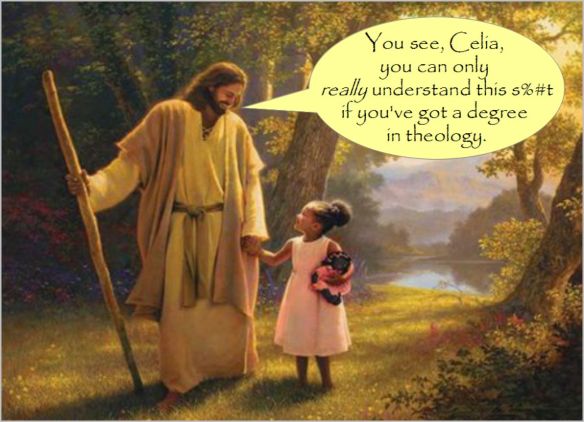
Scripture Explained

In truth, when the Lord said, ‘love your enemies and pray for those who persecute you,’ he meant by taking his gospel to them and speaking the truth unto them in love. This, after all, is the highest form of love: sharing the Good News of Jesus. For surely there is no way we can really love someone who opposes us. Therefore this cannot be what the saviour meant when he commanded us to love our enemies. Evidently, he made use of hyperbole to encourage us in our daily journey with him by making salvation known to those whose sin will only lead them unto Hell. There comes a point nonetheless when we must recognise that there are many enemies who will not accept the Word. These we must oppose, denigrate and condemn as the Holy Spirit directs. Does not scripture itself expect as much?   

When the saviour declared that we can’t serve God and money, he again spoke metaphorically. He did not mean the wealthy cannot enter the Kingdom of God. No, what he refers to is priorities. It is perfectly possible to be wealthy and a follower of Jesus so long as we put Jesus first. Where in the world would we be if we had to give away our money and possessions?

When the saviour commanded us to sell all we have to provide for the poor, he did not mean in this world which stands already condemned. Rather, he speaks in metaphor and refers to the emptying of our very selves to better follow him.

When the saviour said we must take up our crosses to follow him even unto death, he likewise spake metaphorically. He loves each according to that which he is able to bear and seeks to bless those who loves him. He speaks here therefore of our dedication to him. He encourages us to ‘die’ to our selves so that we might allow him to transform us into new creations worthy of himself.

When the Scriptures says we become new creations, it does not mean literally nor that it will happen in the twinkling of an eye. No, rather it refers to our being a ‘work in progress’. The Lord of miracle and all creation does not wish to impose on our free will by transforming us instantly. Instead, he seeks to test and purify us in a long almost imperceptible process. Only in heaven will we attain perfection.

When the saviour promised that the End of the Age was nigh for those who stood before him, he did not mean it was nigh for those who stood before him. No, for this was a secret message, a mystery, for those who would worship him in what would be, for those who stood before him, the distant future. What he meant was that when the time was right, when diverse conditions had been met – some of which would only be made known after our Lord’s time on Earth – the Son of Man would descend from the heavens to inaugurate the final judgement and the Kingdom of God.

When the scriptures declare that the Kingdom of God is intended for here on Earth, it speaks only metaphorically, for God promises those who have been saved by the power of Jesus’s blood that they will live forever with him in Heaven itself. This is a mystery known only to those who exegete the Bible correctly and ignore the plain and literal meaning of what it says.

So this, brethren, is how to deal with scripture. You need only apply one simple rule as you read it: if it appears to make demands of you, it is not actually doing so. It is either metaphor, hyperbole or both and must not be taken literally. On the other hand, when scripture is not making demands of you, everything, however unlikely it seems, is real, true and factual.

He who has ears, let him hear.

The God Who Never Was

Blog404

I’m considering reasons why God is unlikely to exist. The sixth, though by no means final reason is (drumroll): Christians.

If God existed and if he did the things the Bible, and Jesus in particular, claimed for him, then Christians would be very different creatures. They wouldn’t be beligerent and self-righteous, desperately trying to draw others into their cult, callously condemning everyone outside it while claiming they themselves are the persecuted (a caricature, I concede, but not without truth).

Instead, and according to Jesus and Paul, they would be brand new creations (2 Corinthians 5.17), infused with supernatural power: the Spirit of God no less (John 14.26; Romans 8.7-9). They would, moreover, have abandoned their families (Luke 14.26) and sold all they own to give to the poor (Matthew 19.21), relying solely on God for their needs (Mark 11.24; Matthew 21.22). They’d spend all their time as his slaves (Matthew 25.21; Romans 6.22), helping the sick, the destitute and the imprisoned (Matthew 25.35-40) and in return God would have endowed them with the ability to heal all disease (Mark 16:15), raise the dead (Matthew 10.7-8) and do miracles even greater than Jesus’ own (Mark 16.17-18; John 14.12).

If Christians were like this, as Jesus and Paul promised, the world would be a much more remarkable and better place. What does it tell us that it isn’t? When Christians don’t constantly demonstrate compassion and miraculous powers but instead spend their time demeaning gay people, ranting about abortion and proselytising (the latter a redundant activity when, if they were the new creatures the Bible promises they’d be, we would all see God in and through their actions and superpowers.) That Christians are not like this tells us Jesus got it entirely wrong; that his God had no interest in him and has none in us; that faith in God, as Jesus and his early followers envisaged it, does not deliver.

Christians actually know this, which is why they ignore what the Bible says they should be like, or explain it away with convoluted exegesis. They’re focused on their own ‘spiritual growth’, ‘worship’ and on how they’ll be going to heaven when they die – an offer the Bible never makes. Whichever avoidance strategy they resort to, the Bible says what it says: that God will enable his followers to do great miracles, like healing the sick and raising the dead; ‘all things’, in fact, though Christ who strengthens them (Philippians 4.1). The evidence demonstrates conclusively, despite the disingenuous claims of some loopier evangelicals, that God does nothing of the sort. He fails, yet again, to come through. The only reasonable conclusion is that this is because he’s not real.

So those are six major reasons why it is highly unlikely God exists. There are others, some of which I’ve touched on in other posts: how, despite Jesus’ promises he will, God looks after his devotees no better than caged sparrows (Matthew 10.28-31); how there’s no evidence the supernatural exists; how the spiritual realm and the gods that go with it are products of the human imagination. Collectively – and even separately – these convince me there’s no God, and certainly not that sorry excuse for one, Yahweh.

Things a Christian Wishes (Some) Atheists Would Stop Doing (And Saying)

corey

On his blog recently, Doctor Benjamin Corey offered up a post called ‘S%#t I Wish (Some) Atheists Would Stop Doing (And Saying)’. I discovered it via the Friendly Atheist blog and naturally felt compelled to respond to Doctor Corey’s four bits of S%#t. The comment I posted on The Official Blog of Benjamin L. Corey is as follows:

S%#t 1: Please stop saying or insinuating that we’re a bunch of uneducated or unenlightened idiots.

Do atheists say or insinuate this? I’m not sure they do. I would suggest atheists find it difficult to understand why people of evident intelligence choose to believe propositions for which little or no evidence exists, that are rooted in myth and which, in reality, fail to deliver on their promise. It’s not that believers are necessarily unintelligent or idiots – clearly many are not – it’s that they are prepared to disengage their intelligence, critical faculties and rationality in order to believe all manner of spurious nonsense.

S%#t 2: Please stop insisting that we read our Bible like right-wing fundamentalists.

I’m surprised you offer this as something you wish atheists would stop ‘insisting’. First of course, atheists don’t insist that anyone read the Bible the same way as anyone else. We would prefer it if no-one read it at all. It is well past its sell-by date and has nothing to offer people living nearly two thousand years after its creation; it is after all a testimony to the failure of the beliefs that spawned it (the Son of Man ascending to the Earth to establish the Kingdom of God here).

Second, implicit in this demand is that there is an intelligent way to read the Bible and there’s the ‘ring-wing fundamentalist’ way. In fact, you don’t even insinuate that certain Christians are ‘ignorant’ and ‘unenlightened’ because of how they read the Bible, you say so explicitly when you talk, ungrammatically, about the ‘unenlightened, ignorant nonsense that fundamentalists do with the Bible.’

But at least fundamentalists regard the Bible as the Word of God (agreed they cherry-pick it and don’t behave according to it precepts) and claim it is ineffable and infallible. Perhaps, as you suggest, more enlightened Christians are free to interpret it in more liberal ways, dismissing that which is context-bound and so on. But then, where does that leave it? Is it authoritative or not? Does it speak directly to people or can it only ‘really’ be understood through the exegesis of scholars? If the latter, as you imply, then can it only be read and understood by those with above average intelligence? How does this square with Jesus’ insistence that his Kingdom was for those with child-like trust?

S%#t 3: Please stop referring to our belief system(s) as fairy tales.

Difficult this one. It depends whether myth and fairy tale are synonymous. Having taught English literature for many years at a university in the UK, I would argue they’re not. To the layman, however, they probably are in that both involve fantasy beings, implausible events, symbolic characters, sacrifice and enlightenment – just like religion really. So no, there is definitely a case here, Dr Corey, that if the cap fits… if your ‘belief-system’ walks, talks and smells like a myth (or fairy tale) then it probably is. You are stuck with atheists pointing this out to you, I’m afraid.

(By the way, your examples of Mickey Mouse and the Old Woman in the Shoe are not fairy tales. One is a commercial enterprise involving anthropomorphised animals and the other a nursery rhyme. I suggest you consult scholars who can explain to you what a fairy tale is, and the differences and similarities between it and myth.)

S%#t 4: Maybe lay off the whole, “religion hasn’t done any good for humanity” type of argument, because it’s obnoxiously untrue.

Reference for this quotation or did you just make it up? Sam Harris perhaps comes closest to saying this sort of thing – comes close but doesn’t actually say it. He says on balance that the good religion has done is outweighed by the evil perpetrated in its name. He doesn’t, though, say no good has come from religion. Sorry, Benjamin, but this is a straw man ‘argument’ you’re presenting here and is itself ‘obnoxiously untrue’.

Would we be better of without religion? Without the myth, the deadening of critical faculties and the adversarial nature of ideologies (even within Christianity)? Of course we would. Without precepts like ‘love your neighbor, love your enemies’? No, but then these are not exclusively religious. Far too many believers disregard them anyway.