The Great Eternal Life Scam

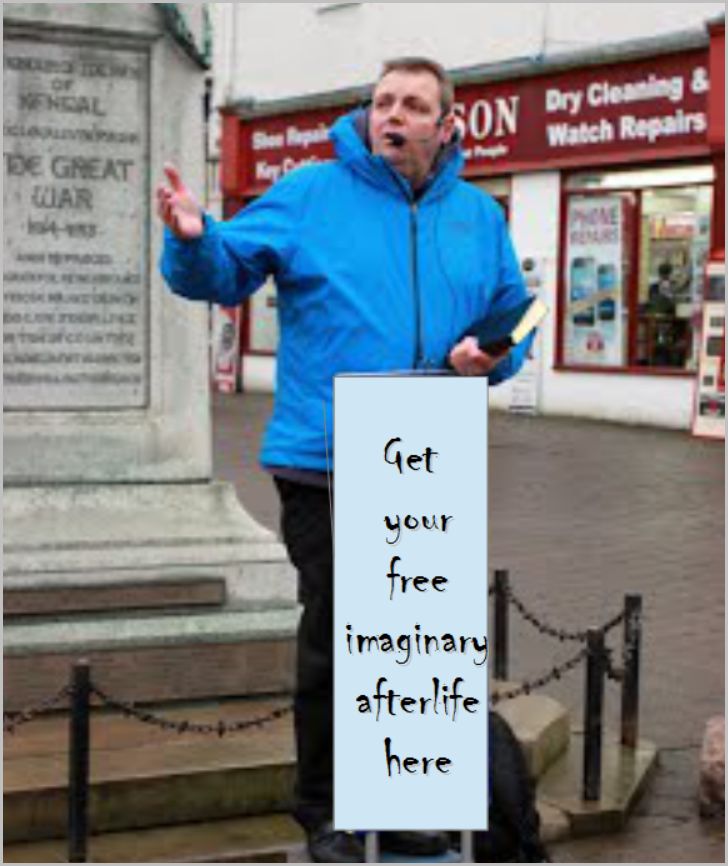
Heathens like me, and you dear reader, are gambling how we’ll spend eternity by rejecting Jesus. We’re turning down everlasting life to live in the mire of our own sin. Or so we’re told by evangelicals and other religious zealots.

So convinced am I that the claims of Christianity are wrong in every respect that I know I’m not gambling anything. Like everyone else who has ever lived, I will not survive my death. This is the nature of death – extinction, obliteration, oblivion. It is absurd to believe it is anything other when we know it is not.

I would not be averse to existence, particularly my own, continuing after death. I’d definitely go for it if that were available; I like being around, all sentient and self-aware and such. This is the sentiment to which Christianity appeals; most people do not want to think their existence is finite and that this often challenging life is really all there is. But life patently does not continue post mortem, except in works of fiction: fantasy, science fiction, the gospels.

Everlasting life is not the only promise Christianity makes, of course. There’s the whole ‘getting right with God’ shtick, forgiveness of sins and Life in all its fullness. Eternal life is the big one though, Christianity’s most miraculous, death-defying special offer.

Those doing the gambling are not atheists or sceptics. It’s Christians themselves doing that, succumbing to the false, utterly worthless promise of life after death. Those fully committed to Christianity spend their lives enslaved to its cultish demands, desperately trying to convince others they should surrender to its preposterous claims.

I value this life too much to squander any more of it on such nonsense. Yes, I did once, but I saw the light and stepped into it. Life is what you make it and needs to be lived before you die. There is zero chance you’ll be able to once it’s over.

Burst the bubble, those of you trapped within it. Your one and only life awaits you here on Earth. The clock is ticking.

Beyond The Grave

A few years ago, a friend of mine was working in his front garden when he spotted what he was sure were a couple of Jehovah’s Witnesses further down the street. He aimed to back inside before they reached his house, from where he could safely ignore them. But he timed it badly and before he knew it, the JWs were upon him.

My friend was under some stress at the time so when they asked him, ‘Wouldn’t you like to live forever?‘ he responded with, ‘Good God, no. This life’s bad enough. Why would I want it to go on forever?’ This took the wind out of their sail though didn’t divert them from their sales pitch for very long.

I’ve been in the same state of mind myself, and maybe you have, when life was so difficult I spent far too much time contemplating whether being dead might not be a better option. Thankfully, I couldn’t really contemplate doing anything about it, and was aware of the effect it would have on my loved ones if I did, but nonetheless I spent too much time considering – desiring even – my own non-existence.

I was pretty sure this was what awaited after death. I hadn’t, by this stage of my life, the conviction of the Jehovah’s Witnesses and mainstream Christians that a better life, one that would last forever, lay beyond this one. Instead, I made radical changes to my life in the here and now, to lift myself out of the slough of despond in which I found myself.

I love life now. It isn’t without its difficulties, not least the physical problems that come with older age, but I enjoy it to the full (apart from supermarket shopping). Having found my pearl of great price, I hope life will last for many years yet. I can’t guarantee it will, of course, so I make the most of every moment, surrounded by people I love and who love me.

Would I like my life to go on forever? Certainly, but I know it won’t. There is simply no evidence life continues after death. Assurances that it does in religious texts is no evidence at all. Even if it were, the type of eternal life suggested by the Bible, worshipping a needy, despotic God for evermore, is not the way I’d like to spend eternity.

Ask Christians how they know they will and the best that can come up with is that the Bible tells them so or that Jesus promises they will (which amounts to the same thing.) Ask them where this everlasting life will be lived and you’ll get one of two answers: in heaven or here on a restored Earth, once Jesus ‘returns’. The earliest writings in the New Testament support the here-on-Earth scenario. The later ones – perhaps because their authors had begun to realise Jesus wasn’t coming back any time soon – start, like John 14:2, to hint at a celestial existence.

No Christian – no non-believer either – has survived death to face eternal bliss or eternal damnation. Some will tell you that rising from the dead happens in an ethereal way immediately following death. The soul (or whatever) is resurrected either to be reunited with God outside of time and space or thrown to the demons in hell. The biblically savvy, like the JWs, will tell you the resurrection will not occur until Jesus’ return at some point in the future. Significantly, both expectations occur off-stage: the first in a undemonstrable plane of existence, the second in a future that never arrives. Both are wishful thinking, scenarios dreamt up by those frightened of their own non-existence.

The offer of everlasting life is one of the New Testament’s most pernicious lies. The idea is not to be found in the Jewish scriptures that make up the Christian Old Testament. It is a later development, dreamt up by extremists who convinced themselves, on the basis of a few visions, that God would ensure their continued survival, just as he had Jesus’s.

If this isn’t how the promise of living forever came about, then what is the evidence there is an existence beyond death? Empty assurances by first and second century cultists are not it.

  • Show me someone other than Jesus – whose ‘resurrection’ is metaphorical at best – who has risen from the dead.
  • Show me evidence that ordinary human Christians have already gone on to eternal life.
  • Show me, if you don’t subscribe to this view of immortality, the souls who rest with God awaiting a future resurrection (1 Thessalonians 4:13-18; Revelation 6:9-11).
  • Show me just one human, Christian or otherwise, who has gone on beyond death.
  • Prove that the promise of eternal life is real.

I Know What It’s Like To Be Dead

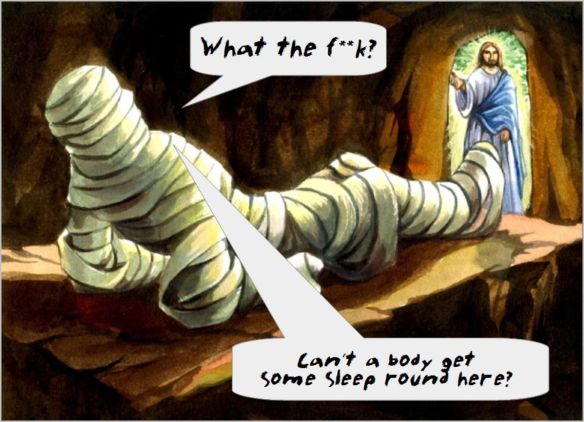
lazarus

And you do too.

We experienced what it was like last night and, you know, it really wasn’t too bad.

We entered, at some point, a deep, dreamless sleep (we dream for only a quarter of the time we’re asleep and even then often can’t remember what we’ve dreamt about) and the rest of the time we were, as far as subjective experience was concerned, dead to the world. During that deep sleep, our conscious mind was completely switched off; we did not experience anything while we were in this state and as far as awareness is concerned, we did not exist. And when we woke this morning we were none the worse for our period of non-existence. We booted up reasonably satisfactorily and the memories we had yesterday, before our deep sleep, were restored and the entity we call our self began to interact with the day.

This period of deep sleep, this unconscious oblivion, is precisely what it is like to be dead. Of course, in death we switch off permanently; there’s with no reboot afterwards, either in our beds, our graves or in heaven. The oblivion that is death is permanent. But, and this is my point, being dead is no more painful or unendurable, and no more to be feared, than the deep sleep you had last night and that you will enjoy tonight. We might not much like the idea that once we fall into the ultimate sleep there will be no waking up, but that is only a concern, if it’s a concern at all, of the living. I guarantee that it does not cross the minds of those who are already dead. They have no minds, the same as you didn’t last night, for it to cross.

Being dead, to paraphrase Mark Twain, does not trouble us at all. Its prospect, while we remain on this side of it, should encourage us to enjoy life and live it to the full. It shouldn’t cause us to worry about being dead, because there’s nothing we can do about it and, in any case, it’s no worse than being in deep sleep. Nor should we be concerned about whether we’ve subscribed to the right incantation, appeased the right God in the right way or lived a good enough life, in order to avoid death. There’s no avoiding death and the promises of religions that we can if only we believe the right magic, are utterly false. Understandable perhaps, but false.

Oh death, where is thy sting, says Paul in 1 Corinthians 15.55. Well, death still has its sting. It has it in its inevitability – every organic creature, of which we are one, must die – and it has it, depending on your perspective, in our individual obliteration. (Though, frankly, why anyone should think their own personal bundle of thoughts, impulses and prejudices merits everlasting existence is a mystery). Most significantly, however, it has it in the dying process, which for many of us can be debilitating and painful. This is the way of it for all of us, including those who believe religions’ false promises. They are not spared the suffering, even though modern medicine can help alleviate much of it. Christians, Muslims and Hindus, despite their belief that a deity smiles benevolently upon them, are not guaranteed a comfortable passage from this life to non-existence.

Death is the great leveller; we all experience dying in much the same way and we none of us experience anything after it. One of these – maybe both if we’re lucky – isn’t too bad. Just like deep sleep in fact.

Until then, we should make the most of life while we still have it.

Sleep well.


All is Vanity

DaleThe idea that human beings can live forever is a very old one, being part of a number of ancient religions. The Egyptians, for example, believed there was an afterlife and that where you spent it was determined by a post-mortem judgement. Christianity would later embrace similar notions of judgement and everlasting life.

The idea is, however, largely absent from Judaism. Ecclesiastes in the Christian Old Testament (‘Kohelet’ in Judaism) has this to say about death and its aftermath:

I said in my heart with regard to human beings that God is testing them to show that they are but animals. For the fate of humans and the fate of animals is the same; as one dies, so dies the other. They all have the same breath, and humans have no advantage over the animals; for all is vanity. All go to one place; all are from the dust, and all turn to dust again (Ecclesiastes 3.18-20).

This seems to me to be an entirely realistic, if somewhat pessimistic, view of life and death. (And humans as animals! Today’s believers still have trouble accepting this, even when their holy book spells it out for them.) Later writing – the book of Daniel, for example – begins to toy with the idea of eternal life, but it isn’t until we get to Jesus’ time that the idea really takes off.

As the writer of Ecclesiastes knew, and as I suggest here, there is no evidence we survive death. Death would hardly be death if we did. The dessicated bodies of those Egyptians, mummified so their ‘owners’ could reclaim and re-use them on the other side, are still with us. There’s no evidence either that a special part of us – a soul or spirit – makes the transition. In any case, this is a predominantly pagan idea and is not what the New Testament offers. Both Jesus and Paul are firm believers in bodily resurrection here on the Earth.

The desire to live beyond the brief few years that our physical bodies last is understandable. It’s hard to imagine that one day every single one of us will no longer exist, that our consciousness, personalities, thoughts, memories, emotions – everything that makes us who we are – will simply no longer be. That’s why, I suppose, people in the past rebelled against that inevitability and fantasised about a continued existence once this one came to an end. Eventually religions came to offer such compensatory life-after-death, provided of course suckers people believed the right things.

Such is Christianity.

When you think about it, what a truly absurd notion it is; that believing in a magic formula will defeat death and enable you to be resurrected on the Earth to live in God’s new Kingdom here, or (when that didn’t quite pan out) taken up to Heaven to live there. All you have to do is believe the right things and God will do this for you. Death will be defeated by the simple expedient of your belief. We’re so used to the idea after 2,000 years of Christianity that the absurdity ceases to register – but absurd it surely is.

to be continued