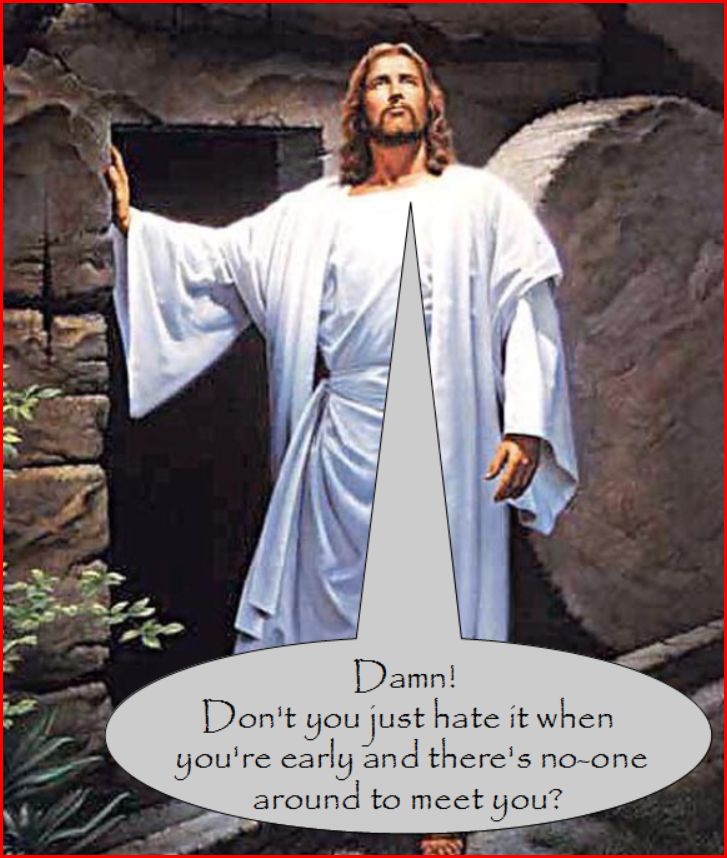
Eggs, Bunnies and Dead Bodies

88

Easter rolls round again. The spring festival, which in English is named after a pagan fertility Goddess (hence the eggs and bunnies), was usurped by the church in the second century as a celebration of a dead man rising.

Sometime in the first century, a few desperate men had visions of a Yeshua – his name meaning ‘to deliver’ – shortly after his death (if indeed he existed). The visions, which were entirely in their heads, were so vivid, it seemed to these men that Yeshua was alive again. They began looking for his (re)appearance in the sky when they thought he would establish God’s Kingdom on Earth. It was a preposterous idea, but in preparation for his appearance, the men encouraged others to adhere to Jewish law so that they would find a place in the New Age.

A short while after, a different fanatic had his own vision. Saoul, who transitioned into Paûlos, thought he heard Yeshua speaking to him. Yeshua told him the conditions that needed to be met in order to secure a place in the new order: all anyone had to do was believe and they would live forever. This was all entirely within Paûlos’ head of course but nevertheless enough people took notice of his preposterous idea and decided to worship Yeshua.

Later still, the Romans destroyed Jerusalem, which was the centre for those who’d come up with the original version of the preposterous idea. Almost all of them were eliminated. Not because of their preposterous idea but because the Romans were indiscriminate in slaughtering those they regarded as rebellious Jews. Their elimination cleared the way for Paûlos’ preposterous idea to flourish unopposed.

Around this time, a literate acolyte of Paûlos’ idea, who later became known as Mark, set about creating a back story for Yeshua. He based it on Paûlos’ teaching and on stories from Jewish scripture that he thought predicated Yeshua, though in fact they didn’t.

Two other cultists liked this idea but didn’t think Mark had done a very good job of it. They set about rewriting his story, adding even more preposterous elements. Finally, about 60 or 70 years after the whole thing had begun, a fourth chap, later called John, reimagined the Yeshua story. His version bore little relationship to Mark’s tale but this didn’t really matter as all the versions of Yeshua’s life story were made up. In any case, no-one would notice the discrepancies provided the four stories were never collected together.

And so Christianity was born, created from visions and false hopes, reinventions and fanciful fictions. The preposterous idea in its different forms appealed to people, now as then, because of its false promise of eternal life and as the means of avoiding an imagined God’s wrath.

This is the idea the church is celebrating, preposterously, this weekend.

As for me, my days of fertility are long gone, but I might, nevertheless, indulge in a little bit of chocolate egg.
Anglican minister almost gets it right Shock

blog352

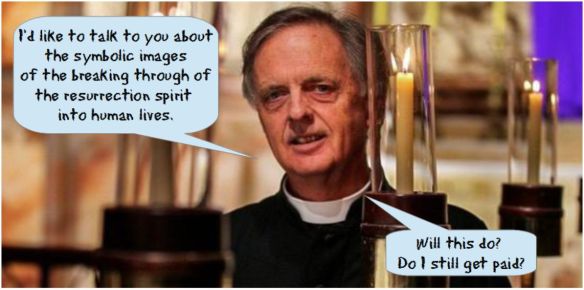
There was controversy last week over the appointment of Dr John Shepherd as the Archbishop of Canterbury’s new ambassador to the Vatican. The controversy wasn’t about the fact one branch of Made-up Beliefs was mingling its Sacred Truths™ with the Sacred Truths™ of another (which was upsetting enough for some of the faithful) but that Dr Shepherd has previously declared Jesus did not rise physically from the grave. In his 2008 Easter sermon, he said:

The resurrection of Jesus ought not to be seen in physical terms, but as a new spiritual reality. It is important for Christians to be set free from the idea that the resurrection was an extraordinary physical event which restored to life Jesus’ original earthly body.

Well, heaven forbid Christians should be compelled to accept reality! Needless to say, many of them didn’t like being made to do so. Undaunted, however, Shepherd went on to explain how the belief in Jesus’ resurrection came about:

…Jesus’ early followers felt His presence after His death as strongly as if it were a physical presence and incorporated this sense of a resurrection experience into their gospel accounts.

Yes, absolutely! This is precisely what happened. I’ve written about it here. This guy’s good. Until we get to his conclusion, anyway:

But (the gospels) are not historical records as we would expect history to be written today; they are symbolic images of the breaking through of the resurrection spirit into human lives.

He’s right about he nature of the gospels, of course. They’re not historical, nor are they eye-witness accounts or even second-hand reports of eye-witness accounts; they’re propaganda, written ‘so that you may believe’ as the fourth gospel  puts it.

But what’s this ‘symbolic images of the breaking through of the resurrection spirit into human lives’, Shepherd talks about? Having a good grasp of how the stories of Jesus’ ‘resurrection’ came about, he wants, for some reason, to continue promote the underlying fantasy – it’s his livelihood, after all – so he has to dress it up as something relevant to people today. He goes for ‘images of the breaking through of the resurrection spirit into human lives’, whatever that means. Breaking through from where? And what’s a ‘resurrection spirit’ when it’s at home?

Why bother though with the Jesus stuff at all? Plenty of people have life-changing experiences without having to hitch them to an ancient cult. My advice to Dr Shepherd would be to dump the ‘breaking through of the resurrection spirit’ hokum and he’ll be pretty much there. Then he can work on getting a real job.

Famous Christian makes fatuous comments

Sentamu3

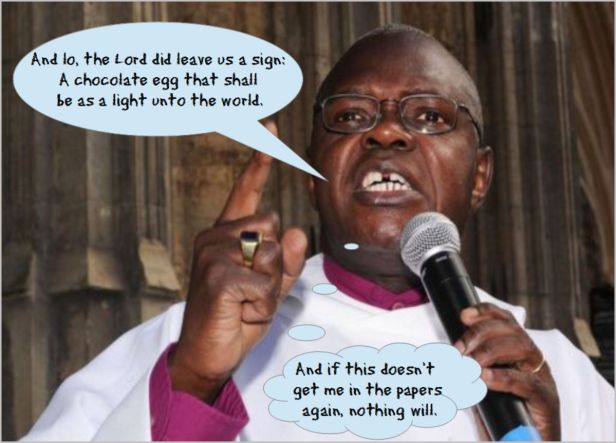
The Archbishop of York, John Sentamu, has spoken out on one of the most important issues of the day.

       Chemical warfare in Syria?

                                              Poverty?

                                                     The repercussions of Britain’s departure from the EU?

No, none of these. Chocolate Eggs. Or more precisely Chocolate Egg Hunts – those arranged by the National Trust in conjunction with chocolate manufacturers, Cadbury. This year, you see, these are not being promoted as Easter Egg Hunts but as Cadbury Egg Hunts.

And I’m sure you can appreciate just how significant this is. Because you see, without the name of a Germanic goddess of fertility (from which we also derive the word ‘oestrogen’) in the title of such a deeply spiritual activity, then, according to Sentamu, ‘faith is being airbrushed out of Easter.’ After all, chocolate eggs were such a crucial part of the original Christian Easter story, when the first thing the resurrected Jesus instructed his disciples to do was find all the Easter Eggs he’d hidden round the garden. And so it came to pass.

That’s why omitting the word ‘Easter’ from the Egg Hunt is, again according to silly old Sentamu, ‘tantamount to spitting on the grave’ of John Cadbury, who was there for that very first Easter but didn’t start making chocolate eggs until 1875.

But wait! Wasn’t John Cadbury a Quaker? And isn’t it the case that Quakers don’t celebrate ‘Easter’ because of its pagan associations? So Mr Cadbury is hardly likely to be upset, even if dead people could be, at his company’s alleged metaphorical grave spitting. Furthermore, might it just have been the case that those original Easter Eggs were – and remain – a cynical capitalist cash-in on a festival that the man himself didn’t actually believe in? Oh my, yes.

So, here’s all that spitting right back atcha, Senty – one in the eye for all your vacuous, self-promoting twaddle.


Next time: Why the side-lining of cute and cuddly Easter bunnies is an affront to the faith of many devout Christians, by Theresa May.


The Great Resurrection Miscalculation

How long was Jesus in the tomb before he ‘rose again’? Three days you say? Wrong! Read on and discover the secret of the Great Resurrection Miscalculation.

Resurrection

Jesus is wrong about no less an issue than his claim that he would rise from the dead after three days. In Mark 10.33-34 he prophesies:

the Son of Man will be handed over to the chief priests and the scribes, and they will condemn him to death; then they will hand him over to the Gentiles; they will mock him, and spit upon him, and flog him, and kill him; and after three days he will rise again.

On the surface, this seems pretty accurate for a prediction of events made some time before they actually happen (it wouldn’t be a prediction otherwise). Except, of course, this prophecy, like others of Jesus’, was written forty years or more after the event. Even then, Mark or whoever wrote the earliest gospel, can’t get it right. He tells us clearly in Mark 15.34 that Jesus dies at 3pm on Friday; Matthew and Luke agree. Jesus then reappears, fully recharged, ‘very early’ on the Sunday morning (Mark 16.2). But 3pm Friday to the ‘very early’ hours of Sunday is less than 48 hours – not three days, not even two.

What is the cause of this failed prophecy? For some reason, Mark assumes that ‘on the third day’, when he believed Jesus rose from the dead, means the same as ‘after three days’, the words he has Jesus prophesy. The third day after the crucifixion would indeed be the Sunday, but it wouldn’t be, and isn’t, three full days after it, as Mark’s Jesus seems to think.

The problem is not Mark’s alone, however. Matthew’s Jesus is even more emphatic that he will be buried for the three complete days:

For just as Jonah was for three days and three nights in the belly of the sea monster, so for three days and three nights the Son of Man will be in the heart of the earth. (Matthew 12.40)

Thanks to Jesus’ insistence in Mark and Matthew that he would spend three days in the tomb, the belief that he must have done so – contrary to the ‘evidence’ in those same accounts that it was less than two – appears to have become securely established by the time of the fourth gospel. Its writers, however, find their own unique way round the problem. Their thinking seems to have been along the lines that ‘if Jesus said he was going to be buried for three days and three nights, then he must have been. He was the Son of God after all, and he wouldn’t get a thing like this wrong. Therefore, if, as we know, he rose on the Sunday, he cannot have been crucified on the Friday. He must have died on the Thursday’. And so the writers of John’s gospel shift the crucifixion back a day, to around noon on Thursday (John 19.14). It’s an ingenious solution. Thursday to Sunday – near enough three whole days. There’s even some neat symbolism as a bonus: the earlier execution equates with the slaughter of the sacrificial lambs on the Thursday, ready for that evening’s Passover. Problem more than solved!

Except it creates a whole raft of new ones, not least the glaring inconsistency between the synoptic gospels’ accounts of the crucifixion on the Friday – after Jesus’ and the disciples’ celebration of Passover the previous evening – and John’s gospel’s account of the crucifixion during Thursday afternoon, well before the Passover meal would have been eaten. Significantly, no-one in the history of Christendom has ever been persuaded by John’s Thursday crucifixion, otherwise we’d remember it on ‘Good Thursday’ instead of ‘Good Friday’, and have a different day off work.

Does any of this matter? Probably not, but it does demonstrate that:

i) if Jesus’ words in the synoptic gospels are to be taken literally, then either he can’t count or he badly misjudges the timing of his resurrection. If scheduled for three days after the crucifixion it should have occurred on the Monday;

ii) the resurrection probably didn’t happen at all, and more than forty years later Mark and Matthew trip themselves up trying desperately to convince people that it did, and that Jesus knew it would;

iii) the gospel writers are prepared to rearrange already highly improbable events to make equally unlikely prophecies appear true;

iv) because the Bible cannot get its own faked, after-the-supposed-event prophecies right it can’t possibly be trusted about other claims it makes. 

Happy Easter, y’all.

Adapted from my book Why Christians Don’t Do What Jesus Tells Them To …And What They Believe Instead. Buy it on Amazon UK or Amazon US.

Why_Christians_Don't_Cover_for_Kindle