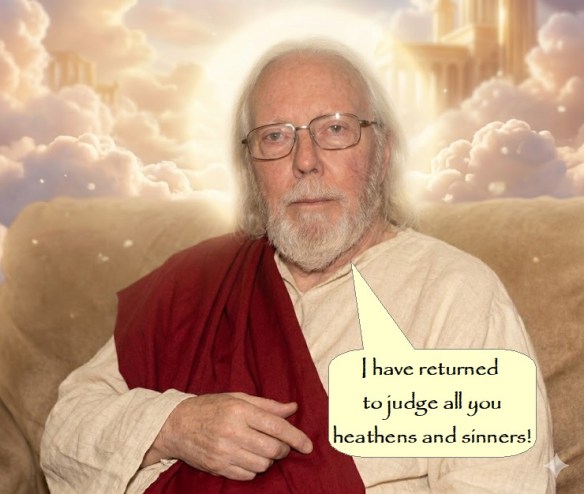
Two Ways of Knowing

A Christian friend told me recently that there are two ways of knowing: science and faith. I don’t agree with him of course and, while I expressed my scepticism, I didn’t argue. It seemed unlikely he would change his mind.

Faith and science have different, incompatible concepts of reality. The first – and faith was first historically – is that there is an invisible realm beyond this one, populated by powerful beings who influence and manipulate the humans who live here below. This reality, though invisible and largely undetectable, is actually more real than the one we see around us. Glimpses have been had of it, however, by those finely attuned to it, in dreams, visions and messages delivered during heightened emotional states. These visionaries – prophets – then pass on to others what the beings of the hidden realm expect of them. Life is then to be lived according to the instructions so conveyed, which usually consist of attempts to appease these gods by doing their bidding. In return for this obsequience, you’re allowed to believe you will live on after death

The other epistemology – actually the only true epistemology in this instance – is empirical, knowledge-based science. A later arrival, historically speaking, than the gods of the invisible realm. The scientific method is the best tool we have for sifting knowledge from superstition and emotion. These, particularly the latter, often impede us in our pursuit of knowledge, which is why science strives to eliminate them from its investigations, taking an objective approach to evidence. Unfortunately, the findings of science are occasionally contradictory (can a man become a woman or not?) and very often misinterpreted by non-scientists. Politicians and the media frequently over-simplify science’s findings and interpret them in ways that suit their own agendas.

Then there are those who masquerade as scientists but are not. During the pandemic, the UK was locked down for almost two years on the basis of computer predictions of what might happen if certain conditions prevailed. These predictions were taken as a scientific conclusion when in fact they were hypotheses, which by their very nature, could not be tested. Needless to say, they turned out to be drastically wrong. Computer projections are not, in themselves, science.

Science, through its practical offspring, medicine and technology, has undoubtedly been a boon to humankind, in a way religion never has. It has also sometimes been a curse too, inflicting us with, amongst other things, an arsenal of ever deadlier weapons, the means of destroying the environment and Covid itself. Science is a tool and like any tool can be wielded both constructively and destructively.

So, perhaps the gods will save us from our own folly after all. If only they and their invisible realm existed. Alas (or thankfully) they don’t; there is zero evidence for them, and visions, dreams and wishful thinking as reliable means of knowing about them. We’re on our own. Science is the best hope we’ve got, our only sure-fire way of knowing. If only politicians and the media understood it more than they seem to.

There May Be Trouble Ahead…

Prophets, from left to right: Elijah, Julie Stephens,
Cindy Jacobs and er... Ed Miliband

Prophets don’t exist. A bunch of people intoxicated by religious fervour who think God has given them a special message that they must deliver to whoever will listen, are not prophets; they are a collection of extremists intoxicated with religious fervour.

We know this because no God exists. He can’t, as a result, drop messages, special or otherwise, into the heads of fanatics.

That’s it, really. No more to be said.

But so-called prophets exert quite an influence on our modern world. According to Abraham (I know, he’s a mythical figure but bear with me), God selected an ancient Jewish tribe to be his favourite buddies, so long as they did whatever he demanded of them, including hacking off their foreskins and that of their sons. What sort of prophet – what sort of God – comes up with this kind of lunatic fetishism?

Later the creators of a new prophet, whom they called Moses, came up with a story in which their hero encountered God in a bush (the symbolism is lost on us today.) This time he wanted his special buddies to invade their neighbour’s territory, slaughter them and take their land for themselves. This his favourite, de-foreskinned tribe did (modern genetic analysis of the peoples in the region suggests this isn’t what happened.)

After these fictional madmen came some potentially real fanatics who thought God had assigned them to lambast their fellow Jews for their shortcomings. These prophets promised the rubes rewards if they behaved as the prophets thought they should. These guys also came up with the idea that God would send a warrior Messiah to help his special little tribe take over the world. This is what happens when fanatics are allowed to get a hold of things.

A couple of centuries later, another self-proclaimed prophet turned up (or is invented) who seemed to think he’s the most special-est of all the prophets so far. This guy, called Yeshua (meaning ‘salvation’, so obviously not in any way symbolic) prophesied that the Messiah would be arriving real soon to sort the world out. He’d then hand it over to the Jewish people to manage. This guy’s script writers weren’t sure if Yeshua was talking about himself or some other supernatural character called the Son of Man. It doesn’t matter really. Nothing he prophesied happened when he confidently predicted it would: there was no Messiah who flies down from heaven, no final judgment, no great reset for the Earth. He was an absolute failure as a prophet; evidence, if more is needed, that those who claim to speak for God don’t know what they’re talking about. Don’t worry, though, this guy was recast as a resurrected Godman, just like the ones in pagan myths.

A few other prophets appeared around about the same time. In fact, the extremist who changed his name to Paul seemed to think that just about anyone could become one so long as they ‘edified’ the brethren. It was a few years though before the next really big so-called prophet came along.

In the 8th century, a guy called Muhammad said he was told by an angel who represented a different version of God that, amongst other things, Islam would spread worldwide and there would be an increase in senseless murders. These rather nebulous and self-fulfilling predictions are even now coming to pass. Muhammad’s future followers are indeed spreading Islam across the globe while senseless murders continue being committed, a good many of them by Muslims themselves.

While Muslims have made it clear that Muhammad is the final prophet, history has blessed us since with a few more. Joseph Smith in the 1880s was commanded by a different God (or maybe by the same one who’s changed his mind again) to start a new church and to obliterate anyone who stood in his way. He was successful in this enterprise, despite managing to get himself killed in the process.

You’d think, wouldn’t you, that given their abysmal success rate and the number of people who have suffered or perished as a result of their endeavours that we’d have had enough of prophets. While churches cannot agree on whether ‘genuine’ prophecy still exists, the prophets keep coming. Fanatics the world over, every bit as barmy as their predecessors, appoint themselves some deity’s spokesperson, and the ‘prophetic’ pronouncements begin: meaningless theobabble spattered across the Internet.

Who Has Seen The Wind, Or Cause and Effect

The first time I encountered this poem was when Yoko Ono intoned it, as only she could, on the B-side of John Lennon’s Instant Karma!, back in 1970.

I noticed at the time (because I always read such things, while playing the B-sides of singles) that the poem’s composer was someone called ‘Rossetti’. Back then I knew nothing about him or her. Years later, I came across Dante Gabriel Rossetti, the Pre-Raphaelite artist but it turned he didn’t write the poem either. His sister Christina did.

Christina Rossetti was profoundly religious. She set about helping fallen women: ‘fallen’ according to the sexual mores of the day. A number of these young girls may well have been ‘led into sin’ in the first place by her hell-raiser brother, Dante. Her poem Who Has Seen The Wind, written in 1847, is an allegory of the work of the Holy Ghost: as the wind itself can never be seen, only detected by its effects, so too the Holy Ghost can be sensed only by its invisible workings in the real world. It’s an old argument, hinted at in Psalm 19:1, which says the heavens declare the handiwork of the Lord. Modern versions of the argument exist, based on the philosophical assertion that every effect must have a cause, including one that equates God with a murderer, 

It’s a terrible idea in all its forms. First, we know the wind, and murderers too, exist. The wind can be measured and the processes involved in creating winds of various strengths are well understood. Likewise murderers (as tempting as it is to equate God with a callous killer.) The inference that the cause of any given effect must be supernatural – a Ghost, a god, an angel – is mere primitive instinct. Even more unjustifiable is the leap that says this supernatural cause is The First Cause, which itself has no cause. A further leap into the absurd is the assumption that this uncaused First Cause is a God who was first imagined by middle-eastern tribesmen and later reshaped by early Christians and the church.

Which brings us to God: The Science, the Evidence, a new book by a Christian scientist, Olivier Bonnassies and industrialist Michel-Yves Bolloré, proposing that because we don’t fully understand how the universe came into being, it must have been God. Bonnasaries explains how they arrived at this conclusion:

It’s the fact that this (piece of paper) exists. And that because it exists, it needs a cause, and that (cause) needs another cause, and at the end, you need what we call a primary cause in order that everything exists. Because nothing can exist by itself.

Except, apparently, that cause designated, without evidence, the First Cause: God.

It is this, Bonnasaries and Bolloré claim as a scientific hypothesis. Bonnasaries must surely know as scientist that it is far from scientific. ‘God did it’ is a conclusion, arrived at without evidence; there is nothing observable, testable or measurable about it. It is philosophical conjecture at best, theology at worst. Christina Rossetti put it so much better, all those years ago (but still she got it wrong).


The Real Jesus

Dear Christian,

When you became a Christian, did you meet the man who wandered around Galilee 2,000 years and who, according to ancient stories, died on a Roman cross? Was it an actual human being you met at the moment you ‘saw the light’ (the clue’s in the term)? Or was it something – an emotional experience perhaps – that you interpreted as the presence of a heavenly, supernatural being? If you’re honest you’ll acknowledge you didn’t meet a real person but felt something that you took to be one.

When you pray to Jesus, exactly who are you praying to? Is it the man who drifted around Galilee 2,000 years ago? Are your thoughts magically transported back in time so he hears you, somehow or other, in his head? No? So do you pray to a supernatural, celestial Jesus who for the past 2,000 years has been sitting at the right hand of God in a mythical never, never land? I’m guessing you’ll say this is the Jesus you commune with (while disputing my calling heaven never, never land).

When you worship Jesus are your honeyed words whisked back 2,000 years to sustain a man who meandered around Galilee spouting profundities before getting himself killed? Or do you envisage your prayers reaching a supernatural figure living out there in space or maybe in another dimension? (C’mon, you know it’s the latter.)

When you say Jesus was present at the creation of the world as described at the start of Genesis, do you mean the man who, billions of years later, would roam around Galilee? Or do you mean a celestial  Jesus who was a part of the Godhead in some mysterious, inexplicable way? (I’m guessing, again, it’s this latter.)

When you say Jesus will judge the living and the dead at the End of the Age, do you refer to the man who lived 2,000 years ago, trudging around Galilee? Or do you mean some mystical manifestation of this character who’s eager to separate the sheep from the goats while hovering in the sky prior to massacring the goats? (It’s this version, isn’t it.)

In the Bible, did Paul meet the flesh-and-blood man who had slogged around Galilee a few years earlier? Or did he hallucinate a celestial being as a flash of light? (It was the latter, wasn’t it.)

When you speak of the Jesus who died on the cross to save you from your sins, do you quote the individual who supposedly drifted round Galilee 2,000 years ago? Or do you more often reference Paul, who never met him and knows nothing of his supposed earthly life? (You know which.)

Yet despite your belief in mystical, spiritual versions of Jesus, you are adamant he was not a mythical being. Not at the start of time, not at the end, nor in Paul’s writings; not in your own conversion, not in your prayers or worship and especially not in your own inner experience of him. No, he was, according to you, a very real person.

Yet there are no signs you believe in this historical Jesus, the man who allegedly roamed around Galilee two millennia ago. You ignore him and his teaching if favour of a celestial superman. How do we know you ignore him? All the examples above for a start, but there’s also the way you don’t do what he says. You don’t love your neighbour and enemies alike, you don’t sell all you have to give to the poor, you don’t give to everyone who asks, you don’t despise riches, you don’t refrain from judging others. You rarely turn the other cheek or go the extra mile and you are not prepared to forgive endlessly. You don’t accept that this man believed the End of Age was coming in his own time (or at least that his script-writers did) nor that he was disastrously wrong. It’s the cosmic super-being you go for every time.

How very strange. Cognitive dissonance is a powerful phenomenon, don’t you think?

Do You See What I See?

Christianity with its visions of God, angels and resurrected god-men, is not distinctive. It emerged from a culture in which such epiphanies were commonplace and highly esteemed. Appearances of deities, other supernatural beings and dead people were valued as genuine encounters with a reality on the other side of this mortal life. Paul was a Hellenised Jew and a Roman citizen (if Acts 17 can be believed); it was perfectly natural for him and his contemporaries to see and hear things that weren’t there.

Not only was the fledging Christ-cult influenced by the superstitious culture around it, but was born too of Judaism, itself awash with visions, apparitions and revelations. How could the new religion fail to be when its originators existed in such a milieu. One or other of these ‘visionaries’ believed they’d seen a resurrected Jesus. Of course they did. This is how gods manifested themselves then; everyone knew it. There were even those who hadn’t really had any inner-visions but wanted to be regarded as mystics themselves so would pretend they too had had direct contact with the deities.

The human mind has always been susceptible to illusions, to the potency of dreams and to misinterpreting what is going on around it. It’s also prone to a spot of fantasising now and then. This propensity didn’t cease once Christianity established itself. Muhammed claimed to have been visited by angels who revealed new truths about the nature of God – not least a change in name.

In the 19th century, a young farmer, Joseph Smith, living during a widespread and particularly intense religious revival, imagined (or pretended) he’d been visited by God and Jesus. Later, he said he’d been visited by a hitherto unknown angel with the unlikely name of Moroni. The result of course was multiple wives for Smith and the foundation of the Church of Jesus Christ of Latter Day Saints. Sufficient numbers of people believed Smith’s cockamamie stories about his alleged visions to commit to Mormonism. Smith wasn’t alone; others had visions of deities, including but not restricted to the Big Two, Jesus and his Father God. Hundreds recently saw the Virgin Mary hovering above New York City. They couldn’t all be wrong could they? Of course not, but they were all be deluded. Just like Joshua Mhlakela whom Jesus appeared to and told him the date of the Rapture was 22nd September, or possibly the 23rd, then with ‘billion percent’ certainty 7th October. Or maybe 8th…

This is how religions are made, changed and adopted: on a bed of illusory sand. If we need any further evidence that such experiences are illusory, created by the mind itself, then consider this: each time God, his angels or his Son appear in the religion-soaked brains of mystics and fraudsters, they reveal a message at odds with that revealed to previous visionaries. Each revelation has to be different of course. There would be no reason for such ‘visits’ otherwise.

Hence Abraham (or his script writer) imagining YHWH promising an eternal covenant and a new land.

Moses (or his script-writer) claiming YHWH had issued new laws while at the time commanding the slaughter of tribal enemies.

Cephas thinking he’d seen a risen Jesus who may or may not have told him of the imminent the End of the Age.

Jesus himself reportedly talking with his ‘Father’ about the necessity of his execution.

Paul flying to heaven so that Jesus could explain in great detail a new covenant, negating the original ‘eternal’ covenant with Abraham.

John of Patmos envisaging Jesus coming to Earth to slaughter the enemies he purportedly instructed his followers to love. (And Christians claim the Bible presents a unified message!)

All of these are manifestations of, and within, the minds of fantasists. Such manifestations are a naturally occurring malfunction of the brain.

And so it continues. Beware anyone who claims to have seen or heard from a deity of any sort. They, like their biblical counterparts, are deluded and almost certainly ill.

Mystic Revelations

What do the three ‘great’ Abrahamic religions have in common?

They all started with visions, hallucinations, dreams and mystic revelations. They’re not only based on these but owe their very existence to encounters with the supernatural that took place entirely within people’s heads. This of course is if they happened at all; many of these encounters with angels and God’s revelations take place in stories that have all the characteristics of myth or legend. Even so, they reveal much about the primitive state of mind (still around today) that believed God frequently revealed himself to, and in the minds of, chosen individuals.

First, the grand-daddy of the Abrahamic religions, Judaism: 

When Abram was 99 years old, YHWH appeared to him. He said to Abram, “I am El Shadday. Live in my presence with integrity. I will give you my promise, and I will give you very many descendants.” Immediately, Abram bowed with his face touching the ground, and again Elohim spoke to him, My promise is still with you. You will become the father of many nations. So your name will no longer be Abram [Exalted Father] but Abraham [Father of Many] because I have made you a father of many nations. I will give you many descendants. Many nations and kings will come from you. I will make my promise to you and your descendants for generations to come as an everlasting promise. I will be your Elohim and the God of your descendants. (Genesis 17)

Then Moses:

The Angel of YHWH appeared to (Moses) in a flame of fire from the midst of a bush. So he looked, and behold, the bush was burning with fire, but the bush was not consumed.

Then Moses said, “I will now turn aside and see this great sight, why the bush does not burn.”

So when YHWH saw that he turned aside to look, Elohim called to him from the midst of the bush and said, “Moses, Moses!” And he said, “Here I am.” (Exodus 3)

Notice how the inner voice goes from being that of ‘the angel of YHWH’ to YHWH himself (or one of his aliases). The entire scenario is preposterous of course, as is the Abraham episode before it. I’ve omitted the other occasions YHWH is said to appear to Abraham, including the infamous Genesis 22, where YHWH instructs Abraham to sacrifice his son. These stories are legends written, created from whole cloth, centuries after Abraham purportedly lived. He, like the later Moses, is almost certainly mythical, a character created to represent the beginnings of the Jewish faith. Even his names are symbolic. In truth, no one knows how Judaism began.

Onto Christianity:

The angel said to (Mary), “Don’t be afraid, Mary; God has shown you his grace. Listen! You will become pregnant and give birth to a son, and you will name him Jesus. He will be great and will be called the Son of the Most High. The Lord God will give him the throne of King David, his ancestor. He will rule over the people of Jacob forever, and his kingdom will never end.” (Luke 1)

Did this happen? If you believe angels exist then possibly, but we know they do not. We also know that this is myth. However, Luke wanted his readers to know that Jesus’ birth was miraculous so invented a story in which Mary encounters a heavenly being. The gospel writer anchors the divinity of Jesus to an implausible event which at best can only be a young woman’s vision (though it most certainly isn’t.)

The same is true of the resurrection appearances. Here’s Matthew 28:1-8:

Now after the Sabbath, as it began to dawn toward the first day of the week, Mary Magdalene and the other Mary came to look at the grave. And behold, a severe earthquake had occurred, for an angel of the Lord descended from heaven and came and rolled away the stone and sat upon it. And his appearance was like lightning, and his clothing as white as snow. The guards shook for fear of him and became like dead men. The angel said to the women, “Do not be afraid; for I know that you are looking for Jesus who has been crucified. He is not here, for He has risen, just as He said.”

More angels (they multiply in later gospels); again at best, though still highly improbable, the angel(s), if seen at all, can only be a vision or an hallucination (or mistaken identity.)

Onto the only first hand account of an encounter with the divine that the bible includes, Paul’s:

God was pleased to reveal His Son in me so that I might preach Him among the Gentiles… I want you to know, brothers and sisters, that the gospel I preached is not of human origin. I did not receive it from any man, nor was I taught it; rather, I received it by revelation from Jesus Christ. (Galatians 1)

I know a man in Christ who fourteen years ago—whether in the body I do not know, or out of the body I do not know, God knows—such a man was caught up to the third heaven. And I know how such a man—whether in the body or apart from the body I do not know, God knows— was caught up into Paradise and heard inexpressible words, which a man is not permitted to speak. (2 Corinthians)

This is all there is. This is the extent Paul talks about his heavenly encounters. In Galatians he admits that God revealing whatever it was he revealed was ‘in’ him, that is, in his own head. The bizarre tale he relates in 2 Corinthians reads like an hallucination (Paul says he doesn’t know whether it was in the body or out of it) which is all it could’ve been; there is no paradise or ‘third heaven’.

And finally, there’s Mohammed:

while I was sleeping last night, the keys of the treasures of the earth were brought to me till they were put in my hand.”… 

The angel came to him and asked him to read. The Prophet replied, “I do not know how to read. The Prophet added, “The angel caught me (forcefully) and pressed me so hard that I could not bear it any more. (Sahih Bukhari 6998)

Encounters with heavenly beings in dreams, ‘revelations’, visions, hallucinations and invented stories: these are central to Judaism, Christianity and Islam. The religions would not exist without them. Written as myth long after they supposedly occurred or referred to obliquely by those who claim to have experienced them, they are the products of fevered pre-scientific minds.

Post-script: I’ve searched in vain for Darwin’s admission that an angel revealed the process of evolution to him. I can only find his collection of evidence, his scientific observations and his careful analysis of his findings. Likewise Mendeleev who calculated the existence of elements that were at the time unknown. Likewise Crick, Watson and Franklin who discovered the structure of DNA. Strangely, none of these people relied on visions, dreams or divine revelations in uncovering truths about reality.

You don’t have to imagine: there is no Heaven

From an Anonymous commenter:

How do you know there is no Heaven or an afterlife? I have no proof Heaven or an afterlife exists either, but where is your proof that they don’t? I don’t think I will ever understand how atheists can be so certain of something that they can’t prove any more than I can understand fundamentalist Christians who say if you don’t accept Jesus Christ as savior you’re doomed to hell. You’ve got something in common. 

And my response:

Thanks for the comment, Anonymous. I’ve copied it here from the old post you added it to.

First, it isn’t up to those of us who question the existence of things like Heaven to ‘prove’ they don’t exist. It’s up to those who claim they do exist to demonstrate that this is the case. A negative proposition such as ‘there is no Heaven’ or ‘there’s no such thing as unicorns’, can’t be ‘proven’ as such, simply because its impossible to present evidence for a no-thing. A positive assertion, however, such as ‘there is a Heaven’, is theoretically demonstrable. But this particular claim never has been. No one has demonstrated where Heaven is (it has to exist somewhere, right?) No-one has ever returned from Heaven with empirical evidence of its existence. No-one has ever survived death to experience Heaven. No evangelical seems to understand that Heaven is exclusively God’s abode and no human will be resurrected into eternal life until the Final Judgement. That’s the Final Judgement Paul and Jesus said was just round the corner but which has never arrived.   

The problem is worse than this, however. There is so little evidence that a god exists, and even less the Christian God (see my previous post, as well as here and here). If there’s no God – and it is highly likely there isn’t – then all contingent beliefs are wiped out: there’s no Heaven, Saviour, Resurrection, Final Judgement, Hell or Eternal Life.

So this is how I know there is no Heaven: it all comes down to probability. The probability there is a Heaven is so infinitesimally small – its highly improbable in fact – that it’s safe to assume there isn’t one.

Despite first impressions suggesting this view has a lot in common with evangelical belief, I think you’ll find it is actually the opposite. While evangelicals accept on faith that Heaven must exist – because the Bible says so – the fact that its existence is both highly improbable and indemonstrable allows for the 99% certainty that it does not.

Finally, Anonymous, no-one other than mathematicians and lawyers deal in proof. Scientists most certainly don’t: they are concerned with evidence and demonstrating something is or is not the case. You’d do best to drop ‘proof’ from your arguments. Unless you can prove something mathematically, you’re not going to provide or find proof, certainly not when contending with religions. Second, how about giving yourself an online name? Commenting as ‘Anonymous’ suggests you don’t have the courage of your convictions and also adds you to the numerous other Anonymous commenters who pop up on blogs. There’s no way of distinguishing between you.  


Proving God

Google ‘Proving the existence of God’ and up come hundreds of videos like these:

My favourite has to be the one that says it only takes 30 seconds to prove God exists and then takes over 11 minutes to do it. The A.I. summary of the online articles and blogs about the subject is, for once, right when it says God’s existence can’t be demonstrated. But that doesn’t stop those who think they can ‘prove’ it from giving it a go. Many of them take a smug swipe at atheists for not seeing the supposed scientific, philosophical and theological ‘evidence’ when it’s right in front of them. Others point out that even if they can’t demonstrate God’s existence conclusively, neither can atheists disprove it. They’re correct, but it’s incumbent on those making the claim to demonstrate it, not those who find it unconvincing to disprove it. 

Let’s imagine the scenario where this isn’t the case though. A scenario where those proposing the existence of God finally manage to present empirical, indisputable evidence that he’s really out there in the vast expanse of the lifeless universe or in a dimension hitherto imperceptible to humans. What then?

They’d have proved God in generic, ill-defined terms. They would not have demonstrated that this Being is creator of the universe, or that he(?) is remotely interested in humankind or that he listens to us or guides us or in any way involves himself in our affairs. They certainly won’t have demonstrated that he is the only God, who befriended one tribe on the Earth, 4.6 billion years after its creation and 23.4 billion years after the universe’s beginning, prompting them to create legends about him. They will not have provided any evidence that he is the one who sent Jesus to the Earth, nor that he is in some incomprehensible way Jesus himself.

Theists haven’t demonstrated a basic God, let alone one with all the characteristics they want him to have. That those who devised stories a mere 2.5 to 2 thousand years ago, claiming their God had all these characteristics, is not evidence he did nor that he even existed. Osiris, Zeus and Allah are all as likely to be accurate reflections of this nebulous God as YHWH or Jesus. And if we’re honest, we know they’re not. None of them are.

At least atheists have probability on their side.

The Day After The Rapture

Are you still there?

Either the rapture didn’t happen or there aren’t many True Christians round where I live. I watched all day for them jetting into the sky to meet Jesus but didn’t see a single one.

What went wrong? That South African preacher Joshua Mhlakela who saw Jesus surely can’t have been mistaken. Jesus told him clearly that yesterday, or maybe today, would be when he’d be back to collect his Chosen and judge the great multitude of sinners. I even turned on the TV last night to see if it had happened elsewhere. I thought the Final Judgement was underway with some dude ticking off the UN. Turned out just to be some big orange guy, not Jesus in disguise.

So what now? I think I can guess. Jesus’ message to Joshua Mhlakela will be reinterpreted: it wasn’t that the Rapture was going to happen yesterday, or today. It’s the events leading up to the rapture that he promised would kick off this week. That’ll be it. The Rapture itself is still some time off, as it always is.

Mhlakela’s vision of Jesus was no different from the ones the earliest Christian believers had: those character with fake names like Peter and Paul. Dismiss the good pastor’s vision of the Lord and what JC purportedly said and you have to dismiss the visions of those early fanatics who operated under aliases. Visions, dreams and hallucinations have no bearing on reality, as Mhlakela and the thousands who believed him have demonstrated yet again. Christianity and many other faiths are founded on such imaginings. As Luke puts it in Acts 2:17 during ‘the Last Days’ of 2,000 years ago:

And it shall come to pass in the last days, says God, that I will pour out of My Spirit on all flesh; your sons and your daughters shall prophesy, your young men shall see visions, your old men shall dream dreams (misquoting Joel 2: 28-29)

This is the basis of the Christian delusion, and every other.

I Wish We’d All Been Ready

Holy cow!

This is a special, urgent post!!! I just learnt to today, courtesy of Joe.My.God that tomorrow is the date set for the Rapture. In case you didn’t know, I need to warn you to give you time to repent and turn to Jesus. We know the rapture’s going to happen this time for sure because a pastor in South Africa was visited by Jesus a couple of nights ago who told him he was definitely returning tomorrow, 23rd September, at the time of the Jewish Feast of Trumpets (me neither). Charlie Kirk’s martyrdom has something to do with it too:

I’m sure these three signs together can’t be wrong, which means the Rapture is going to happen tomorrow as an absolute certainty.

Here’s how the UK’s always reliable Daily Mail reports it:

An ancient Biblical event in which Christians disappear from Earth and those who remain are left to face Doomsday is believed to be just days away.

Claims by social media users, as well as respected pastors and rabbis, have pushed the idea that the Rapture will begin on September 23, marking the Second Coming of Jesus and Judgment Day for non-believers.

This year, September 23 falls during the Jewish Feast of Trumpets, also known as Rosh Hashanah, but some Christians have tied the holiday to the prophecy that Jesus will return to Earth ‘with the voice of the archangel and with the trumpet call of God.’

The prophecy is mentioned in the Bible, 1 Thessalonians 4:16, which states that even the faithful who have died will rise from their graves and be taken to heaven by Jesus; however, a date for this event is not given.

In a YouTubevideo viewed nearly 500,000 times, Pastor Joshua Mhlakela, a South African preacher, claimed Jesus appeared to him in a divine vision and said he would return during the Feast of Trumpets.

‘The rapture is upon us, whether you are ready or not. I saw Jesus sitting on his throne, and I could hear him very loud and clear saying, I am coming soon,’Mhlakela said during the interview with CettwinzTV.

‘He said to me on the 23rd and 24th of September 2025, I will come back to the Earth,’ the pastor declared.

Even more clips predicting the imminent return of Jesus this month have been viewed hundreds of thousands of times in the last week alone.

If you can’t find it in yourselves to welcome Jesus into your hearts as Lord and Saviour then you’ll have to gird your loins for what happens next. Something dire I feel sure. Judgement and a millennium of despair or some such. It might not be too bad though, once the Righteous Ones are out of the picture.

Whichever, I’ll see those of you who are still around come Wednesday when we can discuss what we’re gonna do!!! This blog isn’t going to be of much use any more, that’s for sure. Those of you who’ve decided to head heaven-bound meanwhile, enjoy the trip and don’t forget to write.