What Is Truth?

I’m sceptical (or skeptical if you’re in the US). It’s a legacy of my years of believing the promises of Christianity. Preachers, pastors, Bible study leaders told me for 25 years that the promises of the bible, of Jesus himself, were all true. And like a fool I believed them. Jesus had made a new creature out of me; he loved me; he was guiding my life; he was returning soon; I’d be resurrected; I’d live in heaven forever… and on and on.

What a preposterous set of propositions! It took my Great Realisation, my own personal revelation that there was no God, to make me see how ridiculous they were.

It is this that left me with a legacy of scepticism. If I’d been misled all this time by people I respected and admired, what else was I accepting as true that very well might not be? I wasn’t going to be fooled again and so began to question practically everything I was told by authorities, experts and the media. If it seemed ‘off’, as we say these days, not quite right or too good (or bad) to be true I asked, ‘Who says so?’, ‘How do they know this?’, ‘What is the evidence?’, ‘Do they jump to conclusions or is their reasoning sound?’, ‘Why should I believe what they say?’ It’s exhausting, I assure you, having to search out the evidence – the primary sources of information – and to sift through it, recognising any bias that has been imposed on it. It’s either this or I must accept without question that everything I’m told is true. I can’t do that any more.

Here are a few examples of claims that I’ve been sceptical of on the recent past:

We are being guided by the science, said politicians during Covid to ensure compliance with whatever lockdown measures were being imposed. Did this really just mean was ‘we are being guided by our interpretation of some rather suspect data’? It became clear after we emerged from the hysteria surrounding the pandemic that this was the case.

Tens of thousands will die of Covid unless you comply: this based on computer predictions which turned out to be very far from accurate: the suspect data that ‘guided’ politicians.

A woman can have a penis. A man can have cervix. Yes, our politicians told us this during our recent fixation with transgenderism. Whatever you think of people changing sex, these two statements, designed to change hearts and minds, if not penises and cervixes, are patently false. Whatever was guiding those who said such things, it certainly wasn’t ‘the science’.

No more irresponsible, undeliverable promises. So said the Prime Minister exactly a year ago. I’m not going to be sceptical or cynical about this. I feel sure it’ll turn out to be true. Is he implying though that promises made earlier than this were indeed ‘irresponsible and undeliverable’. Surely not.

We will not raise taxes on working people (and energy prices will fall by £300 in the long term), Labour politicians, now the government, said only last year in an attempt to gain our votes. I was sceptical about this, as with much they said, and for the first time in many years Labour did not get my vote. Taxes have increased considerably for working people and everyone else in the last year and are set to rise again this week. The price of energy has risen too, by 18%, and will do so again in January. A £300 reduction by 2030, if it happens at all, is not really going to offset this by much. This was all very predictable; since when do politicians tell us the truth in order to get us to vote for them?

Anything Donald Trump says. Insert your selection here.

The NHS is the envy of the world. Pundits and politicians are very fond of this one. They like to add too that the NHS is underfunded. But the NHS is expensive, management heavy and wasteful. Is it really the envy of the world, and if it is, so what, when it’s constantly in crisis at home?

The BBC is the envy of the world. It is impartial and balanced. Is it? A number of independent reviews have determined that it has its own agendas and biases. During lockdowns it fuelled hysteria and now contributes to climate change panic. Rather than reporting facts, it tells us too often what we’re meant to think about issues. It has also been rocked over the past dozen years by sleaze and scandals.

Islam is a religion of peace. So many questions about this one. Many Western politicians have claimed something like it. President George W. Bush did, shortly after 9/11. Perhaps ordinary Muslims are committed to peace but there are many Islamists (the term now used for Muslim extremists) are evidently not: as well as 9/11 there have been acts of Islamist terrorism in London (7th July 2005), at Charlie Hebdo in Paris, in Manchester, the slaughter in the street of an off duty soldier, the massacre of Israeli young people in October 2023, the killing of Christians and others in Nigeria.. Is ‘Allahu Akbar’ really a cry of peace?

We can halt or reverse the climate changes we ourselves have caused. Can we? Who says? (Greta Thunberg, yes, but no actual scientists that I can find.) We can perhaps mitigate and slow down the change, and we should. But the climate will continue to change. Are these changes solely the fault of us humans – we’re contributing to the pace of change, certainly – when the climate has been in constant change from time immemorial?

I was accused of trying to be a maverick in a recent comment on an old post. Honestly, I’m not. It’s more a case of ‘once bitten, twice shy’; I’m not going to be told ever again what to think, especially not by those who don’t present good reasons why I should (I’ve Jesus to thank for this). Everything needs to be questioned, otherwise our minds are not our own. Be sceptical.

Mystic Revelations

What do the three ‘great’ Abrahamic religions have in common?

They all started with visions, hallucinations, dreams and mystic revelations. They’re not only based on these but owe their very existence to encounters with the supernatural that took place entirely within people’s heads. This of course is if they happened at all; many of these encounters with angels and God’s revelations take place in stories that have all the characteristics of myth or legend. Even so, they reveal much about the primitive state of mind (still around today) that believed God frequently revealed himself to, and in the minds of, chosen individuals.

First, the grand-daddy of the Abrahamic religions, Judaism: 

When Abram was 99 years old, YHWH appeared to him. He said to Abram, “I am El Shadday. Live in my presence with integrity. I will give you my promise, and I will give you very many descendants.” Immediately, Abram bowed with his face touching the ground, and again Elohim spoke to him, My promise is still with you. You will become the father of many nations. So your name will no longer be Abram [Exalted Father] but Abraham [Father of Many] because I have made you a father of many nations. I will give you many descendants. Many nations and kings will come from you. I will make my promise to you and your descendants for generations to come as an everlasting promise. I will be your Elohim and the God of your descendants. (Genesis 17)

Then Moses:

The Angel of YHWH appeared to (Moses) in a flame of fire from the midst of a bush. So he looked, and behold, the bush was burning with fire, but the bush was not consumed.

Then Moses said, “I will now turn aside and see this great sight, why the bush does not burn.”

So when YHWH saw that he turned aside to look, Elohim called to him from the midst of the bush and said, “Moses, Moses!” And he said, “Here I am.” (Exodus 3)

Notice how the inner voice goes from being that of ‘the angel of YHWH’ to YHWH himself (or one of his aliases). The entire scenario is preposterous of course, as is the Abraham episode before it. I’ve omitted the other occasions YHWH is said to appear to Abraham, including the infamous Genesis 22, where YHWH instructs Abraham to sacrifice his son. These stories are legends written, created from whole cloth, centuries after Abraham purportedly lived. He, like the later Moses, is almost certainly mythical, a character created to represent the beginnings of the Jewish faith. Even his names are symbolic. In truth, no one knows how Judaism began.

Onto Christianity:

The angel said to (Mary), “Don’t be afraid, Mary; God has shown you his grace. Listen! You will become pregnant and give birth to a son, and you will name him Jesus. He will be great and will be called the Son of the Most High. The Lord God will give him the throne of King David, his ancestor. He will rule over the people of Jacob forever, and his kingdom will never end.” (Luke 1)

Did this happen? If you believe angels exist then possibly, but we know they do not. We also know that this is myth. However, Luke wanted his readers to know that Jesus’ birth was miraculous so invented a story in which Mary encounters a heavenly being. The gospel writer anchors the divinity of Jesus to an implausible event which at best can only be a young woman’s vision (though it most certainly isn’t.)

The same is true of the resurrection appearances. Here’s Matthew 28:1-8:

Now after the Sabbath, as it began to dawn toward the first day of the week, Mary Magdalene and the other Mary came to look at the grave. And behold, a severe earthquake had occurred, for an angel of the Lord descended from heaven and came and rolled away the stone and sat upon it. And his appearance was like lightning, and his clothing as white as snow. The guards shook for fear of him and became like dead men. The angel said to the women, “Do not be afraid; for I know that you are looking for Jesus who has been crucified. He is not here, for He has risen, just as He said.”

More angels (they multiply in later gospels); again at best, though still highly improbable, the angel(s), if seen at all, can only be a vision or an hallucination (or mistaken identity.)

Onto the only first hand account of an encounter with the divine that the bible includes, Paul’s:

God was pleased to reveal His Son in me so that I might preach Him among the Gentiles… I want you to know, brothers and sisters, that the gospel I preached is not of human origin. I did not receive it from any man, nor was I taught it; rather, I received it by revelation from Jesus Christ. (Galatians 1)

I know a man in Christ who fourteen years ago—whether in the body I do not know, or out of the body I do not know, God knows—such a man was caught up to the third heaven. And I know how such a man—whether in the body or apart from the body I do not know, God knows— was caught up into Paradise and heard inexpressible words, which a man is not permitted to speak. (2 Corinthians)

This is all there is. This is the extent Paul talks about his heavenly encounters. In Galatians he admits that God revealing whatever it was he revealed was ‘in’ him, that is, in his own head. The bizarre tale he relates in 2 Corinthians reads like an hallucination (Paul says he doesn’t know whether it was in the body or out of it) which is all it could’ve been; there is no paradise or ‘third heaven’.

And finally, there’s Mohammed:

while I was sleeping last night, the keys of the treasures of the earth were brought to me till they were put in my hand.”… 

The angel came to him and asked him to read. The Prophet replied, “I do not know how to read. The Prophet added, “The angel caught me (forcefully) and pressed me so hard that I could not bear it any more. (Sahih Bukhari 6998)

Encounters with heavenly beings in dreams, ‘revelations’, visions, hallucinations and invented stories: these are central to Judaism, Christianity and Islam. The religions would not exist without them. Written as myth long after they supposedly occurred or referred to obliquely by those who claim to have experienced them, they are the products of fevered pre-scientific minds.

Post-script: I’ve searched in vain for Darwin’s admission that an angel revealed the process of evolution to him. I can only find his collection of evidence, his scientific observations and his careful analysis of his findings. Likewise Mendeleev who calculated the existence of elements that were at the time unknown. Likewise Crick, Watson and Franklin who discovered the structure of DNA. Strangely, none of these people relied on visions, dreams or divine revelations in uncovering truths about reality.


You don’t have to imagine: there is no Heaven

From an Anonymous commenter:

How do you know there is no Heaven or an afterlife? I have no proof Heaven or an afterlife exists either, but where is your proof that they don’t? I don’t think I will ever understand how atheists can be so certain of something that they can’t prove any more than I can understand fundamentalist Christians who say if you don’t accept Jesus Christ as savior you’re doomed to hell. You’ve got something in common. 

And my response:

Thanks for the comment, Anonymous. I’ve copied it here from the old post you added it to.

First, it isn’t up to those of us who question the existence of things like Heaven to ‘prove’ they don’t exist. It’s up to those who claim they do exist to demonstrate that this is the case. A negative proposition such as ‘there is no Heaven’ or ‘there’s no such thing as unicorns’, can’t be ‘proven’ as such, simply because its impossible to present evidence for a no-thing. A positive assertion, however, such as ‘there is a Heaven’, is theoretically demonstrable. But this particular claim never has been. No one has demonstrated where Heaven is (it has to exist somewhere, right?) No-one has ever returned from Heaven with empirical evidence of its existence. No-one has ever survived death to experience Heaven. No evangelical seems to understand that Heaven is exclusively God’s abode and no human will be resurrected into eternal life until the Final Judgement. That’s the Final Judgement Paul and Jesus said was just round the corner but which has never arrived.   

The problem is worse than this, however. There is so little evidence that a god exists, and even less the Christian God (see my previous post, as well as here and here). If there’s no God – and it is highly likely there isn’t – then all contingent beliefs are wiped out: there’s no Heaven, Saviour, Resurrection, Final Judgement, Hell or Eternal Life.

So this is how I know there is no Heaven: it all comes down to probability. The probability there is a Heaven is so infinitesimally small – its highly improbable in fact – that it’s to safe to assume there isn’t one.

Despite first impressions suggesting this view has a lot in common with evangelical belief, I think you’ll find it is actually the opposite. While evangelicals accept on faith that Heaven must exist – because the Bible says so – the fact that its existence is both highly improbable and indemonstrable allows for the 99% certainty that it does not.

Finally, Anonymous, no-one other than mathematicians and lawyers deal in proof. Scientists most certainly don’t: they are concerned with evidence and demonstrating something is or is not the case. You’d do best to drop ‘proof’ from your arguments. Unless you can prove something mathematically, you’re not going to provide or find proof, certainly not when contending with religions. Second, how about giving yourself an online name? Commenting as ‘Anonymous’ suggests you don’t have the courage of your convictions and also adds you to the numerous other Anonymous commenters who pop up on blogs. There’s no way of distinguishing between you.  


In which Howard visits Heaven and talks to Jesus

I recently finished reading My Descent Into Death and the Message of Love Which brought Me Back by Howard Storm, in which he recounts events surrounding his serious illness in the 1980s. This, he is convinced, caused his death after which some very dark beings, who at first he mistook for deranged medical staff, attempted to drag him off to a very sinister place. Fortuitously, Jesus and his angels were on hand to intervene and rescued hell-bound Howard.

Perhaps in my Evangelical days I would’ve lapped up stuff like this, but not now. A Christian friend – the same one who lent me the book I wrote about here – bought me. I promised I’d read it but what a struggle it was.

Once rescued by Jesus, Howard felt divested of his ego and overcome by love. He underwent a life review and was ever so gently ticked off for all the times he was less than kind. Instead of enjoying this state of bliss, however, Howard took the opportunity to bombard Jesus and the angels with banal questions, which given Howard’s comatose state they had time to answer at great length over many hours (which is how long it takes to read about them.)

When he came round and discovered he wasn’t actually as dead as he thought he was, Howard was a changed man. Once back on his feet, he joined a succession of churches so he could share his experience. When they didn’t fully appreciate how he’d really spent time with actual Jesus, he trained for the ministry himself. He has been a pastor now for several decades, regaling people with the tale of his encounter with fantasy heavenly beings.

Undoubtedly, Storm’s experience was powerfully real to him, so much so it changed his life on his return to reality. As I read My Descent Into Death, however, I couldn’t help but feel I’d heard it all before: in Paul’s account of his imaginary visits to heaven and his encounters with a resurrected Jesus. These were probably not Near Death Experiences (NDEs) – though who’s to say – but, like Storm’s, brain-induced hallucinations.

As scientist Britt Hartley explains in the video sent by koseighty a while back, we now have a much greater understanding of NDEs; they are culturally determined hallucinations induced by the brain as it begins its shutdown. Hartley is clear that under stress the brain is more than capable of creating reassuring visions for itself.

But like Howard Storm’s, Paul’s ‘revelations’ are more than a mere sighting of Jesus. Paul too has a long discourse with the heavenly being conjured up by and in his own brain. He imagines Jesus explains to him how salvation works (in a mighty complicated way) in the same way Howard does. I’m sure this discourse, like Howard’s, did not take place during the visions but were worked out later, over time, as Paul, and Howard, interpreted what the inner-visions ‘must’ have meant.

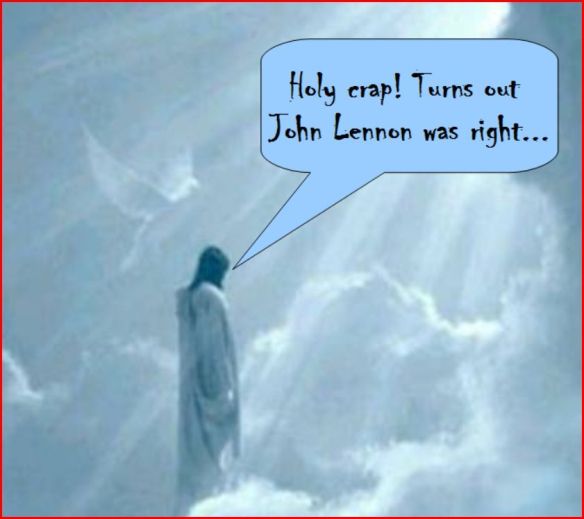
Oddly though, given they both encountered the same character, it’s difficult to reconcile the messages each was given by him. Storm’s is of a mushy universal love, devoid of the demands and convoluted theology of Paul’s Jesus. Strange that the Jesus Christ who is, according to Hebrews 13:8, the same yesterday, today and forever, has modified and softened his message in the two thousand years between Paul’s and Howard’s revelations. It couldn’t be because Howard’s is the result of his conditioning by a modern American culture that sees Jesus as a shiny, white-robed figure surrounded by angels who dispenses nothing but all-embracing love and happy-clappiness, could it? It surely could.


Pest Control

I used to pride myself on how patient I could be. I’m finding recently however that I’m becoming far less so. Not with everyone, I hasten to add, but with religionists, Evangelical Christians in particular.

As I mentioned last time, they have infested my Facebook feed with their inane Jesus-Loves-You Amen BS and now I find they’ve practically taken over a science page I occasionally read called From Quarks and Quasars, a sometimes sensationalist site that collects together science posts from other legitimate sources. It recently published an item called ‘Earth Was Once Entirely A Water World, New Research Shows’, prompting 5.2k comments. Many of these were from cranks trying to show how the finding verifies the biblical flood story, despite the fact the article makes it clear it is talking about something that occurred 3-4 billion years ago. Certified genius Dennis Mears offers this comment (all grammatical, spelling and punctuation errors in the original):

Of coarse it was !! but we don’t need “ new research “ to know what every culture on earth has talked about in their history for thousands of years . We can simply read genesis and learn about it in detail

while Scotty Johnson wades in (pun intended) with:

It’s called the flood, it’s recorded in Genesis in the Bible, Noah and the Ark, kids have been learning about it in Sunday School for years. Scientists should study the Bible first, maybe they wouldn’t be surprised when they discover something.

It’s down to astute reader Gene Steiner, catching the original article’s reference to 3-4 billion years, to correct it:

(In) Genesis 7:24 the great flood covered the whole earth, even the highest mountains; and the waters remained on the earth for 150 days…. Not billions of years ago, but 4500 or so years ago during the NOAHIC GLOBAL FLOOD! We knew that all the time!

This is the line subsequent commenters take up until we get to Tobie Schalkwyk, who offers the insight that the water-covered Earth is the same as mentioned in Genesis 1:

1 In the beginning God created the heavens and the earth. 2 Now the earth was formless and empty, darkness was over the surface of the deep, and the Spirit of God was hovering over the waters.

And on it goes for thousands more comments. The photo at the top of this post was also shoved on somewhere along the line.

It is the purveyors of this sort of crap that I no longer have any patience for. I want to call them out for their tomfoolery. It’s the same with commenters (Arnold and Don on this blog, Marley1312/Aussiestockman on Gary’s, Revival Fires on Bruce’s) who think atheist sites exist only to provide a forum for their brainless theobabble and Bible-bashing. They can’t be argued with, such is the depth of their ignorance and need to inject Jesus into everything. They bring out the worst in me: snark, bad language and name calling (as you can tell from this very post). I don’t want to stoop to this level, nor is it good for my blood pressure, and so feel compelled to leave them to it. I avoid reading comments and sometimes actually abandon sites I like to read because of the infestations of religious gobbledegook.

I know it infuriates some of you too, but what to do? Let the epidemic spread or resist it? What do you advise?

A New Kind Of Christian


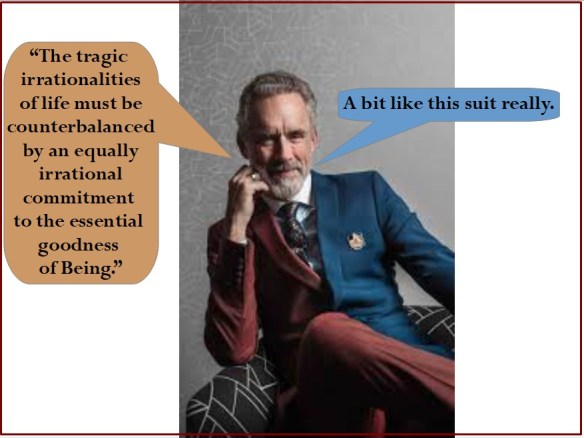
You’ll be overjoyed to hear that Jordan B. Peterson has a new book out. He’s been busy promoting the not at all pretentiously titled We Who Wrestle With God. He was interviewed about it recently in British magazine The Spectator. The interview has to be read to be believed. The introduction can be read here but the rest, alas, is behind a paywall. Don’t worry though, I’ll supply you with the highlights. The article is a goldmine of stupefying statements about God and how Jordan is the only one who really understands the Bible’s stories. They need ‘arranging’, you see, and their underlying ‘hypotheses’ understood:

The Bible presents a series of hypotheses. One is that there’s an underlying unity that brings together all structures of value. The second claim is that there’s a relationship between the human psyche and that unity and each of the main biblical stories casts that unity in a different light, accompanied by the insistence that, despite those differences, what is being pointed to is one animating principle. As far as I can tell, that’s correct.

You got that? As ol’ Jordan humbly admits, this ‘revolutionary realisation’ is his and his alone. Of course, none of this sort of thing is original; the idea that characters, events and stories in the Old Testament prefigure realities in the New is as old as the hills. Typology can be imposed on any set of myths. The gospel writers and Paul did it, seeing Jesus prefigured in Jewish scripture and inventing stories about him so that he complied with these earlier types. There’s nothing ‘revolutionary’ about spotting this, but like so many before him, Peterson gets it back to front and falls, quite literally, for the oldest trick in the Book. Continue reading

Back by unpopular demand – it’s the New Year Pop Quiz!

All set? Here we go!

1. Which one of these fantasy figures actually exists?

2. For which one of these ideas is there refutable/verifiable, corroborative scientific evidence?

3. Which one of these events is demonstrably historical?

4. Which one of these phenomena is verified and corroborated by psychology?

5. Applying logic and reasoning, which of the following scenarios is most likely to be true:

6. Which of these statements is verifiably true?

Answers:

Question 1. The answer is none of them, though C, Donald Trump, comes closest. 10 points if you put C, none if you plumped for any of the others: despite the volumes written about them there isn’t an iota of  evidence that they exist.

Question 2. Award yourself 10 points for B, though if you’re a True Believer this is the only one you think isn’t true. There is an abundance of refutable/verifiable, corroborative scientific evidence that it is. You can only wish there were for the other three.

Question 3. A is correct – 10 points. There is a considerable amount of evidence that the moon landing occurred on 20th July 1969. There is absolutely none at all that the other three are historical. For the sake of argument, let’s say they’re mythical. Nul points if you think otherwise.

Question 4. The answer is all of them. Oh no, wait… that’s my cognitive dissonance speaking. D is the only one of those listed recognised by psychologists. My bad and 10 points to you.

Question 5. The answer is of course E. Award yourself another 10 points if you thought outside the box on this one. (You can also have 10 points if you said they’re all equally likely, as in ‘not at all’.)

Question 6. 10 points for D

Scores: 

If you scored 50 or more, congratulations! If you scored nothing at all, you are confirmation that question 6’s answer – D. Human beings are capable of believing just about anything – is true. Well done.

A happy new year to you all.


A World When Revelation Was Possible

Greek and Roman cultures of the ancient world were obsessed with seers, oracles, prophets, muses and the fates. Politicians, priests and ordinary people were desperate to know how to keep on the right side of capricious gods and what the future held. Word from the supernatural realm, channelled through seers and prophets, was sought after and valued. Visions, dreams, portents and auspices that revealed secrets and mysteries were highly prized. It was a world saturated in superstition. Jewish culture, operating within this milieu, was no different.

Jews too revered prophets, dreams, visions and divination. This is apparent in both the Jewish scripture, the Old Testament, and also in the New, the writing of the early Christian cult birthed from Judaism in a Greco-Roman world. There are in the New Testament:

6 instances of god-induced dreams;

11 visions of heaven and heavenly beings;

578 new prophecies;

300 or so supposed fulfilments of earlier ‘prophecies’;

An abundance of revelations’ (Paul’s phrase) as well as those of Revelation itself (one long revelation or a series of shorter ones?);

113 visits from supernatural agents (Satan, demons, angels);

Assumptions that dead people can reappear (Jesus mistaken for Elijah and Jeremiah; Elijah and Moses manifesting themselves);

Multiple ‘resurrections’ both before and after Jesus’s.

People believed this kind of stuff! The supernatural, prophecy, ‘revelation’ and resurrection were regarded as entirely plausible, a given in the culture in which early Christians lived. The pagans around them may not have subscribed to the new cult’s reworking of these superstitions, nor accepted that Jesus was the Messiah, but they would not have found anything amiss with the idea and presence of the supernatural, with its attendant revelations, visions and prophecies. These were the currency of the day.

That such manifestations were mistaken or misinterpreted by the new cult would have been the point of disagreement for most people (though its important not to over-estimate how many actually knew of the Jesus cult in its early days), not that it manifested and incorporated them in the first place.

In the first century world, revelations, prophecies, visions and the like were considered to be gifts from the gods. Paul insisted that what he ‘received’ was from the supernatural realm, specifically from the heavenly Christ (Galatians 1:12). Accepting this was a prerequisite for believing what he went on to say about salvation, resurrection and Christ’s descent from the clouds. The supernatural world and its ability to communicate with ordinary mortals had to be accepted as real before anything Paul said could even be considered. Fortunately for him, the culture in which he operated embraced the idea that this was a reality.

If, however, there is no supernatural – and let’s be honest, we know there isn’t – there can’t ever have been revelation, prophecy or God-given visions. With no heavenly realm to transmit revelation, prophecy and visions into the brains of seers, prophets and visionaries, from where did – and do – their revelations, prophecies and visions originate? From brains conditioned in an environment infused with irrational, magical beliefs, whether that of the first-century or one of the many Christian, Bible-soaked bubbles that exist today. ‘Revelation’, ‘prophecy’ and visions emanate entirely from the human brain. It is this which originally created revelations and now sustains ideas like heavenly saviours and supernatural resurrections. These things have no independent existence outside of the human imagination.


The Great Eternal Life Scam

Heathens like me, and you dear reader, are gambling how we’ll spend eternity by rejecting Jesus. We’re turning down everlasting life to live in the mire of our own sin. Or so we’re told by evangelicals and other religious zealots.

So convinced am I that the claims of Christianity are wrong in every respect that I know I’m not gambling anything. Like everyone else who has ever lived, I will not survive my death. This is the nature of death – extinction, obliteration, oblivion. It is absurd to believe it is anything other when we know it is not.

I would not be averse to existence, particularly my own, continuing after death. I’d definitely go for it if that were available; I like being around, all sentient and self-aware and such. This is the sentiment to which Christianity appeals; most people do not want to think their existence is finite and that this often challenging life is really all there is. But life patently does not continue post mortem, except in works of fiction: fantasy, science fiction, the gospels.

Everlasting life is not the only promise Christianity makes, of course. There’s the whole ‘getting right with God’ shtick, forgiveness of sins and Life in all its fullness. Eternal life is the big one though, Christianity’s most miraculous, death-defying special offer.

Those doing the gambling are not atheists or sceptics. It’s Christians themselves doing that, succumbing to the false, utterly worthless promise of life after death. Those fully committed to Christianity spend their lives enslaved to its cultish demands, desperately trying to convince others they should surrender to its preposterous claims.

I value this life too much to squander any more of it on such nonsense. Yes, I did once, but I saw the light and stepped into it. Life is what you make it and needs to be lived before you die. There is zero chance you’ll be able to once it’s over.

Burst the bubble, those of you trapped within it. Your one and only life awaits you here on Earth. The clock is ticking.

Neil’s Second Letter, to the Literalists

Dear Literalist,

I’m confused. Please help me understand which Jesus you believe in, the one whose spirit dwells within you.

Is it the Jesus of one of the first three gospels? The rabbi who walked in Galilee two thousand years ago? You see, I expect it to be him but then I find you ignore most of what he says. You know, stuff like love your enemies, pray for those who persecute you, sell all you have and give to the poor. So I can only conclude this isn’t the Jesus you believe in and commune with.

Is it the Jesus in John’s gospel? The problem with this version, I think you’ll agree, is that he isn’t the same as the Jesuses in the other three gospels. He feels kind of made up. Probably no more so than those Jesuses but, you know, more obviously so.

Or is it the Christ Paul talks about? The one he saw in his visions? Because this Jesus really bears no similarity to the ones in the gospels. Paul doesn’t seem to know those Jesuses. Paul’s version is a heavenly being like other demi-gods of the ancient world: Osiris, Apollo, Mithras, Romulus, even defied Emperors, all of whom mystics claimed to have seen in visions. Is this the Jesus you believe in?

Perhaps you believe in the Jesus some New Testament writers claim sits at the right hand of God the Father ‘interceding’ on behalf of sinners. It’s a mystery how they know this, but they seem sure, so no doubt this Jesus is as legitimate as any other. You’d be perfectly entitled to include him in your internal pantheon.

You may also believe, as Paul did, in the Jesus who’ll be coming back to the Earth real soon to put the world to rights. Except of course Paul thought this was going to happen in his lifetime as did the writers of the synoptic gospels, none of whom refer to Jesus ‘returning’. It’s as if they didn’t believe he’d been here in the first place. Still, nothing to stop you from believing your Jesus will return in your lifetime, like millions of others have done in the past two thousand years.

Possibly though the Jesus you believe in is the one you encountered in your conversion experience (or think you did.) The one who you credit with changing your life and who now ‘walks with you and talks with you along life’s narrow way’. I confess this is probably the Jesus I believed in when I was a Christian, with a few extra details added from all the other Jesuses. Of course, my Jesus wouldn’t have been the same as yours. He was my own unique creation, just as yours is for you.

Perhaps you’ve convinced yourself that your own personal Jesus is actually the spirit or ghost of the original. After all, earthly Jesus appears to say in some of the gospels that his ghost will stick around to ‘comfort’ his followers after he himself returns to the heaven just above the clouds. Is this the Jesus you know and love? Does his spirit-ghost dwell inside you? If so, where exactly does it dwell? In your head? And how do you distinguish the Jesus-ghost from your own thoughts, imagination and conditioning? (Asking for a friend.)

I’d really like to know which of these Jesuses is your Jesus. Perhaps he’s an amalgam of them all, a confection of best bits. Please let me know in the comments.

But, if you don’t mind me saying so, almost all of these Jesuses are entirely made up. They’re the product of the human imagination, making themselves known in visions and dreams; they’re the result of subjective emotional experiences, or composites made from different sources.

So your best option is to say you’re committed to the ‘real’ Jesus of the gospels. But as we’ve established, you don’t really believe in him or you’d do as he commanded. In any case, there are several different, often incompatible Jesuses in the gospels. Some of them have to be made up. Oh, wait. They all are. The real Jesus is nowhere to be seen. If he ever existed he’s lost to us, replaced by the heavenly being seen in visions and the metaphorical stories invented about him.

What a quandary! Let me know how I can help.

Yours,

The Apostle Neil