What I learnt in Sunday School

I was expelled from Sunday School when I was 8.

My parents had moved from one side of town to the other and I had likewise changed Sunday Schools. Neither my mum nor dad was a church-goer. I suspect I was packed off to Sunday School each week to give them both an hour’s break from at least one of their offspring.

I quite liked my original Sunday School. It was run by two ladies who seemed positively ancient, Victorian refugees in the Swinging Sixties (not that there was much swinging in the northern English town in which I lived.) They had us sing a lot of songs about Jesus and we stuck pictures of him in an exercise book. These two activities were acceptable in my sight, not because of their Jesus content but because I rather liked singing and sticking things in books.

The new Sunday School had none of these moderately pleasurable activities. Instead, it focused, week after week, on hammering home to little groups of 7 and 8 year olds that Jesus had died for them on a cross and had then come back to life. This, an earnest young woman or frightening older man would tell us, was for real. Now, while I watched Doctor Who on TV (the original) and read Superman comics, I was under no illusion that these were in any way real. I knew they weren’t, and I also knew that the equally far-fetched Jesus story was also made-up. And it wasn’t anywhere near as good.

Despite what the earnest young woman and the older man told us, my undeveloped 8 year old brain just couldn’t accept the weird story of a man who came back to life to save me from something they were calling ‘sin’. Sin, they explained, was all the bad things I’d done that upset God. Now, if I was honest, I did occasionally do things that upset my mum – I once peed up against the wall in the back lane and that upset her a lot – but I couldn’t really see how anything I did could upset God so much he’d need to send his son to die on a cross ‘in my place’. None of it made any sense.

I took to asking the earnest young woman questions about it, not out of a need to know, as I recall, but out of mischief; I seemed to know intuitively that she wouldn’t know the answers. Why did God get upset? How did Jesus dying make him happy again? What had it anything to do with me when it all such a long time ago? (I knew it was a very long time ago because we’d learnt all about the Romans in real school.) 

Sometimes the young woman would ignore my questions. Other times she would attempt an answer, but these made so little sense that I took to behaving very badly, disrupting the little group whenever I could with silly horse play. She retaliated, eventually, by bringing in the frightening older man to tell me off. To no avail. I still couldn’t take any of it seriously, and continued to play up.

Before long, my parents received a letter in the post, informing them it would be better if I didn’t attend Sunday School any more. They seemed disappointed – they’d be losing their hour’s peace – but not particularly surprised.

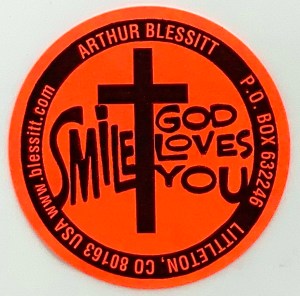
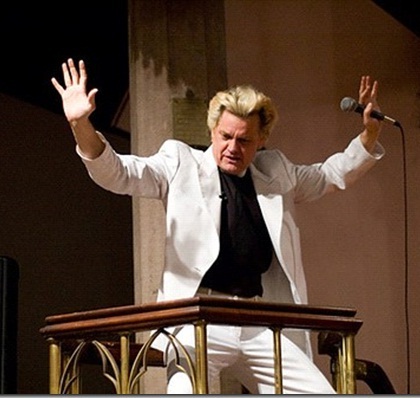
The point of my telling this story is that I wish I had listened to my 8 year old self. He seemed to know instinctively that all this Jesus talk – this Christian ideology – was nonsensical. I didn’t listen, however, and ended up, after joining a particularly evangelical YMCA in my teens, falling for it hook, line and sinker. I seem to remember that a sexy young American evangelist played a part in my conversion. (Plus, he had stickers! See above.)

Evangelicalism consumed my life from that point on, influencing crucial life choices and leading me to suppress who I really was. It would take me thirty years to break the chains and escape. 
Lessons from Life 11: People first

I have learnt over the course of my life to reject ideologies and ‘principles’ that take precedence over people. Political, epistemological and religious ideologies that are only interested in their own perpetuation and not about improving the lot of the maximum number of individuals have no intrinsic value. Consequently, and as Paul Simon once put it, I stand alone without beliefs. Largely so, anyway, though of course no one is entirely without belief; what I mean is that I don’t subscribe to any particular ideology.

While politically left of centre, I can’t honestly say I’m a socialist, never mind a communist. Those packages don’t interest me; they have caused, in their own way, too much damage for those they claim to champion. I don’t stand to the right either. As a slogan that was around in my formative years said, society is about ‘people, not profits’. And there is such a thing as society, despite Margaret Thatcher’s disastrous declaration that there isn’t.

Similarly, and in spite of its claims, Christianity does not put people first. They come a long way behind the ideology’s central preoccupations: defending indefensible doctrine, preserving the honour of imaginary beings and, impossibly, having a ‘relationship’ with them. As Richard Dawkins first pointed out in his 1991 essay, ‘Viruses of the Mind’, religion behaves like a contagion that is only interested in spreading itself. It has a willing and effective transmission system in those already infected and has no time for those in whom a new infection doesn’t take. As it has done from the beginning, those who suffer from the virus immediately take to demonising those who are able to resist it. Religion, despite its fine talk about loving neighbours, always creates division and strife: Us and Them, them being the lost, the obstinate, the apostate and, worst of all, the degenerate. Here’s how the strident but tawdry Reformation Charlotte Christian blog referred recently to LGBT people, who, damn them, just won’t leave their deviant ways and let the virus in: 

Of course, nobody – literally, nobody – can walk away from the Scriptures and come away with the understanding that God is fine with men committing shameless acts with men and women giving up the natural relations for those that are contrary to nature (Romans 1:26-27). This is nothing more than an assault on God’s design for humanity by those who hate God and seek to justify their wickedness. But God has words for them – and he will not be mocked.

An ideology that views other people like this is not one worthy of anyone’s time or attention. It is an ideology for those unable to reason for themselves, who have a pathological need to feel ‘righteously’ superior, a condition achieved, despite what its founder may have said, by disparaging others. It needs to be allowed to die like the nasty infection it is. Christianity isn’t, of course, the only virus of this sort; all those that think more of supernatural beings and exclusionary condemnatory ‘principles’ than they do of real people are equally unhealthy. Like every cult leader before and since, the founders of both Christianity and Islam are made to insist that you love them much more than you love your parents, your children or anyone else. How’s that for wickedness?

If Onlys

I

If Grace hadn’t gone to the dance that night, she’d never have met Johnny.

If she’d never met Johnny, then they wouldn’t have married.

And if they hadn’t married, they would never have had Jean.

If her parents hadn’t then moved to Chester, Jean would never have met Graham.

If Jean had never met Graham, she would never have married him.

If she’d listened to her mother, she wouldn’t have married him.

But if Jean hadn’t married Graham, they would never have had Paul.

If Graham hadn’t married Jean, he couldn’t have left her, and Paul, for Samantha.

If Graham and Jean hadn’t had Paul, then he wouldn’t, later, have gone to the party where he met Anne.

If he hadn’t have met Anne, he couldn’t have married her.

If he hadn’t married her, he might have been happy.

But if he hadn’t married Anne, they wouldn’t have had Tom and Katherine.

And Tom and Katherine wouldn’t have produced Holly and Laurel and John.

If only, he thinks – Paul thinks – if only all of these if’s hadn’t come to pass. If only Grace hadn’t gone to the dance; if only she hadn’t met Johnny; if only they hadn’t married; if only they hadn’t had Jean; if only Jean hadn’t met Graham; if only she’d listened to her mother; if only Jean and Graham hadn’t got married; if only they hadn’t had Paul… then he, Paul wouldn’t exist. And if that were so, he sometimes thinks, things might somehow be have been better. Not for Tom and Katherine, Holly, Laurel and Mark obviously, because they wouldn’t exist. But then, they’d never know. That’s the trouble with if onlys.

II

If only the Colonel hadn’t taken power, then the rebels might not have started the war.

If the rebels hadn’t started the war, the Colonel might not have retaliated with such ferocity.

If only he had not retaliated, the people might not have found themselves in the incessant cross-fire.

If the people had not found themselves in the cross-fire, then surely, not as many of them would have been killed.

If only Alya hadn’t thought she could reach the market before the next air strike.

If only the air strike had started after she had reached the rubble on the other side of the street.

If only Alya had survived the air strike, then she would have had the chance to study, once the fighting had finally stopped.

If she had survived the strike, she would, eventually, have married Malik.

If she had married Malik they would have produced Tariq and Kaley.

And they would have produced Hanah and Leila and Jamil.

If only Alya had survived the air strike.

But she did not.

That’s the trouble with if onlys.


Lessons from Life 10: Probably

Death and taxes aside, nothing is certain. It isn’t certain there’s no God and no after-life. It isn’t certain that we’ll enjoy the average life expectancy or even that we’ll still be here this time tomorrow. It’s possible that these things are the case. The last two scenarios may even be probable.

This is the best we can do. Statistically and on the basis of the evidence, it’s probable there is no God (or improbable that there is, if you prefer it that way round.) It’s likely, again mathematically and provided other conditions are met, that you’ll live to the average life expectancy age in the Western world (if that’s where you’re reading this.) More people live to that age and beyond than don’t. It doesn’t mean you or I will. It just makes it more likely; statistically probable. On that basis, it’s probable, but not certain, you’ll be here tomorrow.

Reality operates on probabilities. Possibilities are more of a gamble, which is not to say probabilities aren’t, but possibilities are, quite literally, chancier. That just how it is, however we might wish otherwise, however much misguided religious zealots might declare otherwise. Probably.

The Pearl: an allegory

The old man lived alone on the edge of the forest. His family had all grown and left home and his wife had died many years ago. He was used to being on his own; he liked being on his own. In his solitude he would often recall the strange wild-haired speaker of words who had visited the village when he was a youth. This speaker of words spoke of a pearl of great price that was waiting to be found, and when it was, he said, the one who sought it would know it for what it was and would abandon all else to possess it. And the old man, when he was a young man, thought he would like to own this great pearl. With it he would be rich beyond his dreams and all of his troubles would come to an end.

Hardly a day passed that he did not think about the pearl of great price. Hardly a week went by that he did not look for it, on his travels into the wide world beyond the village. He began to neglect his family and his other possessions in pursuit of the pearl but alas, after many years he still had not cast eyes upon it. There were, it was true, times when he thought he had caught a glimpse of it and even occasions when treasures of a different sort came into his possession, but these were not the great pearl. He could not rest until he had found it and so he spent years of his life looking for it.

But once he was old, he gave up the search. Moving around was not as easy as it once was and though he had not forgotten the promise of the great pearl, he no longer believed it could be found. He doubted even that it existed and he began to curse the one who had told of it, all those years ago. So the old man lived alone, tending his crops, and fetching water from the well. He spoke when spoken to by those in the village, whenever he had cause to go there, but otherwise, he lived his life in quiet, remorseful isolation.

Until there came a time when, as the cold chill of winter crept over the land once more, he ventured into the forest to collect firewood. There was little to be had in the parts he knew well so he went deeper in, beyond the familiar sights and into the heart of the forest’s darkness. He soon became lost and casting around for a way out, he spied a light in the gloom ahead. As he stumbled towards it, the light shone more brightly, until, finally he reached a clearing in which sat a young man. Arrayed in white, his raiment shining like the sun, the young man raised dark piercing eyes and though he did not know why, the old man’s thoughts turned unbidden to the pearl for which he had once so earnestly searched. As if reading his mind, the young man rose and spoke:

‘That which you seek is here,’ he said in a voice not of this world.

‘I have sought the pearl these many years, my Lord,’ said the old man, a tear falling from his eye. ‘It is not to be found.’

‘You are wrong,’ said the young man. He was tall and dark and possessed of a presence the old man had not encountered since his youth. The boy stretched out his arm and opened his hand to reveal a glowing silver orb that seemed as if it were floating freely in the air. ‘It is here,’ he said.

The old man wiped away tears that now fell freely and stepped forward, reaching for the pearl. ‘Remember, my friend,’ warned the young man, ‘that whoever lays hold of the pearl forsakes all else.’ The old man would not have wished it other. Through the brilliance that emanated from it, he laid hold of the pearl and was, in that instant, consumed by the light. Every thought, every care, every sorrow and every regret that he had ever had was burnt away and he was transformed. No longer himself he was yet more himself than he had ever been.

While the shadows of trees filled the clearing, the darkness enveloped all. Of the old man and the young man and the pearl of great price there was no sign.

Lessons from Life 9: It’s worth the risk

Take some chances.

Life can be spent cautiously and carefully, avoiding all possible risk. To an extent we’ve all had to live this way for the past year. While this has, arguably, kept us safe, it hasn’t felt very much like living life, not in any really fulfilling way.

I’ve lived most of my life this way; risk averse, conforming to expectation and cautious to a stultifying degree. It hasn’t been until later in life, that I’ve started taking more chances, and have realised all that my ordinary little life can be.

I’m not advocating being rash, or doing things that are justifiably illegal or that would harm yourself or others (I could never smoke for this reason.) I am talking about not living life according the maybes, what ifs and possibles that are currently dictating our lives. ‘Maybe there will be a resurgence of Covid-19, possibly there will be vaccine-resistant strains, perhaps health systems will be overrun, what if I catch a virus – any virus – and be incapacitated or die.’ And maybe not.

We cannot live on the basis of such vagaries. We don’t in any other context: we don’t avoid driving because maybe this time will be the time we are involved in fatal crash; we don’t confine ourselves to our homes because the ultra-violent light outside might trigger cancer; we don’t, as Billy Joel so eloquently put it, stay far away from the door if there’s a chance of it opening up. (His ‘An Innocent Man’ is a brilliant song about daring to live.)

Every day under normal circumstances, we take calculated risks, having put in place any necessary precautions – seat belts, careful driving, sun cream or whatever – and we go out there and do things. This is how it should be.

Don’t doubt it; something will get you in the end. As Mark Twain famously put it, there are only two certainties in life: death and taxes. Only one of these is fatal (though the other runs a close second). Whatever we do, death cannot be avoided forever. Yet we behave as if it can. Take some chances; this is the only opportunity you’ll get to do so. Once you’re gone you can’t. I’ve not regretted a single risk I’ve taken.

They’ve made me alive.

Love & Time

I step up on to the bus for a journey I’ve taken so many times before. Usually it takes about twenty minutes to get into town, but I know that today it’ll take much longer. I’m going to see my father.

The birthday card came out of the blue. It arrived on my birthday, of course, so it wasn’t out of the blue in that sense, but it was the first I’d ever had off my dad. It was the first he’d ever sent. In it he’d written, ‘if you’d like to meet, please call me,’ with his number.

She must have the card by now. I timed it to arrive for her birthday and even if it didn’t get delivered on time it must be there now. I know I hardly deserve a response. but I’d so much like one. Need one. Even if it’s to tell me to get lost. I’d understand it if that’s how she felt.

I didn’t reply. Not at first anyway. Then I texted him and told him I would meet him. He texted back almost straight away with a picture of himself. I wouldn’t have recognised him. He left my mum and me just after I was born.

I didn’t send him a picture of me.

No photo, but at least she’s prepared to meet me. More than I hoped for really. Thank God for the Internet. I’d never have found her otherwise.

I sit on one of the seats facing into the bus. I don’t want to look out of the window. I read his instructions again: ‘meet @ the café in market square @ 12. please wait for me. I’ve a long way to drive. looking forward to seeing you after all this time, dad x x’

I haven’t told mum I’m meeting him.

Hold-ups on the A66. I left enough time and now I’m going to be late. She might not wait. Wouldn’t blame her. I’m hardly the most reliable person in her life. Pray to God she will. Text her to ask her to.

After an eternity, the bus lurches to a halt. I put up my brolly and walk through the rain to the café. I buy a decaffeinated coffee and sit at a table in the corner. I’m early but it isn’t long before he’s late. Another text: ‘held up in traffic please wait.’

Finally. I made it. Parking took ages too. I pull my coat round me and run to the cafe, nearly an hour late. Good job there, Tom, that’s the way to treat her. The place is half empty. I scan the faces, looking for someone who looks like me, or Katherine, but no-one holds my gaze. Which of them is she?

I know it’s him as soon as he walks into the café. He looks much older than I thought he would. He glances round, surveying faces, but has no way of recognising me. He sits down at the table in the window and looks out. I look away, just in case. I step back and watch him from across the street, secure in the shadows. I feel sorry for him.

She’s gone. Who can blame her. I blew it. Again.

The return bus comes into view and I step up to the bus stop. This was a big mistake and I want to be at home, with mum. Thirty-two years is a long time not to know someone. Not to know your own dad. The bus stops and when everyone is on board, pulls away again.

As the clock strikes, I cross the road and push open the door to the café.


Lessons From Life 8: Love and Time

The children, summer 1987

I always felt inadequate when raising my children. It was difficult to know what was the right thing to do in any given circumstance. Hard to know whether I was giving them the attention they deserved, showing enough interest in what they were doing, being fair in my discipline, patient enough, providing them what they needed (and often buying what other parents were buying their kids). All of that. There was no manual to refer to, no Google, back in the ‘80s and early ‘90s, to search for advice. I felt as though I were making it all up as I went along and didn’t have much at all to offer them. This was compounded and confounded by my Christian faith at the time; I was not bringing them up in the way of the Lord. They resisted any attempts to get them to go to church, making Sunday mornings traumatic for everyone – the kids, my wife and me in a state that was as far removed from serenity and readiness to worship as it was possible to be by the time we arrived at church.

The occasional child expert who turned up TV or in a magazine, paid to give their unfounded opinions on child-rearing, would invariably say it was important for parents to spend Quality Time with their children. Another standard to fail to meet! Quality time. What was that? The experts were usually pretty vague about what it entailed. You just had to know what was quality and what was not and it seemed every other parent knew this this intuitively. I didn’t. Was it reading the bed time story without nodding off yourself? Enlisting the offspring in every activity group going? (How was this spending quality time with them yourself?) Playing with Sylvanian families with my adult mind switched off? Equipping them for life by passing on my limited skills? I never did discover the answer to these questions, though I did feel guilty, and a failure, when I couldn’t fully engage with the things that interested my kids.

Later, however I came to see that all of this talk of ‘quality time’ and bringing children up in the way of the Lord, together with the notion that there was a right way to bring up children that everyone else knew about, was, to put it mildly, a fiction. I recognised that all I had to give them was love and time. This didn’t seem like very much but in fact these were the very best things I could give my children. Not ‘quality’ time either, just ordinary time spent with them, without worrying about where this time might come on somebody else’s scale of worthiness. Just being with them, talking to them, encouraging them, enjoying the banality of any activity, because that is part of what love is: putting yourself out for others. It is also showing affection, being pleased to be with your children, telling them what they mean to you, building them up.

My kids are grown up now and tell me they had happy childhoods. They’re good people, with children of their own whom I’m privileged to love and spend time with.

Story for Lesson 7: The Vision

He stepped out of the light, as if made of light himself. Light giving form to light, a being of pure light. His garments shone, blazing brilliance. His countenance radiated light and he spoke not as with words from any mouth but as of precious stones – rubies and emeralds – for he had no mouth that I could see. As his radiance shone forth, his words entered the mind of any who would listen. I listened, transfixed by such a vision of loveliness and power, blinded by his iridescence. He raised his hands as he spoke, if hands they were; more discs of light, brighter than the sun.

‘I am your Lord,’ he said, his voice a mellifluent confluence of joy and authority. ‘I appear here before you to set you apart, to reveal to you my message for the world.’

‘Oh, Lord’, I said, lost in the beauty of his radiance. ‘Pray reveal what this message is. Tell me and I will forever do your will.’

‘Let me see,’ he said as he pulled a golden scroll from the folds of his shining raiment and began to read: ‘Preach salvation to all nations in my name.’

‘That’s it?’ I said, confused. ‘Hasn’t that been done before?’

‘It has?’ he asked, sounding confused himself.

‘Yes, you know, Saint Paul and all that.’

‘Oh, yes. Paul,’ he mumbled. ‘Okay. So how about you take dictation of the Holy Words of the One True God to warn people of the judgement to come?’

‘Hasn’t that been done too?’

‘Has it? Well, what if I throw in some imaginary golden tablets and a couple of magic stones with fancy names? That work for you?’

‘Not really. Haven’t you got any original ideas?

‘Original ideas. Let me think… what about a new cult? What if I said my name was John Frum, or the late Prince Philip even; you could start a brand new cult named after me. It’s worked before.’

I sighed. ‘But that’s I’m trying to tell you. They’ve all been done before. I mean, what is the point of a vision if it’s got nothing new to offer?’

‘Fair enough,’ he said disconsolately. ‘But really, you know, it’s not my fault.’

‘How so?’ I asked, not liking the turn the conversation was taking.

‘Well,’ he said, ‘it was you who conjured me up in the first place. Just like Paul and Muhammad, Joseph Smith, the John Frum crowd and any number of others. You and I both know I don’t actually exist. That I’m… well, I’m a malfunction of your brain creating images and voices from the cultural influences around you.’

And I had to concede: he was right.

Lessons from Life 7: Don’t Squander Your Life On Religion

Like a dog returning to its vomit (2 Peter 2.22) I return to religion. I wasted so much of my life being duped by Christianity. As regular readers know, I allowed it to prevent me from living as myself and wasted time and money on it, while switching off my critical faculties to immerse myself in its murky depths.

I know better now. Christianity is built on the visions, dreams and fantasies of first-century zealots who couldn’t distinguish between their hallucinations and reality. They knew nothing about evidence and laboured under the misapprehension that what went on their own heads was as real as what happened outside them. You think I’m overstating the case? Then you don’t know your bible. It proclaims boldly and proudly that this is what faith in the celestial being, known as ‘Saviour’ (the literal meaning of Jesus) is built on:

First, Paul’s psychoses: 

…fourteen years ago (I) was caught up to the third heaven. Whether it was in the body or out of the body I do not know – God knows – … (I) was caught up to paradise and heard inexpressible things, things that no one is permitted to tell. (2 Corinthians 12.2-4. Paul admits he’s prone to hallucinations.)

But when God, who had set me apart before I was born and called me through his grace, was pleased to reveal his Son in me, so that I might proclaim him among the Gentiles, I did not confer with any human being. (Galatians 1.15-16. Paul talks about how Christ was revealed to him in his head.)

With that in mind, how about this collection of sightings that Paul says were of the same nature as his own:

(The risen Christ) appeared to Cephas, then to the twelve. Then he appeared to more than five hundred brothers at one time…Then he appeared to James, then to all the apostles. Last of all, as to one untimely born, he appeared also to me. (1 Corinthians 15:3-8)

Then this claim from decades after the cult got underway, from people who believed themselves to be living in the last days:

In the last days, God says, I will pour out my Spirit on all people. Your sons and daughters will prophesy, your young men will see visions, your old men will dream. (Acts 2.17)

And there are all those stories of people wo had to convince themselves that what they saw was really the risen Christ:

After his suffering, (Jesus) presented himself to them and gave many convincing proofs that he was alive. (Acts 1.3. Convincing proofs? Didn’t they know it was him?)

Acts has even more these sightings (all of them fictional). They show us nonetheless how the earliest believers thought they experienced the ‘risen Lord’: Stephen ‘sees’ him in glory (Acts 7.55-56), while Paul witnesses a bright light and hears Jesus’s voice in the three contradictory versions of his conversion (Acts 9. 13-19; Acts 22. 6-11; Acts 26.12-18). There’s also the aptly named Revelation, in which Jesus appears only as a wacky apparition.

So, all of Jesus’ appearances in the earliest books of the New Testament are visions within people’s heads. Despite this, we’re expected to believe that his resurrection appearances in the gospels, written decades after Paul’s visions, took place in reality. There really was a man, we’re told, who returned physically from the dead; he materialised inside a locked room (John 20.19), appeared in a variety of unrecognisable forms (Luke 24.15-16, John 20.14-18) vanished at will (Luke 24.51) and soared off into the clouds (Acts 24.50-53). These manifestations of the risen Jesus have all the hallmarks of visions, dreams or hallucinations, just like all those other ‘revelations’ that are clearly described as such. It’s preposterous to promote or believe in the gospel’s resurrection appearances as anything other than imaginative accounts of inner visions.

I don’t know about you, but I’m not prepared to base my life on the hallucinations and dreams, real or otherwise, of a few superstitious zealots, nor on later unreliable stories about them; that way Mormonism lies. I know that dreams and fantasies are not real, my own included.

Does this leave me – and you – without hope, purpose or morals? Christians say so, but they’re wrong. It leaves us with a finite life to live to the best of our abilities. It leaves us without an impossible standard to live up to that, God knows, Christians themselves fail miserably to achieve. It frees us from an illusory post-mortem judgement that we’re supposed to live in fear of and instead allows us to be responsible for our own behaviour. It allows us to be happy and free.