The Golden Age of Christian Values

If only we could get back to the golden age of Christian Values. The one that existed when I was young, before things changed so much and when life was so much better. People believed in God, went to church every Sunday and had good old fashioned, biblical values. The troubles of today could so easily have been averted if only we’d stayed true to those beliefs.

Yes, If only we could go back…

‘Let me take you there,’ says a disembodied voice.

‘That you Jesus?’ I ask.

‘If you like,’ it replies, ‘but I’d rather think of myself as the Spirit of Times Gone By. Let’s you and I return to some of them together and see if we can’t find the Golden Age of Christian Values.’

I feel him take my hand and suddenly we’re travelling through a vortex in time, away from the 2020s and into the past. As we do so, my smartphone disappears from my pocket, as if it had never existed. Disconcertingly, my Fitbit does the same. I’m sure going to miss them.

‘Take a look here,’ says the voice as a vista opens up on front of us. ‘Behold, 2003.’

‘Yes,’ I say. ‘Things were so much better even just 20 years ago. No wokeness, no talk of irreversible climate change… and no one had heard of gender identity or drag queen story hours!’

‘Really?’ my guide says. ‘That’s how you remember it? America was still reeling from 9/11, a Christian president was about to invade a country that had nothing to do with the attack and there were a record number of tornadoes across the US. Things weren’t that great for a whole load of people, especially the ordinary folk of Iraq.’

‘I guess not,’ I concede. ‘Maybe we need to go further back. Find that special time when we hadn’t abandoned God and he hadn’t left us to our own devices.’

‘Let’s do that,’ my host says, as once again we take to the swirling vortex, emerging seconds later in what he says are the early 1990s.

‘Much better,’ I say. ‘No destructive social media, no same-sex marriage anywhere. The Berlin wall has come down and the Second Gulf War is set to be a great success.’

I can feel my guide staring down at me, though oddly I can’t quite make out the details of his face. ‘Really?’ he says again. ‘I’m surprised you mention that. There’s also the Siege of Sarajevo on the horizon, racial unrest following the beating of Rodney King and in Bangladesh 138,000 people have just been killed by an earthquake. Plus, as you say no social media to speak of. You do remember, don’t you, how much you like arguing with atheists on it. I’m not sure this is the time we’ve been looking for either.’

I have to agree it isn’t, as once again he takes my hand and we return to the vortex, emerging mere seconds later… when?

‘The ’80s,’ he announces. ‘AIDs, the Iran-Contra scandal, acid rain, Chernobyl. I don’t see any Christian Golden Age here.’

‘Oh, I don’t know,’ I reply. ‘At least there was the Moral Majority, a genuinely Christian president and in England, a Prime minister with Christian principles. She even quoted the Bible sometimes. We had politicians of real integrity in this time period.’

I feel him raise an eyebrow even though I can’t see him. ‘A Christian president who left thousands to die,’ he remarks.

‘They brought it on themselves. God’s judgement on a sinful generation,’ I tell him, pleased to score a point.

We move on. ‘The 1960s,’ he declares. ‘Could this be your Golden Age?’

‘If there’s one thing I know for sure, it’s that the 1960s were not the Golden Age. Definitely not. That’s when everything started to go wrong. Moral relativism, Women’s Lib, Civil Rights riots, Stonewall, psychedelic drugs…’ I stop to catch my breath. ‘Long hair, promiscuity, nudity, abortion, decadent music. Oh Lord, it was awful and it paved the way for the depravity and dissolution that was to come. If ever there was a decade in need of God it was this one.’

‘Let’s not forget Assassinations and Vietnam,’ he adds.

‘For sure. That’s what comes of abandoning God.’

‘It looks like the 1960s were nearly as bad as you say 2023 is. Maybe things don’t really change as much as you think.’

‘Maybe,’ I concede. I haven’t really thought about it before.

‘You know, says my companion, I’m beginning to think we’re further than ever from the Golden Age you seek. But I’m prepared to give it one more shot if you are.’

I agree and we’re off again, emerging this time in the 1950s. ‘This is it!’ I exclaim, ‘This is Christianity’s Golden Age! People going to church, looking after their neighbors; there’s prayer in school and real Christian standards. This is where it all happened and it’s here where we should all return.’

‘I see what you’re saying,’ the figure beside me replies, ‘but it wasn’t good for everyone, was it.’

‘What do you mean?’ I ask incredulously.

‘Well,’ he says, ‘it wasn’t a great time if you were black. There was segregation and I assume you know there were still lynchings in this era.’

‘I didn’t say it was perfect,’ I object.

‘No?’ he says. ‘In this Golden Age, women were expected to keep house, raise children and serve their husbands, just like it says in the Bible. Too bad if they wanted a life beyond that.’

I can’t see a problem with this but something stops me from saying so.

‘And of course it was illegal to be gay back here. Fines, imprisonment and ruin were the price to be paid. Staying hidden was the only option for many.’

‘Not a bad thing,’ I murmur.

‘Then there was the Korean War in which 2.5 million people died, including 36,000 American servicemen; the Cold War with its ever present threat of nuclear annihilation; McCarthyism, the paranoia of The Red Scare and the persecution of those presumed to have left wing views… Need I go on?’

‘No, no. I take your point. Perhaps this isn’t the Christian Golden Age I’m looking for after all.’

‘You still don’t get it, do you?’ my companion says. There is no Christian Golden Age. If we were to go back another ten years we’d find the Second World War and the Holocaust when 6 million of God’s Chosen People and 5 million others were brutally, senselessly murdered.’

‘I guess,’

‘You guess? And even if we were to go back to the start of your Faith you would find the infighting, corruption and immorality prevent even that from being a Golden Age.’

‘Oh, I think you’re wrong there. It says in Acts…’

But he cuts me off: ‘My friend, your Golden Age has never existed.’

‘I’m sure we could find it somewhere,’ I mumble.

‘No,’ he says. ‘This is it. This, here in the ‘50s is as good as it gets. But only for some. This is where we stop. This is where you stay.’

‘Stay? I don’t want to stay here. I need to get back to my own time, to my family and my technology. I’ve atheists to argue with online.’

I see his eyes glow high above me. ‘The only way you’ll get back is to live your life from this point on, through the decades you’ve dismissed, and see how far you get. But it’s unlikely you’ll get back to 2023. Life expectancy in the 1950s is much shorter than where you’ve come from. And you’re no spring chicken to begin with.’

‘No, please,’ I stammer. ‘You can’t. I don’t belong here. This isn’t a Christian Golden Age after all.’

But I was on my own. My companion, like my shaky beliefs, had simply vanished.


Jettisoned

It’s all very well discussing how the gospels came to be, but are they true and do Christians adhere to what Jesus purportedly tells them there? Let’s take a look at one of his instructions from Matthew 23.8-10:

But you are not to be called ‘Rabbi,’ for you have one Teacher, and you are all brothers. And do not call anyone on earth ‘father,’ for you have one Father, and he is in heaven. Nor are you to be called instructors, for you have one Instructor, the Messiah. 

Context: Matthew’s cult community is moving away from synagogue worship and so supplies Jesus with words condemning Pharisaic practices. Instead, because the new cult at this point is egalitarian, they have him endorse its practice. One teacher: the heavenly Christ. One church: the brotherhood. One Father: God in heaven. One Instructor: the heavenly Christ again.

How quickly the church jettisoned this advice! By the time of Ephesians (written in the late 1st or early 2nd and certainly not by Paul who was long dead) the church is awash with ‘the apostles, the prophets, the evangelists, the pastors and teachers, (given by Christ) to equip his people for works of service, so that the body of Christ may be built up (Ephesians 4.11-12)

A little later still, 1 Timothy – again, not written by Paul – speaks of hierarchical structures of overseers (‘bishops’), leaders, teachers and instructors (the two words have the same meaning), while later in the first century, and in direct contravention of Jesus’ admonition, the Roman church started calling its priests ‘father’. The Pope, – the term means Father or Papa – soon became the Father of all fathers.

Did the early church not really believe that Matthew 23.8-10 recorded the words of Jesus? (They’d be correct if so.) Or did they think that they didn’t matter; were, in fact, optional? (Parenthetically, what is it with gospel-Jesus habitually referring to saviour-figures in the third person? He does it here – ‘one instructor: the Messiah’ – and when he refers to ‘the Son of Man’. Why should we suppose he means himself when he does this? He’s not afraid to talk at length in the first person about himself in John’s gospel, but in the synoptics he’s apparently too timid to do so and feels compelled to use the third person and hide behind alter-egos. Unless of course fictional gospel-Jesus, or his script writers, regards ‘the Messiah’ and ‘the Son of Man’ as beings other than himself.) 

Then there’s the modern church, with its pastors (‘shepherds’), bishops (‘overseers’), teachers, instructors and priests (‘elders’). Does it too consider that gospel truths about brotherhood, no father but God and no teacher except the Christ, to be optional – insignificant even? Apparently so.

Which other words of Jesus do believers feel free to jettison? We’ll take an occasional look in the weeks ahead.


An Open Letter to the Bride of Christ

Every day, it seems, there are reports of pastors, ministers, priests, youth workers, church officials – you name it – who sexually abuse children, teenagers and other vulnerable people. These predatory abusers are especially repugnant because they are Christians; born again servants of the Lord, cleansed, supposedly, by the blood of Jesus. As such they have a higher moral standard than those of us who don’t have God to make us good. Or so you keep telling us. Instead these individuals take advantage of their status to rob others of their innocence, psychological well-being and the joy they should later experience in a healthy, adult sexual relationship.

You, the Bride of Christ, the Church at large, who harbour these truly awful people, need to get your house in order. You’ve had a mere 2,000 years to do it. Instead, you spend your time condemning atheists, gay people, trans-people, feminists. Have you not read 1 Corinthians 5:12: ‘What business is it of mine to judge those outside the church? Are you not to judge those inside?’ Likewise, you are told by your Saviour to attend to the log in your own eye instead of carping about the speck you perceive in others’.

You need to stop tolerating the abusers in your midst. Stop defending them when they’re found out, stop pretending all is wholesome and savoury in the Church. Stop lying when you claim that the few offenders who do get caught are mere bad apples and not ‘true’ Christians.

If not for the good of others, do it for your own sake. The Bridegroom when he descends to claim his Bride is not going to want to copulate with you, riddled as you are with malignant sexual disease.


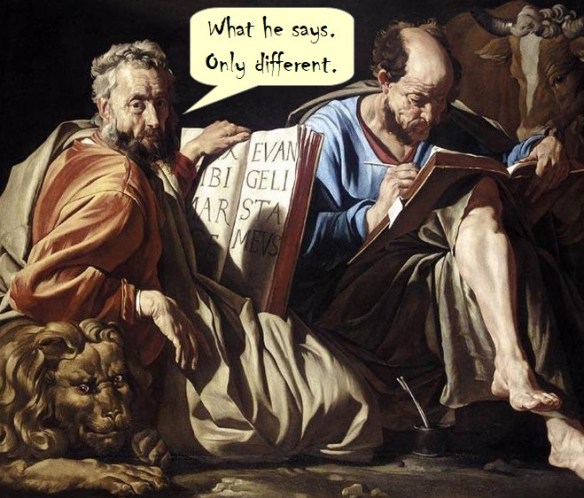
The Gospels and Other Fiction, part 3

The final part of my critical look at Christians’ defence of scripture as truth.

‘The logia of the Lord in all three of the synoptics stand out from the narration of the author by style and grammar.’

The same way Elizabeth Bennet’s/Jay Gatsby’s/Hermione Granger’s dialogue stands out from the narration and the speech of other characters in Pride and Prejudice/The Great Gatsby/Harry Potter. A skilled author can make all of their characters speak in different and distinctive styles, with their own particular grammar and syntax. This doesn’t mean those characters are real. Nor does the fact that some of the ‘logia of the Lord’ was carried over from Mark into Matthew and Luke mean the two later authors were at pains to preserve the real words of Jesus. They were, as scholars, including the evangelicals Dr Strauss and Dr Wallace suggest, copying, plagiarising, editing, amending and inventing his script.

There are also the omissions to take into account: words recorded by Mark that Matthew and Luke didn’t see fit to copy into their gospels. Were they not convinced these were genuine sayings of Jesus? Did they just not like them? On what basis did they jettison these ‘logia of the Lord’?

If only there were a fourth gospel that didn’t lift its logia from Mark, one whose Jesus speaks in a very different style, with different content, vocabulary, syntax and grammar from the synoptics, but which is itself internally consistent. We would know then his script could be made up.

Miracles of miracles, we do have such a gospel, one in which Jesus is completely different from the version in the synoptics. Where does this character’s logia come from? A different oral tradition, one totally separate from and uninfluenced by that used by Mark but which existed in parallel to it? Highly unlikely. An eyewitness? One who heard Jesus speak an entirely different set of words from whoever supposedly heard those eventually used by Mark? Of course not. The fourth gospel’s logia was invented by a much later author and his collaborators, with no direct experience of Jesus (if he existed). He and they do a pretty good job of writing his fake lines.

And if they can do it, why not Mark forty years earlier?

‘There are, in the synoptic gospels, fewer variations in the logia than in the surrounding shared narrative.’

This doesn’t mean there aren’t any. There are. For example:

Whoever is not against us is for us’ (Mark 9.40) v. ‘Whoever is not with me is against me.’ (Luke 11.23). 

‘And these are the ones sown on the good soil: they hear the word and accept it and bear fruit, thirty and sixty and a hundredfold.’ (Mark 4:20) v. ‘But as for that in the good soil, these are the ones who, when they hear the word, hold it fast in an honest and good heart, and bear fruit with patient endurance.’ (Luke 8:15) [Luke makes a terrible job transferring this parable from Mark to his own gospel. His is full of errors and discrepancies, generally attributed to ‘author fatigue’. He was just so tired of cribbing from Mark and Matthew.]

The time has come,’ he said. ‘The kingdom of God has come near. Repent and believe the good news!’ (Mark 1:15) v. ‘The kingdom of God is not coming in ways that can be observed, nor will they say, ‘Look, here it is!’ or ‘There!’ for behold, the kingdom of God is in the midst of you of you.’ (Luke 17.21)

It looks like isolating the logia and claiming because they are similar across the gospels they must be the actual words of Jesus. Matthew and Luke copying from Mark (and each other?) while John invents his own unique dialogue, makes for a far better explanation of both the similarities and the differences.

The Guilt Legacy

A couple of nights ago I watched a programme called Jehovah’s Witnesses and Me fronted by Rebekah Vardy. I know nothing about Rebekah apart from the fact she’s a footballer’s wife who was recently involved in a social media scandal, but her reflections on being brought up in a Jehovah’s Witness household were honest and sincere. She said one of the legacies of her mother being ‘disfellowshipped’ when she, Rebekah, was 8 was that she felt, and still feels, guilty about much in life. The teaching of the organisation was, as it is in many evangelical churches, that the individual is a hopeless sinner who cannot please Jehovah, though must nevertheless endeavour to work out their own salvation. For JWs this involved (and still does, as you may know from personal encounters with them) going door to door and standing for hours on end in public spaces with a trolley-full of Watchtower publications.

I could relate to Rebekah’s feelings of guilt. While not a Jehovah’s Witness (I was never that gullible) my years as a Christian left me with a legacy of guilt. For many years it was the dominant emotion of my life. While a Christian I constantly felt I was letting God down: not as good a Christian as those around me, not witnessing enough, listening to pop music instead of worship songs – practically anything could trigger my not-good-enough feelings. I also felt responsible for anything that went wrong, even when I couldn’t possibly be, and guilt about my secret sexual feelings and, most especially that I wasn’t been a good enough father. To this day, I feel awful if I’m unable to help with my grown-up children’s problems. I am moving away from such fruitless thinking, and recognise that possibly I am naturally inclined to blame myself for events both within and outside my control. Christianity nonetheless exacerbated the problem, with its emphasis on the sinful worthlessness of the individual who is nothing without Jesus. I have, I’m pleased to say, got a lot better since abandoning its negative anti-human philosophy.

What scars has religion left those of you who are escapees from religion with? I’d be more then pleased to hear it’s none, but most of the ex-Christians I know have not come away unscathed. Feel free to share in the comments.

What Happens Before We Die (according to me)


Did you ever go to a party when you were a child and your parent told you it was time to leave before you were ready? That’s how I feel about death. I’m enjoying the party too much to want to leave. Although my ‘parent’ hasn’t told me it’s time to go just yet, I know they will before I want to. I can’t see me ever being ready really, though perhaps whatever cruelty nature visits upon my body and mind in years to come will change my mind about that. But as things stand, despite my fibromyalgia (a constant painful companion) and the levels of anxiety I allow myself to feel over trivial matters, I really have too much to live for. My partner Dennis and the adventures we have together; my family with my lovely grandchildren; my friends with whom I spend many good times; the many, many simple pleasures of life; everything I still want to do and try.

So, as the days, months and years roll by at an alarming rate – there’s definitely more of life behind me than there is front of me – it’s these things that matter in my life. 

All of this might suggest I’m afraid of dying. While I doubt the process of dying will be much fun, having so much to live for – enjoying the now – dispels, perversely, the fear of death itself. I’ll face it when I get to it, raging, I hope, against the dying of light, throwing a shameful tantrum because the party will go on without me. I’ll die, though, in the knowledge I actually got to it when so many didn’t. I’ll have enjoyed it too, for the most part, with a only a few bad times, fewer regrets and many more memories.

As Christians often tell those of us who are delusion-free, I am without hope. Of course I have hope – in continued days and achievable happiness – but none that there’s existence beyond death. I am confident there isn’t. Consciousness is completely dependent on the brain; when my brain dies, so do I. That will be that. The fantasy promoted by the New Testament, that there’ll be eternal life in a new body, is nothing but hopeless wishful thinking, that in spite of overwhelming evidence we go on. There is instead serenity and purpose in accepting the reality of death. It’s part of the deal, after all.

So let’s all eat, drink and be merry, as Ecclesiastes says. Enjoy life and help others, where we can, to enjoy theirs.

____________________________________________________

Dennis and I will be on one of our adventures when next I’m due to post. While I’ll set WordPress to publish it, I can guarantee it won’t. If I can do it manually (depends on whether I have a signal) I will. Otherwise I will see you on my return.

What Happens When We Die (According to the Bible)

Street preacher Dale McAlpine was busy regaling the shoppers of my home town yesterday with the good news that they’re all sinners destined for hell. The God who created them will, Dale assured them, face an eternity of torture unless they turn to Jesus.

Dale didn’t have many (any) takers for this wonderful good news. One brave person, a young woman, asked him why, if people are resurrected, the cemeteries remain resolutely full. Good point! Dale, armed with his megaphone and hectoring ignorance, responded that it is the soul that survives death and is taken up to Heaven to live eternally with God. For those without Jesus, their souls will be consigned to hell where they will burn for eternity.

How unbiblical is that? The Bible does not teach that believers will go to live forever with God in heaven. Eternity in Heaven is not on offer. The New Testament writers anticipated the arrival of Heaven – God’s new Kingdom – on Earth. When it did, they believed, the dead would be resurrected: the saints to everlasting life in new spiritual bodies on a regenerated Earth (Revelation 21:1-4), the rest to eternal damnation.

Paul has some vague ideas about what will happen to those who die before the general resurrection – he thinks their souls will be kept safe ‘in Christ’ (whatever that mean but doesn’t suggest they will be living it up in Heaven. Rather, he describes them in 1 Thessalonians 4:14-15 and 1 Corinthians 15:20 as being ‘asleep’. Many Christian ‘thinkers’ really take exception to this idea, though Paul says this intermediate state won’t last for long; the Kingdom on Earth was imminent. He believed it would arrive while most of those he was writing to were still alive (1 Thessalonians 4:17; 1 Corinthians 15: 51-52).

It’s all tosh, of course. Paul had absolutely no idea what happens to people after death. He invented everything he said about it, from the independent existence of sleeping souls to Jesus arriving on the clouds to resurrect the dead in new spiritual bodies. These bizarre ideas come from a fevered brain convinced it had seen a dead person alive again and thought it had once taken a trip to the third heaven (whatever that is).

How do we know Paul invented it all? Because of the aspects of his teaching that should by now be history: the arrival of God’s Kingdom on Earth, the resurrection of the dead and Christians being supplied with new spiritual bodies ( while the rest of us roast in hell.) None of these things happened when he said they would, or indeed at all. We know it too because we are aware both instinctively and empirically that there is no continuation after death. When the body ceases to function so too does the ‘self’, which can be generated only by a living brain. We have no ‘soul’ that goes on alone after death and which will one day be clothed in a new sparkly body.

Here’s my challenge then to those who believe and propagate such nonsense; the Dales, the evangelicals, the fundies and the oxymoronic intellectual Christians of this world: provide evidence of one individual who has survived death in the way Paul said they would. Show us one believer who has been resurrected or whose soul is currently sleeps in Christ or who now lives in Heaven. The only proviso is that this must be a real person who is 100% human; not a mythical demi-God, not a character in a story, not someone for whom the evidence of a resurrection is extremely poor. Not, in short, Jesus. Where is the evidence anyone else has experienced a resurrection or embarked on their eternal life in heaven? Billions of believers have died since Paul created his fantasy. Surely there must be someone

Eggs, Bunnies and Dead Bodies

88

Easter rolls round again. The spring festival, which in English is named after a pagan fertility Goddess (hence the eggs and bunnies), was usurped by the church in the second century as a celebration of a dead man rising.

Sometime in the first century, a few desperate men had visions of a Yeshua – his name meaning ‘to deliver’ – shortly after his death (if indeed he existed). The visions, which were entirely in their heads, were so vivid, it seemed to these men that Yeshua was alive again. They began looking for his (re)appearance in the sky when they thought he would establish God’s Kingdom on Earth. It was a preposterous idea, but in preparation for his appearance, the men encouraged others to adhere to Jewish law so that they would find a place in the New Age.

A short while after, a different fanatic had his own vision. Saoul, who transitioned into Paûlos, thought he heard Yeshua speaking to him. Yeshua told him the conditions that needed to be met in order to secure a place in the new order: all anyone had to do was believe and they would live forever. This was all entirely within Paûlos’ head of course but nevertheless enough people took notice of his preposterous idea and decided to worship Yeshua.

Later still, the Romans destroyed Jerusalem, which was the centre for those who’d come up with the original version of the preposterous idea. Almost all of them were eliminated. Not because of their preposterous idea but because the Romans were indiscriminate in slaughtering those they regarded as rebellious Jews. Their elimination cleared the way for Paûlos’ preposterous idea to flourish unopposed.

Around this time, a literate acolyte of Paûlos’ idea, who later became known as Mark, set about creating a back story for Yeshua. He based it on Paûlos’ teaching and on stories from Jewish scripture that he thought predicated Yeshua, though in fact they didn’t.

Two other cultists liked this idea but didn’t think Mark had done a very good job of it. They set about rewriting his story, adding even more preposterous elements. Finally, about 60 or 70 years after the whole thing had begun, a fourth chap, later called John, reimagined the Yeshua story. His version bore little relationship to Mark’s tale but this didn’t really matter as all the versions of Yeshua’s life story were made up. In any case, no-one would notice the discrepancies provided the four stories were never collected together.

And so Christianity was born, created from visions and false hopes, reinventions and fanciful fictions. The preposterous idea in its different forms appealed to people, now as then, because of its false promise of eternal life and as the means of avoiding an imagined God’s wrath.

This is the idea the church is celebrating, preposterously, this weekend.

As for me, my days of fertility are long gone, but I might, nevertheless, indulge in a little bit of chocolate egg.

Christian Values

I keep coming across the idea that the West is abandoning its ‘Christian values’ (here for example). Some say we’re doing so without having anything with which to replace them, while others bemoan the influence of ‘wokeism’, Islam and social media.

This seems to me to be lazy journalism. What Christian values are we talking about?

  • Self-sacrifice, humility, selling all to help the poor, putting others before oneself? These are Christian values according to gospel Jesus but they have never been the prevalent values of Western culture.

  • Prohibitions against lying, stealing and murdering, together with admonitions to be civil and respectful predate the Bible by some considerable time. Then, as now, they were not values adhered to by everyone but were, nonetheless, ones that ancient cultures aspired to.

  • Sexual mores, then. This is, after all, what most Christians mean when they refer to Christian values. These are forever in a state of flux in any culture; however much authorities attempt to legislate sexual practices, consenting adults will always do what they want to do. The sixth commandment and the Bible’s homophobic stance would not exist if adultery and homosexuality were not practised in the barbaric past. Meanwhile, polygamy, paedophilia and non-consensual sex (with slaves) get a free pass in the Old Testament. The West’s sexual mores, which in any case vary from culture to culture, are not based on the Bible.

  • Anti-Semitism, superstition, slavery, the subjugation of women and the denigration of those of different religions, race and sexuality, are Christian values, all derived from the Bible, that the West has upheld in the past, and occasionally returns to still. If these are the Christian values we are abandoning then good, and good riddance too. We’re all better off without them.

The West’s values are capitalism, ‘civil rights, equality before the law, procedural justice’, education, empiricism and democracy, none of which derive from Christianity. Arguably they emerged in the West as a reaction against the church and the establishment, with their oppressive values, during the Enlightenment. These are humanistic values that, it seems to me, are not under threat today (though some of them could benefit from reform).

This being said, other values, particularly the right to free speech, empiricism, privacy and the right to live peaceably according to one’s own principles do appear to be under threat. There are aspects of wokeism and its troublesome twin, cancel culture, that pose a threat to these values, which have been, until recently, highly prized in the West. wokeism gnaws troublesomely at the West’s self-esteem and self-respect, rewriting its history and insisting it apologise and make reparation for the actions of people who lived hundreds of years ago. Even so, the values wokeism threatens were not derived from Christianity; you will not find individuals’ rights, empiricism and free speech promoted in the Bible, nor by later church tradition. These values were hard won by enlightened men and women and subsequently evolved, as all values and principles do, over the last couple of centuries.

Despite the loud lament that the West is losing its Christian values, it isn’t. Apart from a few unpalatable prejudices that can be traced back to the Bible, the West does not operate on Christian values and has not done so, if it ever did, for a very long time.

Jesus: Practically Perfect In Every Way?

Was Jesus a gracious, gentle and humble as Christians like to claim or was he intolerant, self-important and frequently wrong? What do the gospels say?

He’s intolerant and self-important when:

He insists people should love him more than their own families (Matthew 10:37).

He says he’s not a peacemaker but intends creating strife (Luke 12:51).

He claims anyone who doesn’t follow him deserves to be burnt (John 15:6).

He wants the world to be destroyed by fire (Luke 12:49).

He commands people not to call others ‘fools’ (Matthew 5.22) but tells those he doesn’t care for that they’re ‘swine’, ‘dogs’, ‘snakes and vipers’, ‘whitewashed tombs’, and, yes, ‘fools’ (Matthew 7:6; 15:26; 23:33; 23:27; 23:17 & Luke 11:40).

He deliberately speaks in riddles so that people won’t understand him and won’t find forgiveness (Mark 4:12).

He tells his followers to love their enemies but says he’d have his own killed (Luke 19:27 & Matthew 13:41-42).

He endorses slavery and the cruel treatment of slaves (Luke 12:47-48).

He says people would be better off if they cut off their hands, plucked out their eyes and castrated themselves (Mark 9:43-48 & Matthew 19:12).

He endorses the Jewish law that demands the death penalty for those who disrespect their mother and father (Matthew 15:4-7).

He disrespects his mother (Matthew 12:48-49).

He tells people not to get angry but loses his own temper (Matthew 5:22 &Mark 3:5).

He callously kills a herd of pigs and, in a fit of pique, destroys a fig tree (Matthew 8:32 & Matthew 21:19).

He takes a whip to people (John 2:15).

He tells his mates he’ll soon be king of the world and promises them that they’ll rule alongside him (Matthew 19:28).

Are these the marks of a tolerant, compassionate man? Or the characteristics of an unpleasant, delusional megalomaniac?

As for frequently wrong: first, the false promises –

I will do whatever you ask in my name, so that the Father may be glorified in the Son (John 14:13).

Very truly, I tell you, if you ask anything of the Father in my name, he will give it to you (John 16:23).

These signs will accompany those who believe: …they will lay their hands on the sick, and they will recover’ (Mark 16:17).

Therefore do not worry, saying, “What will we eat?” or “What will we drink?” or “What will we wear?” But strive first for the Kingdom of God and his righteousness, and all these things will be given to you as well (Matthew 6:25-7.1).

and then there’s the failed prophecies –

For the Son of Man is going to come in his Father’s glory with his angels… I tell you the truth, some who are standing here will not taste death before they see the Son of Man coming in his Kingdom (Matthew 16:27-28). Just in case we don’t get this the first time, he tells us again in Matthew 24:27, 30-31, 34 and in Luke 21:27-28, 33-34.

Did he return with the angelic host and establish God’s kingdom on Earth before his disciples died? He did not.

Christian zealots unable to accept the evidence of the gospels themselves will no doubt have a hundred and one clichéd, implausible excuses for Jesus’ many failures: ‘he was speaking metaphorically’; ‘you lack the spiritual insight to see what he really meant’; ‘you’re quoting him out of context’, blah blah, blah.

All I ask is that they please, please don’t inflict these excuses on us here when we’ve heard them all so many times before.