True Stories (or perhaps not)

Stories work best. We’re all susceptible to them. As Yuval Noah Harari demonstrates in Nexus, we absorb them far more readily than cold hard facts, evidence, statistics. A narrative means much more to us, which is why humans have told stories since we evolved the ability to speak and, later – much later – write.

The gospel authors knew this and dressed up their beliefs about their heavenly saviour as stories about a man who lived and died in Galilee a few decades earlier. As we know, these stories became popular, were repeated and reshaped down the years by the church, still drawing people in today. They are effective because they’re memorable: the Nativity, the temptation in the wilderness, the miracles, the trial before Pilate, the crucifixion and resurrection are all well constructed narratives that draw on archetypes of human experience.

Within these stories, Jesus is made to tell his own: he, or more likely his writers, knew this was the best way to drive a point home. Even today, many people know at least the outline of the Good Samaritan, the Prodigal Son and the Lost Sheep. Only a few can repeat, far less explain, Paul’s convoluted theology from Romans. The gospels are effective because they, and the stories within them, are well put together, relatable and memorable. This does not, however, mean they’re true in any meaningful sense.

That’s the problem with stories. It’s difficult to know whether they’re true (as in factual), convey (universal) truths, contain some element of truth or are entirely untrue. What we need to do is search for any evidence that supports or refutes them. Very often we don’t. We accept them on the basis of their plausibility or on the authority of those telling them. Their pedigree plays a part too – as with ancient religious claims – as does the way they’re often accepted uncritically by other people. Our own predisposition to believe certain stories (but not others) is a factor too. Then there’s the way that constant repetition of stories endows them with the ‘illusion of truth’ or, as Nazi leaders put it, ‘repeat a lie often enough and it becomes the truth.’ It’s a maxim still applied today.

Not many of us hunt down the evidence for ourselves, and sometimes there isn’t any to hunt down: did George Washington really chop down his father’s cherry tree and follow it with his ‘I cannot tell a lie’ shtick? Probably not, but there’s no way of knowing for sure – and surely millions of people who do believe it can’t all be wrong. Very often we are complicit in our own conditioning.

How about stories that circulate today? Next time I’d like to offer some examples. In the meantime if you have any suspect narratives we’re subject to, please let me know.

How some see others as brainwashed while they themselves are not

You may have been informed yesterday that a new post was available. For some reason, WordPress may have briefly put next week’s post online while I was working on it. If so, please ignore it as it really needs to be read after this week’s post. As we’ve recently been reminded, context is all! Here’s the correct post for today:

Apparently, I’m anti-intellectual and a fascist. This was revealed to me when I became involved in a discussion on Facebook about a highly suspect report claiming less well educated people were more likely to vote for right-wing parties. This, the Facebook ‘experts’ scoffed, was because less well educated people were brainwashed and indoctrinated. My mistake was in suggesting that better educated people were just as likely to be indoctrinated as their less well educated counterparts. Perhaps higher education institutions, inclined to the left, might influence the views those attending them to the extent that they too are conditioned. Hence, the accusation I’m anti-intellectual and a fascist*.

This happy experience got me to thinking about the extent to which we’re all indoctrinated/ conditioned/brainwashed.

Like many of you reading this, I was brainwashed as a Christian. I swallowed whole the story I was told: that I was a sinner in need of salvation because my sin alienated me from God. Jesus had to give his life so that I might be reconciled to God. I had to accept Jesus into my life. I would then live forever, going to heaven after I died to be with God, Jesus and the angels. You know this story. And a story it is. As Yuval Noah Harari shows in his book Nexus we – all of us not just the less well educated – are more susceptible to investing in a story than in cold hard facts or evidence (not that there is any evidence for this Christian narrative, as with so many of the others we’re subject to.)

Then there were too all those optional additions to the Jesus story that weren’t optional at all: God would meet my needs if I prayed in earnest, read His Word (always with the capitals), met with fellow-believers and listened to the prompting of God’s Holy Spirit inside me. (Deep breath.) Also If I shared my faith with others (‘witnessed’), grew in my walk with him (a mixed metaphor, surely?) and regularly gave money to the work of the church, then I’d be a True Christian™. You and I could not be reasoned out of any of this, because we weren’t reasoned into it in the first place.

The indoctrination was reinforced on an ongoing basis, which is why we were constantly told that we must ‘fellowship’ with those who had been similarly brainwashed. We were told we must also reject and separate ourselves from the thinking and values of non-believers (‘the world’) because they might be a threat to what we were being taught, causing us to backslide and out of the Truth (a feature of every cult.)

There came a point for some of us, however, when a small chink appeared in our armour of God conditioning: an unanswered question about something we’d been told that seemed, well… a little off; an unconvincing attempt to reconcile faith with an aspect of science; the realisation in a crisis that God wasn’t there at all.

It was this latter for me, and as I’ve said before, I began to read books I hoped would throw some light on what I’d believed for so many years. Did these books condition me in ways contrary to those I had escaped from? Yes, probably. But I didn’t subscribe to their stories unquestioningly. I weighed arguments and evidence, taking some on board, putting some aside and creating a synthesis of views as diverse as Carrier’s (Jesus was probably mythical) and Ehrman’s (Jesus existed but was mythologised by early converts.)

I’m quite prepared to accept that this too was a form of conditioning, my selection and rejection of arguments and evidence being determined by my being predisposed to find some persuasive and others not. This predisposition was of course part of earlier conditioning to which I had already been subject, the result of my liberal education that taught me to be impressed by sound argument and evidence. We can’t invest in a position, idea or even propaganda without previous conditioning predisposing us to. Our politics, religious beliefs, rejection of religious beliefs, perspective on life and morality are not genetic. We do not arrive equipped with them, rather we learn them from our environment, our parents, our education, influential people in our early lives, the media, our reading, our culture, the zeitgeist, the groupthink we’re subjected to and the bubble in which we find ourselves. In short, the views we’re exposed to, which is why most of us in the West are not communist or Muslim. Even rebelling against familial or societal values is a form of conditioning, replacing the views and values of our parents or school with others from, for example, a subculture or political cause.

We are never in a position to exercise ‘free will’. We can only make decisions about that which confronts us in the present, with whatever we have internalised in the past. I don’t think there’s ever been a truly original thought in the history of humankind because each thought depends on that which has gone before, both in our own heads and in the heads of others. Your position on any issue, your opinions, views, religious/anti-religious beliefs politics are all the result of conditioning, as selective as that might have been as a result of your conditioned predispositions.

Where does that leave us? Not as ‘free thinkers’ (your free thinking will conform fairly closely with that of other ‘free thinkers’) nor as entirely open-minded (your previous conditioning and the predispositions it led to have taken care of that.) It will, in all likelihood leave you exposed – even though you may regard yourself to be immune – to whatever political and social propaganda is circulating in your particular culture. We’ll take a look at this next time – if you’re predisposed to.

*For the record, I have not so far voted for a right wing party in all of my 70 years. I get my news from a variety of outlets, some left wing, some right. I spent all of my working life in Education, the latter part as an academic; anti-intellectual I am not, though I have little time for those who flaunt their credentials and use them to cudgel others.

The Prophet’s Return

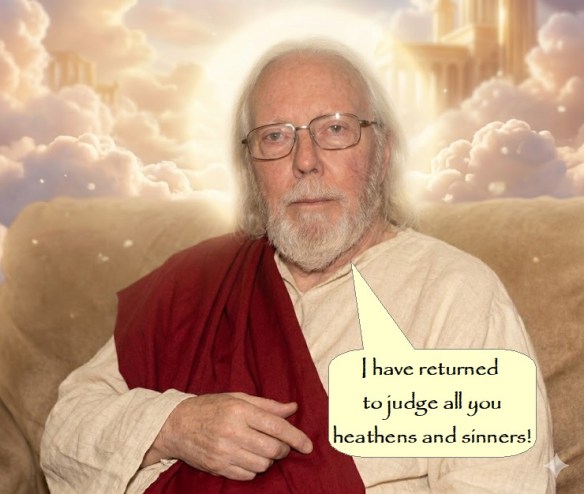
He’s back! After all this time, Jesus has returned! He came through the clouds the other day to judge us and save us from our sin and ignorance!

Oh wait… it’s not Jesus. It’s Don. Yes, Don’s back, eager to rescue us from ourselves. That’s almost as good as JC making a long overdue appearance, don’t you agree?

Let’s see what the sage has to say this time. He commented on three posts: Racism? What Would Jesus Do?, Conversion Porn and Falling By The Wayside. I’m not going to address his comment on Falling By The Wayside as it’s merely a plug for his own blog, something I’ve previously asked him not to do. His other two comments are below. All typos, leaps of logic and condescension are in the originals.

First his response to Racism? What Would Jesus Do?:

A alwaysNeil, you display a particularly poor knowledge of he N.T. and a surprisingly poor ability to read a text given you are a literature guy. You should know, though perhaps it was not part of the curriculum, that any chunk in a text is connected to all the rest and should be read with that in mind. And you should know that there is a cultural and historical context to every piece of writing. You wouldn’t read Tale of Two Cities without considering those, right? Why read Matthew in bits and pieces, then?

Thanks Don, I do know how to read a book, but like you I focus on a particular section when constructing a blog post. Just like preachers do when preaching, just like the set readings do in the liturgy, just like Christian bloggers do. Just like you do, in fact. You do exactly this in the post for which you sent the link. Why do you do that? Don’t you know how to read a book?

All the same, I do set what I say in Racism? What Would Jesus Do? in context: the milieu in which Jesus and his scriptwriters existed. For example, I say, ‘Many of Jesus’ admonishments were written by cultists anticipating the end of the age for members of their own group; they were all too happy to lash out at those who weren’t part of it.’ We know this from the way NT writers address dissidents (‘anti-Christs’), Jews (‘children of the devil’ etc) and those they saw as opponents (‘evil-doers’, ‘dogs’). I also referenced the racism Jesus exhibits in the other gospels. Did you miss this? Do you not know how to read?

Your ‘argument’ is actually nothing but that old chestnut, ‘you took it out of context’. So tell me, Don, what would Jesus’ unpleasantness look like if it were in context as you might define it? Of course you don’t actually tell us how you define it: are you talking about the surrounding verses? The chapter? The whole gospel? The entire New Testament? The Bible from beginning to end? Would Jesus’ behaviour be any more justifiable in these ‘contexts’? Would you be able to excuse it more easily? Do tell us how a wider context would change what Jesus says.

Next, Don passes judgement on Conversion Porn:

Greetings Neil. It jewels to me from your tone, you have reached the bottom of the barrel. So let me give you some more conversion porn.

Richared Bransford, Air Force surgeon who after his toru went to Africa with African Island Mission and spent 30+ years building hospitals and medical clinics and training African medical personnel across east africa. And worked himself in surgery where I visited him in the early 90s. He didn’t write a book or get rich.

Corrie ten Boom. prisoner of the Nazis who lived (her family did not) to tell about how God changed her to love her captors and went on to tell how God made her a new person through her painful imprisonment. Yes, she wrote a book. The Hiding Place.

Harriet Tubman, a slave, who escaped and helped many, many of her fellow negro slaves find freedom. She did not write a book or get rich, though many books have been written about her and a movie was made more recently.

Eric Liddell, olympic runner and missionary to China where he served the poor and where he died in a Japanese internment camp in 1945. Poor I might add. He wrote no books and made no movies, though there have been those made about him.

These are some of the well-known followers of Jesus. Add to them many thousands who worked in rescue missions for nothing, who served as nurses, as my wife did, with no recognition, who fought slavery, who went to India, as my daughter did, to create homes for rescued traffic girls, who build homes for homeless people, as I have done, at their own cost. No one will ever know of them.

What about them, Neil? They believed the “conversion porn” and made a difference in the world.

Don, most of these examples are the same ones trotted out 55 years ago when I was a young Christian. No doubt these individuals did remarkable things, and ‘Richared’ Bransford too. But they’re a select few out of the millions of Christian converts in the hundred years since Eric Lidell. What about all those others? What did they all do? And what about the non-Christians who achieved as much?: Oskar Schindler, Nicholas Winton, Chiune Sugihara, Malala Yousafzai, Chen Shu-chu, Lou Xiaoying (look them up). And, seeing as we’re including people known to us, the young atheist surgeon, the daughter of a friend of mine, who has spent years now in African hospitals working for nothing, despite being diagnosed with cancer herself (now recovered, thanks to medical science, not Jesus).

You see, Don, you’ve selected half a dozen remarkable individuals out of millions without considering the context. Statistically, your examples are insignificant. Maybe most of them didn’t make money from writing books or otherwise cashing in on their service but as I noted in the post, there are certainly those who do. We all know of the many preachers and evangelist who are multi-millionaires. You’ll no doubt say these are not True Christians™, so should be disregarded. Except… they can’t be; they are Christians and they’ve done very well off the back of it. Conversion porn, indeed.

Don, if you’re back to commenting, bear in mind that you won’t get off as lightly this time as you did a couple of years back. I’m not going to put up with your sly ad hominem remarks, your limited, narrow perspective of the Bible, your evasiveness and condescension and your shoddy promotion of Jesus. Comment at your peril.