Getting Things in the Right Order

It’s difficult to find the probable chronology of the New Testament online. The Christians have taken over, many insisting the order of the books as we have them today is correct. I’ll work from one originally devised by Bart D. Ehrman in The New Testament: A Historical Introduction (accessed here). While there are apologists who insist improbably on earlier dates and scholars who argue for later ones, there is general consensus amongst scholars for the order of the books as they’re shown here:

The first book of our reordered New Testament, if we had it, would describe the visions of Cephas, and possibly others, who believed they’d seen the heavenly Jewish Messiah. Apparently, this envisioned Messiah told them he was coming to the Earth real soon to usher in God’s kingdom. This is all we know of the beliefs of these original Christians and we know it only from Paul. They themselves left no writing of their own. And why would they? The Messiah had appeared to them (in their heads), which could only mean he’d be coming to the Earth imminently. It was all too urgent to bother writing a treatise about it. It was going to happen any day!

Paul opposed these early Jewish cultists over their very concept of the Messiah. After his own visions converted him to a belief in Jesus, he profoundly disagreed with them over their insistence that the Messiah was coming from Heaven to rescue only his own people, the Jews. They held, as Paul did not, that Jewish rites and traditions must therefore be maintained. These ‘so-called pillars of the church’ as Paul snidely calls them in Galatians 2, were probably wiped out when the Romans destroyed Jerusalem and most of its inhabitants in 70 CE.

Following this representation of pre-Pauline cultists, our reordered New Testament would next have Paul’s letters. Written between 49 and 59 CE or thereabouts, the letters derive from the visions Paul claimed he’d had of the Jewish Messiah and what he thought these meant: his so-called revelations from the Lord. He decided the Messiah had made the ultimate sacrifice in order to offer salvation to all people, not just Jews. While the letters in chronological order reveal Paul’s evolving theology they have nothing to say about a human Jesus who wandered around Galilee a couple of decades earlier. Either Paul knew nothing about this character or he didn’t care about him. Or there was no earthly Jesus for him to know about. Paul boasts several times that he devised all of he knew about ‘the Christ, Jesus’ from his visions and subsequent contemplation.

The first gospel (‘Mark’) was written circa 70 CE. Whoever created it transplanted Paul’s Heavenly Messiah into a geographical and historical context. He structured his story around Paul’s ideas, predictions about the Messiah from Jewish scripture and sayings from those same scriptures. He also incorporated cult beliefs and rules from his own time. The original ‘so- called pillars of the church’ he cast as Paul viewed them – as boneheaded disciples who failed to understand the significance of what they were experiencing. He didn’t, curiously, include any resurrection appearances.

Next comes the second letter to the cult in Thessalonica and the first of the letters supposedly by Peter. Both are considered to be forgeries for all the reasons Ehrman discusses here and here.

2 Thessalonians concentrates on the vengeance Jesus will wreak on those who have rejected him. Like in the real Paul’s letters, there’s nothing about any historical Jesus. 2 Thessalonians and 1 Peter demonstrate that possibly as early as 70 CE, cultists were happily making stuff up and passing it off as written by cult heroes (who’d also made stuff up.)

Matthew, Luke and Acts follow. Again, these books were written anonymously only acquiring their traditional attribution many years later. Matthew takes 80% of Mark, adds some material of his own derived from the Jewish scriptures, and presents his new gospel as the definitive account of the Jewish Messiah’s time on Earth. Matthew’s gospel takes the use of allegory and metaphor that he’s picked up from Mark to extremes.

Luke likewise plagiarises Mark, adds some Matthew (though he’s not keen on Matthew’s Jewish emphasis so eliminates it) and creates material of his own based on Paul and Josephus. 

Buoyed by the success of his story, Luke ploughs straight on into an account of the early church and Paul’s doings. There are multiple problems with Acts, not least that Paul’s theology in the book is nothing like that of the real Paul. It is not history but a fabrication, reworking parts of older stories, such as the Odyssey, in several places.

A couple more forgeries follow: Colossians and Ephesians, both written between 80 -100 CE, long after Paul’s death in 64/65 CE. The two books make no mention of an earthly Jesus, despite at least three accounts of his supposed life that were, by the time Colossians and Ephesians were written, in circulation among the various sects of the new cult. Instead, Jesus is depicted as a heavenly super-being. Because they’re forgeries, they really don’t belong in our new New Testament; they muddle Paul’s already muddled thinking.

Well, we’re only half way through and I figure we all need a break. We’ll pick up on the second half of Putting The New Testament In The Right Order next time.

The Lyin’, Cheatin’ Book

The Bible is a lyin’, cheatin’ book. And no, that isn’t the title of a long lost country song. The Bible was compiled by men who allowed themselves to be deceived and who were more than willing, perhaps unwittingly (to give them the benefit of the doubt), to dupe others. They included letters claiming to be by Paul and Peter that we know were not. They took the imaginary history of the early church, Acts, at face value, and the invented stories about Jesus – the gospels – as historical. They put them together in a way that made it look as if the gospels were written first, followed by Acts, Paul’s letters and the bulk of the forgeries. Paul’s letters they arranged, not in any sequential or thematic way, but from longest to shortest.

In fact, as far as Paul and the gospels are concerned, this is pretty much the reverse of the order in which they came into being. Of the documentation that made it into the New Testament, Paul’s genuine letters were first, starting with 1 Thessalonians in the late 50s and ending with Philippians in the early 60s. Only after Paul was dead did the first gospel appear (circa 70 CE), the anonymous account later attributed to ‘Mark’. After yet two more attempts to get the Jesus story right, came Acts, the notoriously inaccurate account of the early days of the cult and Paul’s adventures lifted from other sources. The fourth gospel followed much later, between 90 – 100 CE. Written by a sect of the late first century it offered a complete reimagining of the Jesus story. Along the way, numerous forgeries appeared as well as the lunacy that is Revelation, written circa 96 CE.

What would happen if we rearranged the books of the New Testament so they followed the order in which they were written? It would make them less duplicitous for a start and would also give us a more realistic picture of how Christianity arose. We would still be lacking a picture of what the earliest cultists believed prior to Paul but we can make a rough guess of what that might have been from what he says about those who preceded him.

We’ll do this next time and see what the newly ordered New Testament tells us about early Christian beliefs.

I Don’t Count


I don’t count. You don’t count. Not if, like me you’re an ordinary person quietly getting on with life, perhaps working to support your loved ones or maybe retired now, drawing the pension you’ve paid into all your life and paying your taxes. You don’t count. I don’t count.

Politicians only become interested in you, and then only as a statistic, when election time rolls round. They see us, in the UK at least, as a cash cow, needed only to fund not merely those services that are necessary to a functioning society but also for every other ill-thought-through scheme they devise.

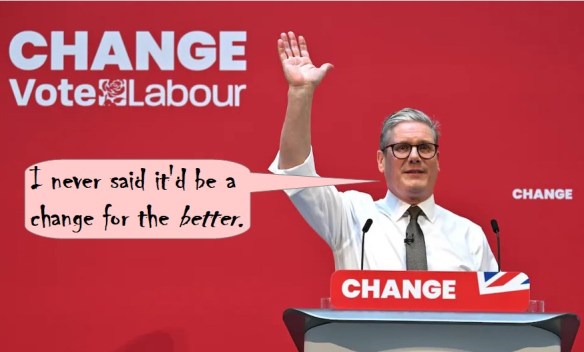
When Labour – the equivalent of the Democrats in the States – came to power last year they suddenly ‘discovered’ that the previous Tory (Republican) government had left them with a £22 billion debt. A number of financial institutions disputed this figure and the government produced no concrete evidence for it. Nonetheless, they took immediate action, shelving most of their pre-election promises until the debt could be repaid. To this end, our politicians, being among the most unproductive members of society, cut out an enormous amount of government waste and immediately cancelled projects of no benefit to the British people. The Spectator magazine estimated that they saved in the region of £200 billion this way. They were quids in!

Except they did nothing of the sort. What they did was keep up their prolific spending, turning to their cash cow – the British tax-payer – to milk it for even more money by increasing taxes all round. Particularly hard hit were high earners (which I am not), the lower paid, businesses and farmers.

A disputed debt, created solely by politicians (much of it by unnecessarily locking down for two years), now has to be paid for by those who had nothing to do with its creation. As if this weren’t bad enough, the new UK government has extended its control of its people by –

  • Deciding what can and can’t be said online and elsewhere (a new, so-called Islamophobic blasphemy law is currently being considered);
  • Encouraging police to investigate ‘non-crime hate incidents’, while ignoring burglaries and shoplifting ‘incidents’;
  • Restricting how much of our own money we can give away to family and friends before the government helps itself to a massive slice;
  • Freezing tax thresholds, meaning individuals will start to pay tax at lower levels of income;
  • Making taxpayers pay for schemes and projects with no proven track record (carbon capture, net zero);
  • Permitting local councils to increase council taxes, some above the legal limit, for fewer services. (Almost a quarter of council tax collected is spent on ‘unjustifiably generous’ staff pensions.)
  • Allowing government agencies access to private bank accounts in order to determine whether benefit recipients are lying about their income (powers that are set to be extended in 2029);
  • Making tax payers fund mass immigration, which successive governments have failed to control.
  • Requisitioning farm land in order to build more houses. In a second blow to farmers, paying them less than the market value. The government seems hell-bent on destroying food production in the UK.
  • Expecting tax-payers to pay Mauritius between £9 billion and £18 billion to take a tiny island in the Indian Ocean off our hands (though Trump might prevent the handover). 

Also under consideration is a two-tier justice system offering greater lenience to those from minorities. Should penalties for criminal acts be determined by ethnicity?

None of this makes us North Korea, but it certainly doesn’t feel like we’re  living in a Western democracy. What happened to government of the people for the people? Why is there growing resentment in the UK that government is now something that is done to the electorate? Beware legislation that is ‘for your own good’ because it never is.

It’s no wonder so many British citizens feel neglected and side-lined by politicians who view them only as a source of income. Can you blame them, and me, for feeling like we don’t count?

The latest, most accurate translation of 2 Corinthians 12:1-5

I met this bloke down the pub, oh, I dunno, 14 years ago maybe, and he was telling me how he’d taken a wild trip to another dimension. Yes, really. I believed him and so should you. I mean, why would he lie? He said it was absolutely fab and totally mind-blowing. The incredible beings he met in this other dimension told him that once he sobered up got back to reality he’d have to keep schtum about what he’d seen and heard. So really he couldn’t say much about it. Now, I mean, why would he make up stuff like this? He wouldn’t, right? Specially when people would say he was a nutter if he did. So it really happened, right?

Anyway, I promised I’d write it up for him if ever I started a blog, so I did, way back here. Honest to God, even after all that time I could remember what he told me word for word.

I might though have claimed it was me who’d tripped out in the other dimension (a spliff or two can do that to ya) so I’m here to set the record straight.

You do believe me, don’t you?

Your best mate,

Paul