The Case of Plagiarised Essays and the Missing Source

This is a true story. I was involved. It took place when I was a university tutor and had dozens of student essays to mark at any time. The work of about 120 students were distributed randomly between myself and two colleagues.

On this particular occasion, I had about 40 to assess and about half way through them I came upon an essay from a student whom I’ll call Matty. It wasn’t a particular good essay; it was poorly argued, and was littered with errors, the most glaring of which was the referring to the well known psychologist E. (for Elizabeth) Loftus as a man. I gave it a grade only a little over the pass mark and moved on.

Three or four essays later I reached one by ‘Lucas’. As I started on this submission, I realised I’d read it before. I searched back in the marked pile and pulled out Matty’s work. Sure enough, both essays were pretty much identical. The occasional word had been changed, paragraph breaks altered here and there and some sentences rearranged, but the two pieces of work were essentially the same. Crucially, the second essay used the very same quotations from E. Loftus and again used male pronouns for her when discussing her work.

The university, quite rightly, took plagiarism seriously. I summoned Lucas and Matty to my office and confronted them with their third-rate essays. Both insisted they had not copied. They had, they insisted, worked independently. They hadn’t even seen the other’s work.

So,’ I asked, ‘how is it your essays are so similar, identical in many places, and most tellingly, how have you both ‘independently’ managed to attribute the wrong sex to Elizabeth Loftus?’

We must have used the same books,’ Lucas offered.

Right,’ I said, ‘and which book was it that thought Loftus was a man?’

Not sure, ‘ Matty offered, ‘but we could maybe find it for you. Because it definitely did.’

Just point it out to me from one of your identical and very thin bibliographies,’ I suggested.

The two scanned down the list of three or four books. ‘Erm, not sure,’ Lucas said.

No, it’s not there,’ Matty concluded. ‘I’m not sure which it was.’

Okay,’ I said, ‘when you find it, maybe you can bring the book in to show me.’

They nodded eagerly, believing they’d averted the problem.

In the meantime,’ I said, ‘I’m going to fail both of your essays. I’m afraid too I have no choice but to report you to the Academic Standards Board for your plagiarism.’

The boys looked stunned. ‘But we didn’t copy and that book definitely said Mr Loftus was a man.’

There’s no book that says she’s a man,’ I said, ‘and you know it. You’re not going to be able to produce the book because it doesn’t exist. One of you made the mistake of thinking she was male and the other simply copied the error. I don’t know which way round it was, but that’s the only reasonable explanation.’

They left dejected. I did report them to the Academic Standards Board. Unbeknown to me, a tutor from a different department had also reported them for plagiarism in the essays they had submitted to him. Both students were eventually expelled for repeated offences.

I recalled the episode while reading Gary Marston’s Escaping Christian Fundamentalism blog about the hypothetical ‘Q’ that some scholars argue existed before Matthew and Luke’s gospels were written. These scholars postulate that both gospel authors lifted the material they have in common, other than that copied from Mark, from ‘Q’. Like my two likely lads, none of them has ever been able to provide evidence for the existence of this mythical document.

The most obvious explanation for the similarities between Matthew and Luke’s non-Markian material is that one of them, probably Luke, cribbed from the other. Like my two plagiarists, Matthew and Luke are without credibility. Whoever came first – probably Matthew – plagiarised from Mark and made up stories that Luke then copied, mistakes and all, and altered to suit his own purposes. If they’d been dishonest students they’d have been expelled long ago.

Pest Control

I used to pride myself on how patient I could be. I’m finding recently however that I’m becoming far less so. Not with everyone, I hasten to add, but with religionists, Evangelical Christians in particular.

As I mentioned last time, they have infested my Facebook feed with their inane Jesus-Loves-You Amen BS and now I find they’ve practically taken over a science page I occasionally read called From Quarks and Quasars, a sometimes sensationalist site that collects together science posts from other legitimate sources. It recently published an item called ‘Earth Was Once Entirely A Water World, New Research Shows’, prompting 5.2k comments. Many of these were from cranks trying to show how the finding verifies the biblical flood story, despite the fact the article makes it clear it is talking about something that occurred 3-4 billion years ago. Certified genius Dennis Mears offers this comment (all grammatical, spelling and punctuation errors in the original):

Of coarse it was !! but we don’t need “ new research “ to know what every culture on earth has talked about in their history for thousands of years . We can simply read genesis and learn about it in detail

while Scotty Johnson wades in (pun intended) with:

It’s called the flood, it’s recorded in Genesis in the Bible, Noah and the Ark, kids have been learning about it in Sunday School for years. Scientists should study the Bible first, maybe they wouldn’t be surprised when they discover something.

It’s down to astute reader Gene Steiner, catching the original article’s reference to 3-4 billion years, to correct it:

(In) Genesis 7:24 the great flood covered the whole earth, even the highest mountains; and the waters remained on the earth for 150 days…. Not billions of years ago, but 4500 or so years ago during the NOAHIC GLOBAL FLOOD! We knew that all the time!

This is the line subsequent commenters take up until we get to Tobie Schalkwyk, who offers the insight that the water-covered Earth is the same as mentioned in Genesis 1:

1 In the beginning God created the heavens and the earth. 2 Now the earth was formless and empty, darkness was over the surface of the deep, and the Spirit of God was hovering over the waters.

And on it goes for thousands more comments. The photo at the top of this post was also shoved on somewhere along the line.

It is the purveyors of this sort of crap that I no longer have any patience for. I want to call them out for their tomfoolery. It’s the same with commenters (Arnold and Don on this blog, Marley1312/Aussiestockman on Gary’s, Revival Fires on Bruce’s) who think atheist sites exist only to provide a forum for their brainless theobabble and Bible-bashing. They can’t be argued with, such is the depth of their ignorance and need to inject Jesus into everything. They bring out the worst in me: snark, bad language and name calling (as you can tell from this very post). I don’t want to stoop to this level, nor is it good for my blood pressure, and so feel compelled to leave them to it. I avoid reading comments and sometimes actually abandon sites I like to read because of the infestations of religious gobbledegook.

I know it infuriates some of you too, but what to do? Let the epidemic spread or resist it? What do you advise?

This Must Be Heaven

In the last week or so my Facebook feed has been bombarded with posts and memes of a religious nature. Every other one is of this sort. Most are Evangelical though some are evidently Roman Catholic, what with Jesus and his mom with their hearts pinned to their blouses. All of them inform me in the schmaltziest of terms how wonderful Jesus/God/Heaven is. Just about every one is followed by comments consisting single word: Amen! Some have a ‘Praise Jesus’ and occasionally there’s profound philosophical insight (kidding).

Last time my FB was invaded, about six months ago, I had to go into each post separately to blocked them. For a while FB complied. Now that my period of grace (pun intended) is over, they’re back with a righteous vengeance. Before I block them all over again, I’d like to share one with you. Its picture is at the top of this post. Some bright-spark has given it the title First Moments in Heaven, which is patently not what it’s called; not even the nuttiest fantasist would include gravestones in heaven. None of the undiscerning commenters seemed to have spotted their inclusion. Having had this pile of old cobblers dumped on my FB page, I felt obliged to point out the problem. As if a single drooling commenter cared. Here’s a sample of what they went on to say:

I despair that this saccharine banality is the best many Christians have to offer. It really can’t be argued with; people who enthuse over such slush are immune to reflection, reason and critical thinking. A staggering 13,000 of them reposted the damn thing.

The picture evidently depicts the general resurrection here on Earth and, as I thought when I first saw it, is a Jehovah’s Witness creation, originating in a Watchtower magazine. Not a single one of the thousands of born-again geniuses who orgasmed over the picture noticed it was the product of a sect they detest. Again, I felt compelled to alert them to the fact.

Now to block the lot of them. Amen! Praise Jesus!


A New Kind Of Christian


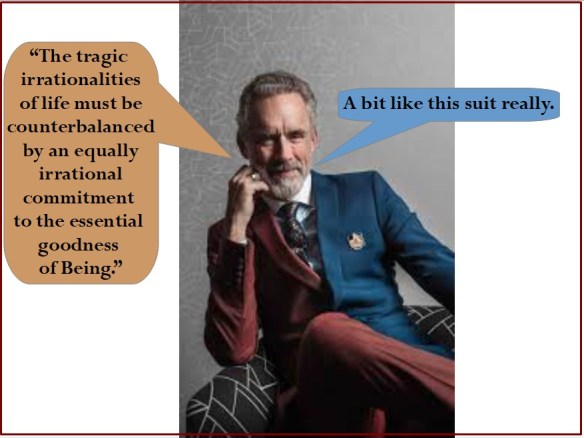
You’ll be overjoyed to hear that Jordan B. Peterson has a new book out. He’s been busy promoting the not at all pretentiously titled We Who Wrestle With God. He was interviewed about it recently in British magazine The Spectator. The interview has to be read to be believed. The introduction can be read here but the rest, alas, is behind a paywall. Don’t worry though, I’ll supply you with the highlights. The article is a goldmine of stupefying statements about God and how Jordan is the only one who really understands the Bible’s stories. They need ‘arranging’, you see, and their underlying ‘hypotheses’ understood:

The Bible presents a series of hypotheses. One is that there’s an underlying unity that brings together all structures of value. The second claim is that there’s a relationship between the human psyche and that unity and each of the main biblical stories casts that unity in a different light, accompanied by the insistence that, despite those differences, what is being pointed to is one animating principle. As far as I can tell, that’s correct.

You got that? As ol’ Jordan humbly admits, this ‘revolutionary realisation’ is his and his alone. Of course, none of this sort of thing is original; the idea that characters, events and stories in the Old Testament prefigure realities in the New is as old as the hills. Typology can be imposed on any set of myths. The gospel writers and Paul did it, seeing Jesus prefigured in Jewish scripture and inventing stories about him so that he complied with these earlier types. There’s nothing ‘revolutionary’ about spotting this, but like so many before him, Peterson gets it back to front and falls, quite literally, for the oldest trick in the Book. Continue reading