
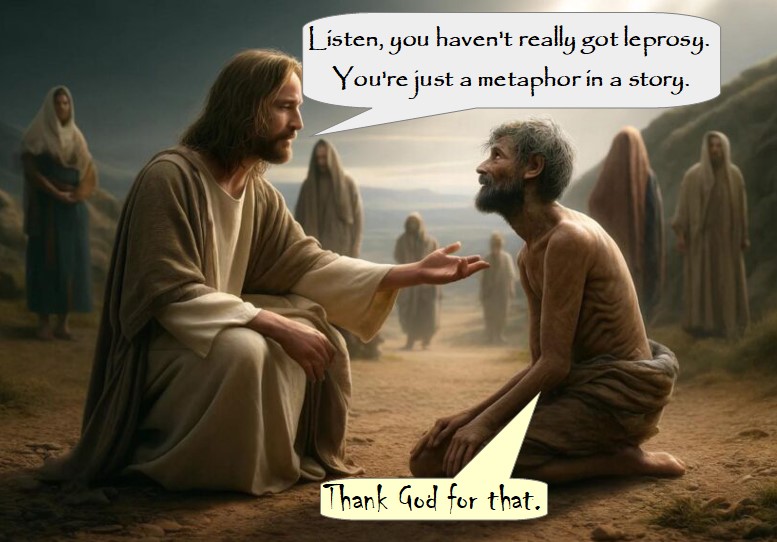
Jesus and the Leper

I thought we might share a couple of Bible studies these next couple of weeks. Some of you will remember these from your Christian days, when you’d gather with other eager believers so that a self-appointed expert could tell you what a particular story in the Bible really meant. I’m no expert, just someone who subjected myself to such indoctrination while all the time wondering if what I was being told was really what the passage was about. Doubts, however, were ‘of the devil’ so any such critical thinking needed to be suppressed. Since my eyes were opened to the allegorical nature of much of what is in the Bible and in the gospels in particular, I now see these same passages in a completely different light. I hope you’ll allow me to share my insights with you.

First off, it’s Mark 1:40-45, in which Jesus (seemingly) heals a leper:

 A man with leprosy came to him and begged him on his knees, “If you are willing, you can make me clean.” Jesus was indignant. He reached out his hand and touched the man. “I am willing,” he said. “Be clean!” 

Immediately the leprosy left him and he was cleansed. Jesus sent him away at once with a strong warning: “See that you don’t tell this to anyone. But go, show yourself to the priest and offer the sacrifices that Moses commanded for your cleansing, as a testimony to them.” 

Instead he went out and began to talk freely, spreading the news. As a result, Jesus could no longer enter a town openly but stayed outside in lonely places. Yet the people still came to him from everywhere.

The giveaway phrase here is ‘make me clean’. The man does not ask Jesus to heal him which, suffering from a debilitating disease as he was, would have been the most obvious, most pressing request to make. Instead, he asks to be ‘cleansed’ with all its ritual connotations, the word used here, καθαρίζω (katharizo), also meaning ‘purify’. According to Leviticus 4: 11-12, leprosy was a condition that was spiritually unclean. Only by making the prescribed offerings – the usual doves, lambs and ‘crimson stuff’ – could a leper who was already healed become ritually pure.

Who, according to the New Testament, replaces all the sacrificial offerings of the old covenant? Why, it’s Jesus himself of course (1 Corinthians 11:25, Ephesians 5:25-26 etc). Jesus cleanses and purifies the leper in the story, just as he is able to cleanse and purify sinners. This is what the early cult believed: ‘Ask Jesus, the heavenly Christ, to cleanse you of your sins and, just like he does for the leper in this parable, he’ll do it for you. As a penitent believer, you are the leper. Not only are you cleansed of your sin, you are purified.’

This also explains why Jesus is ‘indignant’ when the leper first approaches him. On the surface it makes little sense for him to be indignant with the man, which is why some translations change this verse to say Jesus ‘felt compassion for him.’ Jesus’ metaphorical annoyance is for those who have allowed the man’s spiritual condition to have deteriorated to a state comparable with leprosy. The Jewish priestly system, symbolised anachronistically in Mark as the Scribes and Pharisees, the later arch-enemies of the new cult.

Jesus commands the leper to visit the Jewish priest to demonstrate that he, Jesus, is the new cleanser of sins, replacing the priesthood itself. Instead, the leper goes against Jesus’ and the early cult’s wishes. My God, how could the cult remain secret and exclusive if newly cleansed converts behaved like this!

So there you have it. The leper is a metaphor for the sinner in need of the heavenly Jesus’ cleansing. His leprosy is a metaphor for the sin itself. The healing is a metaphor for the penitent’s spiritual purification. The man’s by-passing of the Jewish law is a metaphor for Jesus replacing the law. The cleansed leper’s shouting about it is a metaphor for the early cult’s desire to keep its rituals and teaching secret. Its parables like this one were designed to enlighten cult members while obfuscating and confusing the unbeliever (Mark 4:11-12).

As a literary creation, an allegory replete with metaphor, this event need never have happened in reality. Given its literary nature, it’s highly unlikely it did.

Featuring the Battle of the Century! Doomsday v. Panacea!

Human beings love doomsday scenarios. We have perpetually convinced ourselves that the circumstances in which we live are the most dreadful ever and, to quote The Beatles, can’t get no worse, The earliest Christians thought it: things were so bad that the end was surely to come. YHWH would tolerate the awful state of affairs no longer. But to the surprise of no-one he did.

Those alive in 17th century Europe couldn’t conceive of a worse time, what with the plague and all, and persuaded themselves that the world was ending. During the Covid lockdown we were told that the human race faced being annihilated by the virus and that whatever we’d previously regarded as normal would never return. Today we’re assured that the planet faces extinction if we don’t stop using fossil fuels. At the same time others claim that democracy/the West/civilisation are in such decline that the world will soon disintegrate into anarchy. Who knows, perhaps one day one of these modern doomsday scenarios will come to pass. Even a stopped clock is right twice a day.

Equally though, we are adept at devising panaceas, universal remedies to our problems. We have an unshakeable belief that by making a few simple changes – a new government/president/policy/ invention/initiative/innovation – we will avert disaster and resolve the challenges we face.

How have the panaceas of the past fared? The Jesus’ cult’s promises of new life and heaven of earth collapsed in the first century when God failed to rescue those who identified as his Chosen Ones from the wickedness that surrounded them. Nevertheless, Christianity bullied its way on to the present day, still offering the same tired solutions to age-old problems. Religion, in all its forms, only makes matters worse.

Revolution is no solution either, as the socially aware songs of the 1970s advised us. The French, American, Russian and Chinese revolutions changed situations but they didn’t usher in an age of peace and prosperity or remedy everything their instigators said they would. History demonstrates again and again that violence fails to improve anything. The freedom and independence that the Baltic states now enjoy came not from revolution but from the foresight of Mikhail Gorbachev who knew Russia could no longer afford to sustain its satellite states. Putin however knows better and seeks to reabsorb them back into his own soviet union.

Other panaceas of the past have similarly failed to deliver. The so-called industrial revolution created our modern world, led to the end of slavery and gave us the standard of living those of us in the West enjoy. Now we must deal with what many perceive as its legacy: world pollution, climate change, dwindling resources. Eliminating these is the new panacea. Once these challenges have been met, or so we’re told, the world will find itself on a much better footing, on course to recover from the damage we’ve caused it. Hence Just Stop Oil and Extinction Rebellion. It’s as simple as that. Except we know that surely it isn’t when the biggest polluters – China, Russia, India and potentially the US (Trump says he will pull out of climate change agreements if returned to the White House) – are not wholly on board.

We are a very long way from eliminating the use of oil: for a long time to come it will be needed to lubricate machinery, engines and windfarms, and for the production of plastics (a panacea in their own right not that long ago), computers, mobile phones and building materials. That’s not to mention the need for oil in the nation’s defence: the navy’s ships, the air force’s planes and the army’s tanks. We do not yet have the means of replacing the oil which fuels and lubricates modern life. We can be sure too that when we do, this new panacea will also have its own drawbacks, which will only become apparent once we have committed to them. We know this already with nuclear power which, once fossil fuels are eliminated, will be the principal means of producing electricity in the enormous quantities required to supply to industry, for heating, lighting and transport, including electric cars, which, if politicians have their way, will be the only kind available. We are already using environmentally-damaging methods’ to extract the rare minerals used for the manufacture of batteries, a process which also, ironically, creates more CO2 than the manufacture of a petrol car (itself a panacea not too long ago): According to MIT’s Climate Lab, one ton of mined lithium emits almost 15 tons of CO2’.

While there are those who claim that EVs cause less environmental damage than petrol (gas) vehicles, damage is still damage. It is not net zero. The dream of worldwide net zero is impossible. The only way it is even approachable is for the car and other forms of transport to disappear altogether – and we all know that isn’t going to happen. Even  hypocritical eco-warriors use the car and other forms of transport dependent on fossil fuels to get themselves to whichever work of art or ancient monument they plan to deface. 

China, which produces two thirds of the world’s electric car batteries, accounted ‘for 95% of the world’s new coal power construction activity in 2023.’ Then there’s the disposal of spent batteries: do we have policies for doing that in an environmentally friendly way? Is there an environmentally friendly way?

As you can probably tell, I’m not a believer in panaceas, whether religious or politically devised. They don’t work and never have. In years to come, the West will be wringing its hands at its plundering of the Congo for cobalt and South America for lithium for electric car batteries. ‘How could we get it so wrong?’ we will cry. ‘There must be a better way, a better panacea. Meanwhile, we must do penance and make reparations.’ I don’t have the answers, but extremist approaches like the half-baked schemes of Ed Miliband, the UK’s Secretary of State for Energy Security and Net Zero (yes, really), and pursuing impossible dreams do not seem to me to be the solution.

Scripture Explained

In truth, when the Lord said, ‘love your enemies and pray for those who persecute you,’ he meant by taking his gospel to them and speaking the truth unto them in love. This, after all, is the highest form of love: sharing the Good News of Jesus. For surely there is no way we can really love someone who opposes us. Therefore this cannot be what the saviour meant when he commanded us to love our enemies. Evidently, he made use of hyperbole to encourage us in our daily journey with him by making salvation known to those whose sin will only lead them unto Hell. There comes a point nonetheless when we must recognise that there are many enemies who will not accept the Word. These we must oppose, denigrate and condemn as the Holy Spirit directs. Does not scripture itself expect as much?   

When the saviour declared that we can’t serve God and money, he again spoke metaphorically. He did not mean the wealthy cannot enter the Kingdom of God. No, what he refers to is priorities. It is perfectly possible to be wealthy and a follower of Jesus so long as we put Jesus first. Where in the world would we be if we had to give away our money and possessions?

When the saviour commanded us to sell all we have to provide for the poor, he did not mean in this world which stands already condemned. Rather, he speaks in metaphor and refers to the emptying of our very selves to better follow him.

When the saviour said we must take up our crosses to follow him even unto death, he likewise spake metaphorically. He loves each according to that which he is able to bear and seeks to bless those who loves him. He speaks here therefore of our dedication to him. He encourages us to ‘die’ to our selves so that we might allow him to transform us into new creations worthy of himself.

When the Scriptures says we become new creations, it does not mean literally nor that it will happen in the twinkling of an eye. No, rather it refers to our being a ‘work in progress’. The Lord of miracle and all creation does not wish to impose on our free will by transforming us instantly. Instead, he seeks to test and purify us in a long almost imperceptible process. Only in heaven will we attain perfection.

When the saviour promised that the End of the Age was nigh for those who stood before him, he did not mean it was nigh for those who stood before him. No, for this was a secret message, a mystery, for those who would worship him in what would be, for those who stood before him, the distant future. What he meant was that when the time was right, when diverse conditions had been met – some of which would only be made known after our Lord’s time on Earth – the Son of Man would descend from the heavens to inaugurate the final judgement and the Kingdom of God.

When the scriptures declare that the Kingdom of God is intended for here on Earth, it speaks only metaphorically, for God promises those who have been saved by the power of Jesus’s blood that they will live forever with him in Heaven itself. This is a mystery known only to those who exegete the Bible correctly and ignore the plain and literal meaning of what it says.

So this, brethren, is how to deal with scripture. You need only apply one simple rule as you read it: if it appears to make demands of you, it is not actually doing so. It is either metaphor, hyperbole or both and must not be taken literally. On the other hand, when scripture is not making demands of you, everything, however unlikely it seems, is real, true and factual.

He who has ears, let him hear.

Ramifications

I started writing this blog as a way of working out just what it was I’d believed prior to my realisation there was no God. While this ‘revelation’ caused the whole Christian edifice to collapse, I still had a lot of conditioning to deal with. I had been taught over the years that, like every other human being, I was worthless without God/Jesus. I needed first to regain some self-worth.

I had hang-ups too about how I spent my time and money. The cult had assured me that God was obsessively interested in how I used both. Did my use of my time and money further his kingdom? Was I using my time wisely? Tithing? Giving my money to alleviate suffering? I knew buying CDs and comic books didn’t really fit the bill, but I sinfully persisted in spending my hard-earned cash on them, when I had any to spare after taking care of my family and giving to the church and charity. Then the guilt! How could I be so thoughtless, so selfish? I had let God down badly (specially if I’d bought some of the devil’s music.)

The guilt was self-induced of course. I think I have a personality type that is prone to feeling guilty – it’s been the predominant emotion of my life – but the Christianity I encountered exacerbated it. I still struggle with guilt, not over any great ‘sin’ but in terms of how much I help others and whether my use of my money is self-indulgent and wasteful.

Despite now having no truck with the idea of sin (which is a worthless religious concept) I do sometimes catch myself worrying that I’ll be made to suffer in the next life (which doesn’t exist either) for who I am and my ‘lifestyle’ in this world. Completely irrational, I know, but the conditioning runs deep. It hasn’t been fully rooted out yet.

On the plus side, I can now see the Bible for what it is: a collection of stories, those in the so-called New Testament designed, as they declare quite openly, to promote the beliefs of the ancient Jesus-cult.

I realised that in an ocean of myth, legend and invention I had been taught to regard the gospels as an island of historical fact. Yet two of them are prefaced with patent fantasy – the incompatible nativity stories – and conclude with equally incompatible resurrection and ascension narratives. Yet I was expected to trust that everything in between these make-believe beginnings and endings – the miracles, the visions, the speeches, the fulfilled prophecy, the false promises and unlikely new prophecies – were all somehow factual and true.

No longer gullible, I came to see this as a preposterous expectation. Sandwiched between fantasy and illusion the gospels are all myth and legend. It’s pointless to argue, as apologists do – and quite a few sceptical scholars too – that we can discern the real Jesus among the invention:

that we can make something worth considering out of the discrepant resurrection appearances;

that because one or two historical figures are written into the story it must therefore be historical throughout;

that we can sift the factual wheat from the metaphorical chaff;

that there is a kernel to the tales that can be teased out from the fantastical accretions;

that contradictions can be explained (away) and by sleight of hand made compatible;

that somehow believing all of this fantasy material can ensure eternal life.

None of these things can be done, any more than they can with the legendary tales of Romulus, Buddha and King Arthur. Legends, are legends are legends. Stories are stories are stories.

Would I have been happier never to have been a Christian, never to have committed my life to Jesus? Almost certainly. But we are all where we are. Christianity and I have a history. It’s probably left me scarred, and perhaps you too. At least I escaped it to live my life as I needed to, even if I am still working my way through its legacy.