
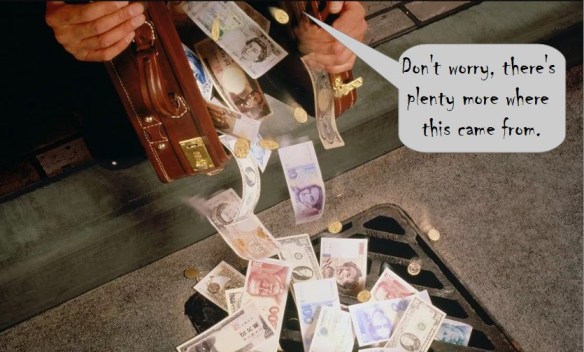
Can I have a rant? I’m sick and tired of tax I have to pay in the UK to pay for others’ ill-conceived schemes and failures. I know a society depends on taxation for its services; taxation, in theory, ensures its successful operation. Here in the UK taxation pays for health care, policing, the justice system, defence, amenities, schools, welfare support, local services and the salaries of local and national government officials. However, British tax payers are currently paying the highest tax in 70 years – since World War 2 in fact.
Currently in the UK, average incomes are taxed at 20%. Purchases on everything except essential food items and children’s clothing are taxed at 20%, petrol at a staggering 54%, average house purchases at 5% while so-called green taxes are set at around 15%. Then there are local taxes, based on property size, road tax for those who drive and inheritance taxes that limit how much an individual can pass on to his or her offspring of money that has been already taxed. Plus the tax on alcohol (variable but around 25%), sugar tax (an average of 21p per litre of fizzy drink), house purchase tax (‘stamp duty’), inheritance tax and tobacco tax. It is estimated the average working person in the UK pays in the region of 40% of their income in tax.
What does the government do with all the money it collects? Too much of it pays for government bungling:
- The mess made of the Covid pandemic when almost 10 billion pounds of public money was wasted – thrown away – on unusable PPE equipment. More tax payers money is now being spent on destroying that same equipment, while the Covid Enquiry, set up to discover just how badly the government bungled lockdown, is currently costing tax payers a further 156 million pounds.
- Approximately 10.3 billion pounds was lost on the government’s Covid support scheme in 2012-22 due to ‘fraud and error’. In the same period, a further 40 billion pounds was wasted on other government schemes, none of which it was capable of operating with any degree of competence.
-
The government’s inability to control immigration, both legal and illegal, despite numerous promises it would do so. I have a great deal of sympathy for those fleeing danger (though many who claim asylum in Britain are actually coming from France) but the UK’s services – those mentioned above – simply cannot cope with the increased numbers. Asylum seekers are initially accommodated at a cost of 8 million pounds a day, 1.3 billion pounds per year, in hotels and houses bought or rented by the government’s appointed agencies. It takes about 18 months for the Home Office to assess whether applicants can stay.
-
The 537 million pounds of tax payers’ money the government gave to China between 2009 and 2021. This apparently funds private enterprise in a country known for its disregard of human rights, one which the government itself has recently said poses a major threat to world security. It is currently donating a ‘reduced’ amount of 10 million a year. Why? Is this little more than protection money?
Last year, the UK also gave £33.4 million to India, a country with its own space program. The amount is set to increase to £57 million next year. The UK government claims that much of this is for ‘business investment’. But again, why?
-
The 480 million pounds being handed over to French authorities in return for them preventing smugglers leaving French shores with illegal immigrants in unsafe rubber dinghies. The French authorities fail to do this but the British government continues to pay them.
- The subsidies government hands over to private business, like the train companies that now receive more tax payers’ money than they did when the system was in public ownership.
- The bailing out of failing banks in loans, only a small fraction of which is ever repaid despite the extortionate amounts the banks continue to pay their executives in bonuses.
- Redundancy payments made to those in failing private businesses: the Body Shop is the latest to benefit from tax payers’ largesse.
- Paying not just the salaries but the pensions of civil servants, bureaucrats, politicians and police. (Disclosure: as a former teacher, I paid, together with my employers’ contributions, for my own pension.)
-
The generous pay increases MPs award themselves. The latest only a few weeks ago was 5.5%. Local councillors meanwhile awarded themselves 20%, again payable by tax payers. The bars and restaurants in the Houses of Parliament are all subsidised in the same way, as is the heating of MPs’ second homes.
- The endless expansion of the civil service, some of whom are currently considering striking because they have been told they must turn up at the office two days a week. This, they say, is an imposition too far, contravening the basic human right to work at home in their pyjamas (or something.)
- Failing to get people back into work and paying those who will not work, often over entire lifetimes.
- Unnecessary green policies. Britain has little need, despite the ranting of a few excitable extremists, to rush headlong into unsustainable green policies. Green taxes are, in theory at least, passed to multi-billion pound industries, that are more than capable of doing so for themselves, to develop more sustainable energy sources.
- For the government’s failure to reform the NHS, which, it is estimated, employs as many administrators and bureaucrats as it does clinicians and medics, the people who actually deliver health care.
Tax payers’ money is not the panacea for all the problems politicians have failed to resolve. Liberally throwing tax payers’ hard-earned cash at whatever problem arises should not, on every occasion, be the first resort. It ought to be the last. It is easy to spend other people’s money, without accountability, and easy to waste it. When it runs out, it is equally as easy to increase taxes to extract still more from the masses. This is precisely what happened last year when taxes were, yet again, raised ‘temporarily’.
There is nothing I and ordinary hardworking people can do about this unjust, exploitative arrangement. We can vote against the current governing party and perhaps, as seems likely, have it replaced with another who will tax us just as much, or, as seems likely, more. They will then waste our money on other self-serving, hair-brained and ultimately fruitless causes.
End of rant.
 rejectingjesus,