I Don’t Count


I don’t count. You don’t count. Not if, like me you’re an ordinary person quietly getting on with life, perhaps working to support your loved ones or maybe retired now, drawing the pension you’ve paid into all your life and paying your taxes. You don’t count. I don’t count.

Politicians only become interested in you, and then only as a statistic, when election time rolls round. They see us, in the UK at least, as a cash cow, needed only to fund not merely those services that are necessary to a functioning society but also for every other ill-thought-through scheme they devise.

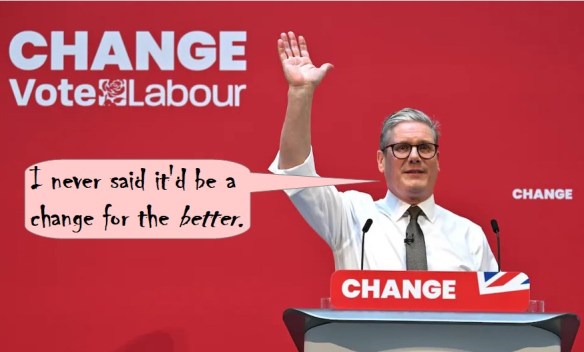
When Labour – the equivalent of the Democrats in the States – came to power last year they suddenly ‘discovered’ that the previous Tory (Republican) government had left them with a £22 billion debt. A number of financial institutions disputed this figure and the government produced no concrete evidence for it. Nonetheless, they took immediate action, shelving most of their pre-election promises until the debt could be repaid. To this end, our politicians, being among the most unproductive members of society, cut out an enormous amount of government waste and immediately cancelled projects of no benefit to the British people. The Spectator magazine estimated that they saved in the region of £200 billion this way. They were quids in!

Except they did nothing of the sort. What they did was keep up their prolific spending, turning to their cash cow – the British tax-payer – to milk it for even more money by increasing taxes all round. Particularly hard hit were high earners (which I am not), the lower paid, businesses and farmers.

A disputed debt, created solely by politicians (much of it by unnecessarily locking down for two years), now has to be paid for by those who had nothing to do with its creation. As if this weren’t bad enough, the new UK government has extended its control of its people by –

  • Deciding what can and can’t be said online and elsewhere (a new, so-called Islamophobic blasphemy law is currently being considered);
  • Encouraging police to investigate ‘non-crime hate incidents’, while ignoring burglaries and shoplifting ‘incidents’;
  • Restricting how much of our own money we can give away to family and friends before the government helps itself to a massive slice;
  • Freezing tax thresholds, meaning individuals will start to pay tax at lower levels of income;
  • Making taxpayers pay for schemes and projects with no proven track record (carbon capture, net zero);
  • Permitting local councils to increase council taxes, some above the legal limit, for fewer services. (Almost a quarter of council tax collected is spent on ‘unjustifiably generous’ staff pensions.)
  • Allowing government agencies access to private bank accounts in order to determine whether benefit recipients are lying about their income (powers that are set to be extended in 2029);
  • Making tax payers fund mass immigration, which successive governments have failed to control.
  • Requisitioning farm land in order to build more houses. In a second blow to farmers, paying them less than the market value. The government seems hell-bent on destroying food production in the UK.
  • Expecting tax-payers to pay Mauritius between £9 billion and £18 billion to take a tiny island in the Indian Ocean off our hands (though Trump might prevent the handover). 

Also under consideration is a two-tier justice system offering greater lenience to those from minorities. Should penalties for criminal acts be determined by ethnicity?

None of this makes us North Korea, but it certainly doesn’t feel like we’re  living in a Western democracy. What happened to government of the people for the people? Why is there growing resentment in the UK that government is now something that is done to the electorate? Beware legislation that is ‘for your own good’ because it never is.

It’s no wonder so many British citizens feel neglected and side-lined by politicians who view them only as a source of income. Can you blame them, and me, for feeling like we don’t count?

Featuring the Battle of the Century! Doomsday v. Panacea!

Human beings love doomsday scenarios. We have perpetually convinced ourselves that the circumstances in which we live are the most dreadful ever and, to quote The Beatles, can’t get no worse, The earliest Christians thought it: things were so bad that the end was surely to come. YHWH would tolerate the awful state of affairs no longer. But to the surprise of no-one he did.

Those alive in 17th century Europe couldn’t conceive of a worse time, what with the plague and all, and persuaded themselves that the world was ending. During the Covid lockdown we were told that the human race faced being annihilated by the virus and that whatever we’d previously regarded as normal would never return. Today we’re assured that the planet faces extinction if we don’t stop using fossil fuels. At the same time others claim that democracy/the West/civilisation are in such decline that the world will soon disintegrate into anarchy. Who knows, perhaps one day one of these modern doomsday scenarios will come to pass. Even a stopped clock is right twice a day.

Equally though, we are adept at devising panaceas, universal remedies to our problems. We have an unshakeable belief that by making a few simple changes – a new government/president/policy/ invention/initiative/innovation – we will avert disaster and resolve the challenges we face.

How have the panaceas of the past fared? The Jesus’ cult’s promises of new life and heaven of earth collapsed in the first century when God failed to rescue those who identified as his Chosen Ones from the wickedness that surrounded them. Nevertheless, Christianity bullied its way on to the present day, still offering the same tired solutions to age-old problems. Religion, in all its forms, only makes matters worse.

Revolution is no solution either, as the socially aware songs of the 1970s advised us. The French, American, Russian and Chinese revolutions changed situations but they didn’t usher in an age of peace and prosperity or remedy everything their instigators said they would. History demonstrates again and again that violence fails to improve anything. The freedom and independence that the Baltic states now enjoy came not from revolution but from the foresight of Mikhail Gorbachev who knew Russia could no longer afford to sustain its satellite states. Putin however knows better and seeks to reabsorb them back into his own soviet union.

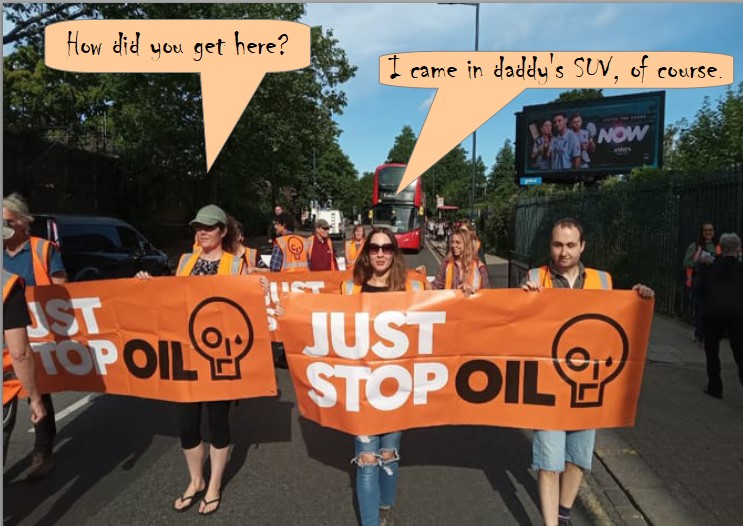
Other panaceas of the past have similarly failed to deliver. The so-called industrial revolution created our modern world, led to the end of slavery and gave us the standard of living those of us in the West enjoy. Now we must deal with what many perceive as its legacy: world pollution, climate change, dwindling resources. Eliminating these is the new panacea. Once these challenges have been met, or so we’re told, the world will find itself on a much better footing, on course to recover from the damage we’ve caused it. Hence Just Stop Oil and Extinction Rebellion. It’s as simple as that. Except we know that surely it isn’t when the biggest polluters – China, Russia, India and potentially the US (Trump says he will pull out of climate change agreements if returned to the White House) – are not wholly on board.

We are a very long way from eliminating the use of oil: for a long time to come it will be needed to lubricate machinery, engines and windfarms, and for the production of plastics (a panacea in their own right not that long ago), computers, mobile phones and building materials. That’s not to mention the need for oil in the nation’s defence: the navy’s ships, the air force’s planes and the army’s tanks. We do not yet have the means of replacing the oil which fuels and lubricates modern life. We can be sure too that when we do, this new panacea will also have its own drawbacks, which will only become apparent once we have committed to them. We know this already with nuclear power which, once fossil fuels are eliminated, will be the principal means of producing electricity in the enormous quantities required to supply to industry, for heating, lighting and transport, including electric cars, which, if politicians have their way, will be the only kind available. We are already using environmentally-damaging methods’ to extract the rare minerals used for the manufacture of batteries, a process which also, ironically, creates more CO2 than the manufacture of a petrol car (itself a panacea not too long ago): According to MIT’s Climate Lab, one ton of mined lithium emits almost 15 tons of CO2’.

While there are those who claim that EVs cause less environmental damage than petrol (gas) vehicles, damage is still damage. It is not net zero. The dream of worldwide net zero is impossible. The only way it is even approachable is for the car and other forms of transport to disappear altogether – and we all know that isn’t going to happen. Even  hypocritical eco-warriors use the car and other forms of transport dependent on fossil fuels to get themselves to whichever work of art or ancient monument they plan to deface. 

China, which produces two thirds of the world’s electric car batteries, accounted ‘for 95% of the world’s new coal power construction activity in 2023.’ Then there’s the disposal of spent batteries: do we have policies for doing that in an environmentally friendly way? Is there an environmentally friendly way?

As you can probably tell, I’m not a believer in panaceas, whether religious or politically devised. They don’t work and never have. In years to come, the West will be wringing its hands at its plundering of the Congo for cobalt and South America for lithium for electric car batteries. ‘How could we get it so wrong?’ we will cry. ‘There must be a better way, a better panacea. Meanwhile, we must do penance and make reparations.’ I don’t have the answers, but extremist approaches like the half-baked schemes of Ed Miliband, the UK’s Secretary of State for Energy Security and Net Zero (yes, really), and pursuing impossible dreams do not seem to me to be the solution.

Who Decides What A Culture’s Values Are?

Did you decide? Would you prefer to live in culture based on Christian, Islamic or Marxist values? According to some Internet Christians, these are the only choices available. Of course anyone with an ounce of sense and a modicum of honesty knows they’re not.

I choose to live in a society that is not dominated by cherry-picked Christian values, or indeed ‘values’ derived from any religion. I reject the claims of them all, including their demonstrably false notion that I and my fellow citizens cannot behave ourselves unless controlled by a morality imposed by an imaginary deity. Likewise, I don’t care to live in a culture determined by an extreme political ideology that serves only one part of society: usually the elites who devise the ideology in question.

Instead I choose, or rather was fortunate enough to be born into, a relatively liberal democracy, capable of determining its own values. These are largely secular and humanistic and include, amongst others, the rule of law, tolerance, and freedom of speech and movement. Of course the UK has never fully realised these aspirations but there has always been a sense, since the 1960s, that we were moving towards them. Perhaps I’m naive to think this, given the turbulence of the Thatcher years and President Blair’s mania for regulation, but overall it used to feel that we were moving gradually towards a fairer, more reasonable society.

It doesn’t now. The elites have embraced a wokeness that benefits a limited few and have redefined terms – ‘woman’, ‘crime’, ‘offence’, ‘hatred’ and ‘phobia’ among them – which has impacted negatively on personal rights and freedoms. They have reinterpreted the law so that it benefits vocal minorities while side-lining the majority. They have repeatedly reneged on promises and over-reacted to the crises of recent years – Covid in particular – by granting themselves greater powers to manage their own over-reaction; powers which, once each crisis has passed, they have declined to relinquish. The values of Britain today, as imposed by the governing classes, are overly woke and authoritarian. In my 68 years, I have never felt as micro-managed in my personal life as I do today.

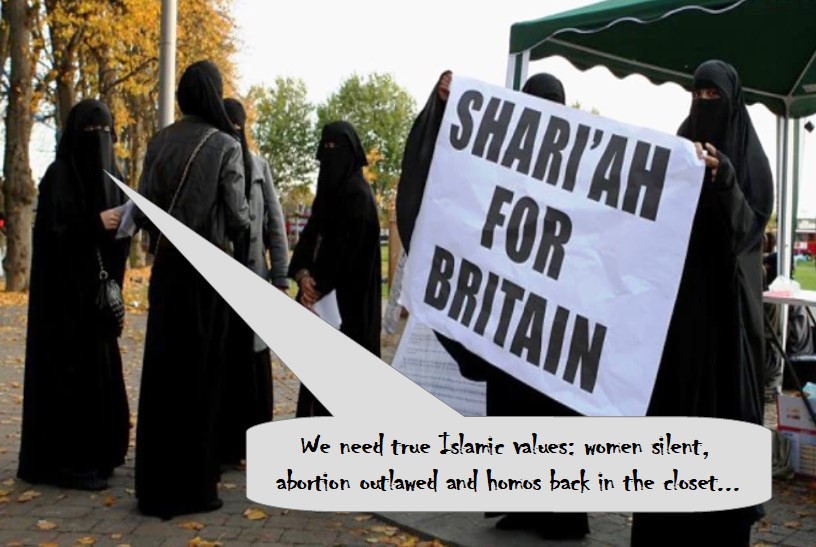
So, I do understand why there are those who call for the return to what they perceive as Christian values or a cultural Christianity of church bells and hymn singing. I understand too the fear of some that the waning of Christian influence will see extreme Islamic values fill the vacuum. This seems to me to be a real possibility and one that would prove seriously detrimental and damaging to British society. However, attempting to resurrect nebulous ‘Christian values’ in order to prevent more intolerant ones from being imposed is no solution.

We need to be clear about our values and assert those we aspire to: tolerance, liberalism, democracy, freedom of speech, rights for all, equality under the law and, I would add, truthfulness, honesty, fairness, consideration and reasonableness. For a time, this may very well involve being intolerant of intolerance, whether derived from Christianity, Islam, wokeism or political ideology. In particular, we need to stop conceding ground to Islam and resisting the demands of Muslim activists when they conflict with the values and aspirations of the majority.

Perhaps none of this will matter to me, given I’m not going to be around for many more decades (if that). But I would like the Britain my grandchildren grow up in to be one that reflects humane, secular values. I fear for them that it might instead operate on the basis of oppressive, intolerant religious ones.


free speech

Why We Can’t Return To Christian Values

There has been a spate of articles recently advocating for a return to Christian values in the UK. Some, like that by Madeline Grant, don’t specify which values they have in mind. Nonetheless, Ms Grant worries about these unspecified values being replaced by the ‘terrible new gods’ of wokeism, while Douglas Murray – an agnostic commentator I admire and enjoy a great deal – argues for the revival of Christian forgiveness. Elsewhere, Richard Dawkins repeats his call for the preservation of ‘cultural Christianity’ in the face of less ‘decent’ religions like Islam.

I’m sure there are good arguments to be made for exercising more forgiveness both in our personal and national lives, though the idea is not without its difficulties. Dawkins too is right to express concerns that the vacuum that may be left as Christianity declines might be filled with more unsavoury and less charitable values.

But what are the Christian values that these writers see less of in modern life? For Dawkins it’s the chiming of church bells and rousing hymns, which, as pleasant as these are (I would not like them to disappear either) do not have any bearing on our morals and values.

According to Total People, our values in the UK are Democracy, the Rule of Law, Respect & Tolerance and Personal Liberty. Certainly the UK has long regarded itself as a tolerant country – though those on the receiving end of intolerance in the past (early immigrants, gay people for example) might disagree – and we have always aspired to show respect without necessarily achieving it. Our morals on the other hand, especially with regard to sex (and Christians invariably mean sex when they talk about moral decline) have changed over the last 30 or so years, becoming more tolerant of, for example, same-sex relationships and less accepting of adulterous or abusive ones.

The question is, however, do we owe our values and morals to Christianity? I’ve argued before that we don’t. I’ve also tried to demonstrate that there is no time in the past we could pinpoint and say, ‘here’s where the country demonstrably and consistently upheld Biblical principles, showing us just how far we’ve fallen since.’ I applied this criterion to the USA when Don Camp suggested there was a now lost Christian golden age, taking random points in US history and demonstrating there never was a time when Christian values prevailed. Any such golden age is a myth, in the States, the UK and anywhere else. It always has been so; read Paul’s first letter to the church in Corinth to see how far even early cultists fell short of his ideals. Christians themselves don’t and never have demonstrated the high standards the bible demands.

Why is this? Because Christian morals and values are impossible. Even those who think they live with the Holy Spirit in them fail, and frequently fail dramatically, to practise what they preach. They don’t love their enemies, a ridiculous expectation of Jesus’s that certainly can’t be extended to nations. Many of the righteous don’t demonstrate love for their neighbours (other than bombarding them with the gospel) and frequently showing an appalling lack of empathy for fellow-believers (take a look at the abuse that goes on in the church at large.) They don’t, in the main, sell all they have and give the proceeds to the poor; give to anyone and everyone who asks and give away their shirt as well as their jacket when it’s demanded of them. They do judge others but don’t – sorry, Douglas – forgive fellow-believers seventy times seven, let alone those of us they regard as the great unwashed. Perhaps it’s as well; what would a culture be like that repeatedly forgave its criminals, abusers and bullies?

The frequently ignored Golden Rule of ‘do onto others as you would have them do unto you’ predates Jesus by centuries, while the more realistic, secular version of it, tolerance and respect, likewise doesn’t derive from the Bible, Jesus or the church. This Holy Trinity of terrors demonstrate a marked absence of tolerance and respect for any positions other than their own and ‘personal liberty’ is not a concept known to them. Didn’t Jesus insist his followers become his slaves? His Father, meanwhile, is intolerant of everything human beings do and everything they are.

A Christian who commented on Grant’s article asked those who disputed her premise – that we need to return to Christian values – whether they would prefer to live in a country dominated by Christian, Islamic or Marxist values. I’ll leave his question with you – answers on a postcard please – and return to it next time.

.

On my Mind

After a lifetime of voting in national and local elections I think it unlikely I will ever vote again. I am disillusioned with politicians of all stripes and at every level. Their decisions over the last few years have been disastrous and certainly not for the betterment of the British people. After so many broken promises I can’t find it in myself to believe in them any more.

Leaders and politicians take us into war but it is always ordinary people, quietly going about their everyday lives, who suffer. Religion lies at the heart of the conflict in the Middle East, motivating terrorist acts of unimaginable brutality. A god at war with himself, with innocents paying the price.

The human capacity for overreaction does not solve problems. Every unusual event is now classified as a crisis to which we respond irrationally and without resolution. In the UK during the 21st century, we (or rather politicians and leaders) have failed to address or resolve:

The so-called millennium bug (came to nothing after unnecessary panic and the waste of millions of pounds);

Foot and mouth disease (millions of healthy animals slaughtered, many lives ruined);

Iraq’s Weapons of Mass Destruction (never located and never used; non-existent. The irrational insistence by western powers that they did exist led to war and the destabilisation of the world);

Covid pandemic (lockdowns did not protect the vulnerable and elderly but successfully crashed the economy, from which the UK has still to recover);

Net-zero (electric cars, heat pumps and Ulez zones will not save the planet, yet they and similar measures will impoverish millions. We do not have the technology to halt, let alone reverse, climate change; it is hubris to think we will);

Illegal immigration (the UK and other European nations cannot cope with the strain on our infrastructure. Meanwhile the tax payer funds the accommodation of people who are here illegally, the system fails to process legal asylum seekers and politicians dither).

The narrative of the day, be it trans/gender issues, racial identity or climate change must not be challenged. Get with the agenda or be abused and cancelled. Whatever happened to free speech? I’m concerned about the attempts to control our thinking here in the UK.

Alarmist media that spend more time espousing their own opinions and endlessly speculating than reporting facts.

AI: More artificial than intelligent, AI is a disaster so far. Imagine Alexa handling the complexities of your business transactions or your banking and data security: ‘I don’t know the answer to that. Please try asking a different question (I.e. one that has no bearing on what you need to know but which fits my algorithmic agenda.)’ Does the human intelligence foisting AI on us bother to test the interface of AI and real, frustrated people?

Does bureaucracy exist only for its own self-perpetuation?. It certainly seems so.


The More Things Change…

This year it’s Black Lives Matter. Last year it was Extinction Rebellion. Before that #MeToo, GM crops and gun control. Every year it seems there’s a new cause for us to take to the streets, or, if we can’t be bothered doing that, to social media where we can make our feelings known. Of course, the common people – you and I – have a voice. We have greater means of expressing it, more platforms on which to exercise it, than have ever existed before. No-one in history has had the means we have to express our outrage, opinions and grievances.

But so what? Whether we take to the streets, vlog, blog or tweet, the result, it seems to me, is the same: things stay pretty much as they are. Hardly anything changes as the result of our outcry and protest. Maybe a few statues are demolished, a handful of sexual predators jailed, but ultimately there’s no lasting change. Perhaps a tokenistic law is created, maybe the media involve themselves for a short time in the issue of the day, but before very long everything reverts to the way it was: black lives are no more improved, the police go back to their former ways of behaving (once no-one’s looking any more), children continue to be abused, the environment is still in crisis, there’s another mass shooting by an idiot who’s bought a gun too easily and politicians carry on acting as if they’re above the law. There’ll be a new cause to excite ourselves about next summer. And another the year after that. Today’s preoccupation will disappear just as quickly as the latest fashion or pop sensation.

Why is this, and  why are we largely ignored when we take to the streets or campaign on social media about the things that concern us? Why does our voice count for so little? We live in democracies don’t we, here in Europe and in the States; we have a right to be heard, to be listened to and be taken into account – don’t we?

Well, no. We don’t. No-one is obliged to listen to us. They don’t even have to pretend to, unless they’re politicians running for election and then they are only pretending. Even then we don’t really have the choice we think we do; we’re told we can vote for the candidate of our choice, but we can’t; choice is so severely restricted it’s hardly qualifies as a choice at all. We vote for whoever the parties have put up for us to vote for; for a package that dresses either to the left or the right, without nuance or balanced consideration of the issues, and very often with no long term view of what we need to survive and flourish. That’s why so many fail to vote; they know intuitively that the more things change, the more they stay the same – so why bother?

Blog411

The rest of us dutifully select from an already selected few: the millionaires, billionaires, career politicians and failed businessmen who claim they have our best interests at heart, who say they can manage us and make our country great again. Once they have power they forget about us – their lives are so far removed from ours that they can’t possibly relate to the way we ordinary people live – and what the most vocal of us say we want. We think we won’t get fooled again, as the Who say in their politically astute song, but of course we will: we are fooled again, and again and again. Every time.

To be continued.