
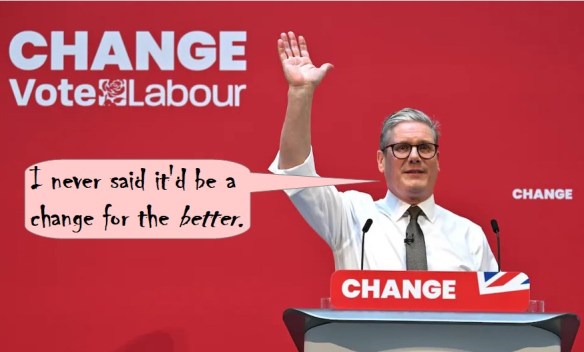
I don’t count. You don’t count. Not if, like me you’re an ordinary person quietly getting on with life, perhaps working to support your loved ones or maybe retired now, drawing the pension you’ve paid into all your life and paying your taxes. You don’t count. I don’t count.
Politicians only become interested in you, and then only as a statistic, when election time rolls round. They see us, in the UK at least, as a cash cow, needed only to fund not merely those services that are necessary to a functioning society but also for every other ill-thought-through scheme they devise.
When Labour – the equivalent of the Democrats in the States – came to power last year they suddenly ‘discovered’ that the previous Tory (Republican) government had left them with a £22 billion debt. A number of financial institutions disputed this figure and the government produced no concrete evidence for it. Nonetheless, they took immediate action, shelving most of their pre-election promises until the debt could be repaid. To this end, our politicians, being among the most unproductive members of society, cut out an enormous amount of government waste and immediately cancelled projects of no benefit to the British people. The Spectator magazine estimated that they saved in the region of £200 billion this way. They were quids in!
Except they did nothing of the sort. What they did was keep up their prolific spending, turning to their cash cow – the British tax-payer – to milk it for even more money by increasing taxes all round. Particularly hard hit were high earners (which I am not), the lower paid, businesses and farmers.
A disputed debt, created solely by politicians (much of it by unnecessarily locking down for two years), now has to be paid for by those who had nothing to do with its creation. As if this weren’t bad enough, the new UK government has extended its control of its people by –
- Deciding what can and can’t be said online and elsewhere (a new, so-called Islamophobic blasphemy law is currently being considered);
- Encouraging police to investigate ‘non-crime hate incidents’, while ignoring burglaries and shoplifting ‘incidents’;
- Restricting how much of our own money we can give away to family and friends before the government helps itself to a massive slice;
- Freezing tax thresholds, meaning individuals will start to pay tax at lower levels of income;
- Making taxpayers pay for schemes and projects with no proven track record (carbon capture, net zero);
- Permitting local councils to increase council taxes, some above the legal limit, for fewer services. (Almost a quarter of council tax collected is spent on ‘unjustifiably generous’ staff pensions.)
- Allowing government agencies access to private bank accounts in order to determine whether benefit recipients are lying about their income (powers that are set to be extended in 2029);
- Making tax payers fund mass immigration, which successive governments have failed to control.
- Requisitioning farm land in order to build more houses. In a second blow to farmers, paying them less than the market value. The government seems hell-bent on destroying food production in the UK.
- Expecting tax-payers to pay Mauritius between £9 billion and £18 billion to take a tiny island in the Indian Ocean off our hands (though Trump might prevent the handover).
Also under consideration is a two-tier justice system offering greater lenience to those from minorities. Should penalties for criminal acts be determined by ethnicity?
None of this makes us North Korea, but it certainly doesn’t feel like we’re living in a Western democracy. What happened to government of the people for the people? Why is there growing resentment in the UK that government is now something that is done to the electorate? Beware legislation that is ‘for your own good’ because it never is.
It’s no wonder so many British citizens feel neglected and side-lined by politicians who view them only as a source of income. Can you blame them, and me, for feeling like we don’t count?
 rejectingjesus,