Should Sceptics* Comment on Christian Sites?

This post was written for Bruce Gerencser’s blog last month. In case you missed it there (What? You don’t read Bruce’s blog?) here it is again in slightly amended form.

Is it ever reasonable for non-believers to comment on Christian blog sites? I know Bruce compares it with turning up at a church service and arguing with the preacher, and a recent comment on Debunking Christianity described it as ‘bad manners’. But are there circumstances where it’s reasonable to do it?

Can I suggest a couple of scenarios where it might be? I should declare first that I rarely comment on Christian sites – I have a life to live, after all – and have, I’d guess, done so no more than a dozen times in the past three or four years. This hasn’t been to promote atheism, but to counter the ignorance and intolerance of some Evangelical sites.

So here are my thoughts on when it’s okay to stray over to the dark side and engage with its denizens. First is when True Believers arrive on this site and tell me, usually in no uncertain terms, where I’m wrong. This is often for the same few reasons that are directed at other sceptic bloggers: I don’t know the Bible well enough; I misinterpret it; I don’t know Jesus the way they do; I was never really a Christian. Having batted these ad hominems around for a while, some commenters decide there’s nothing for it but to recommend posts of their own. They provide links to their blogsites that will set me and you, my reader, straight. Now and then (but not always) I’ll take a look at and, if appropriate, comment on what they’ve written. After all, they have specifically invited me round to their place; I haven’t gate-crashed, they wanted me to visit so they could enlighten me. I have, as a result, the right to reply, to let them know they haven’t. I don’t, if I can help it, argue theology or push any particular ideology, but I have been moved to point out that the Bible is open to multiple interpretations and theirs (or, I suspect, their minister’s) involves a considerable degree of cherry-picking to make it compatible with their orthodoxy. Of course, they have the right, and the means, not to publish my comment if it upsets them too much.

Second, Facebook’s algorithm – and that of other social media sites presumably — is fond of finding extreme Christian sites to add to my much-neglected page. Invariably I delete these and tell the algorithm I want to see fewer posts of this sort. It complies for a short while before it decides I really do need to know that Jesus is my friend or that I’m headed straight to hell. (Honestly, you write a few articles that mention Jesus and God and the entire Internet thinks you want to be cosy up with JC.) Now and then, and rather more frequently than I’d prefer, the nuttier sites that pop up announce that atheists have no basis for morality and are shaking their collective fist at God who’s feeling mighty wrathful about it. Alternatively, these sites find the need to headline the scourge of homosexuality, which likewise is bringing the Western world, and more specifically America, to the verge of destruction. Now I happen to be both an atheist and a homosexual (I don’t have any trouble with this word despite its use by some as a slur). I feel that, as sites disparaging either atheists, gays, or both have intruded on my FB page, it is again perfectly appropriate for me to respond, which, every few years, I do. Prejudiced, ill-informed, hateful opinions about me and my kind, be they atheist or gay, need to be challenged. These bloggers’ claims that their anti-atheist, anti-LGBT rhetoric is a ‘ministry’ or a demonstration of love are disingenuous. They’re nothing of the sort.

So I suggest to these bloggers that they are wrong. I like, also, to remind them that their Saviour commands them to love their neighbours as themselves and to love and pray for their enemies, to which they invariably reply, ‘even the devil can quote scripture’. I have been known to point out too that Jesus expects them to feed the hungry, help the needy and care for those less fortunate, and that sitting at a computer for hours on end, trashing non-believers and ‘sodomites’ (I do object to that one) isn’t what he had in mind.

Am I wasting my time? Almost certainly, but I can’t stand by as ‘loving’ Christians judge me, and others like me, as fit only for hell – and sometimes for more worrying, tangible fates in the real world.

Commenting on Christian blogs is not always for the faint-hearted, nor is it something I’d advocate. Many don’t even allow comments, so certain are they that they’re right (or perhaps they’re just fearful of contradiction; faith is, after all, a very fragile thing). Occasionally, however – a couple of times a year – I feel compelled to counter their attacks on others.

What do you think?

*British spelling, of course

Looney Tunes


In the air are Satan and his evil host. On earth are his servants – the masses of demons – and his innumerable worldwide human slaves. Throughout the once Christian West and America Satan’s slaves are all of the ungodly souls who have rejected our Lord Jesus Christ in favor of darkness, rebellion, autonomy, power, materialism, and a life of sin.

Linda Kimball, Renew America

This is reality for some modern day fanatics. They lift this sort of baloney from Ephesians (2:1-2, 6:12) which they attribute, erroneouslyto Paul.

It has to be true because it’s in the Bible. We must all respect it too because whackadoodle Linda believes it sincerely. Who needs evidence, sanity even, when you can diss every other human being like this? You can forget loving your neighbour as yourself when your neighbour is nothing more than a demon-possessed slave of Satan!

Anti Podeans

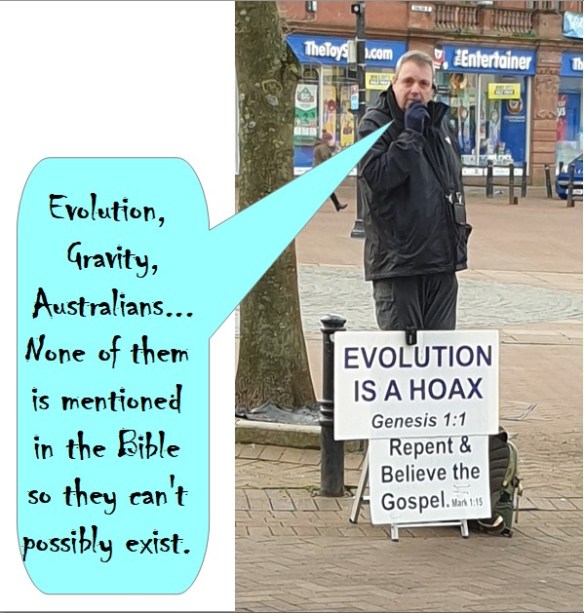
In Heresy (p243-248), Catherine Nixey relates how Greek philosopher Plato (b. circa 247BC), aware that the Earth was spherical, speculated there were lands on the other side of it. He ‘posited the idea that if one walked around the world far enough, one would end up in a position where one’s feet (podes, in Greek) would be opposite (anti-) the position you had been in when you first started walking… the notion of Antipodes had been born.’ By the first century AD, ‘Pliny the Elder… was therefore able to observe that all educated men agreed the world was spherical and that there were Antipodes.’ He wrote of the inhabitants of the Antipodes whom, he said, were as unlikely to fall of the world as those who lived in the northern hemisphere.

A thousand years after Plato and we find Christian writers rubbishing the ideas of these clever men. One, Lactantius (b. 240), declared that the idea the Earth was spherical was ridiculous and lampooned the ‘senseless’ notion that there were people on the other side of it ‘whose footsteps are higher than their heads.’ The ‘pagans’ who suggested such things, he argued, needed ‘divine instruction; for that only is wisdom.’ Augustine (b. 354) too argued that there were no Antipodeans in the Bible and as ‘there is no falsehood in scripture’, then Antipodeans could not possibly exist; the very idea was ‘absurd’. And so it continued: ‘Saint’ Jerome (b. circa 342) declared that the notion of Antipodeans was ‘witless’, while Cosmas Indicopleustes (6th century) wrote that ‘pagans’ ‘vomit out fictions and fables’ about the earth and solar system. He set about disproving these fictions from the Bible and did so, to his own satisfaction at least.

Scripture and the teaching to which it gave rise, set human knowledge and learning back a millennium: the so-called Dark Ages, in which, thanks to the church, ignorance and superstition prevailed. It wasn’t until the thirteenth century that Greek ideas began to be rediscovered and revived.

Despite this, there are plenty of people around today who think that the world was created in six literal days, a virgin gave birth, they themselves will live forever and the world will end soon when Jesus comes through the clouds. All because the Bible says so.

Heresy: Jesus Christ And The Other Sons Of God

I’m reading Catherine Nixey’s new book Heresy: Jesus Christ And The Other Sons Of God (I reviewed her previous one, The Darkening Age, here). Among other things, she demonstrates in Heresy how Christianity is a product of its age,  an age when dime-a-dozen saviours, miracle cures and resurrections were seen as real. Nixey also shows how, from the start, there were many ‘Christianities’, not just one. The set of beliefs that eventually became, by fair means and foul, the orthodoxy, jostled alongside hundreds of others for well over a century. Despite their proliferation, however, early Christianities remained an insignificant cult for almost two centuries.

Those who recognised these early forms of Christian beliefs for what they were, were vociferous in their criticism of them. Much of what they had to say no longer exists, unfortunately, thanks to later Christians who frequently destroyed it. We know of it, however because of what survives in the works of Christian writers who in their refutations quoted from it.

The arguments offered by these early critics still sound remarkably relevant today; the objections of modern sceptics are not really new. The likes of Celsus (b. circa AD140) and Porphyry (b. circa 234) came up with them first. Their early criticism bears repeating:

Celsus:

If these people proclaim Jesus, and others proclaim someone else, and if they all have the common glib slogan, “Believe if you want to be saved, or else away with you – well then, what will those do who really want to be saved? Are they to throw dice in order to divine where they may turn, and whom they are to follow?’ (Heresy, p26)

Those who claimed to have witnessed the resurrection were either ‘deluded by… sorcery, (or through) wishful thinking had an hallucination due to some mistaken notion. (An experience which) has happened to thousands’. (p47)

while he (Jesus) was in the body, and no one believed upon him, he preached to all without intermission; but when he might have produced a powerful belief in himself after rising from the dead, he showed himself secretly only to one woman, and to his own boon companions.(sourced here)

According to Porphyry,

Christian parables were ‘fictitious’… no more than imaginative little stories… replete with stupidity, written in a ‘comical and unconvincing style. (Heresy, p24)

Responding to Christians’ belief in bodily resurrection, Porphyry points out that many ‘have perished in the sea and their bodies eaten by fishes and many have been eaten by wild birds and animals. How then is it possible that these bodies should return?’ (pp47-48)

How indeed.

Critics like these were soon silenced, their work burnt – Celsus’ survives mainly in Origen’s rebuttal – and, as the church assumed greater power, so too were later authors.

As Nixey demonstrates, the word heresy originally meant ‘choice’. For Christians it soon came to mean making the wrong choice, the adoption of beliefs that did not conform to those who, in the ascendancy, came to control ‘Christian Truth’. Whoever chose otherwise, including those of alternate Christianities, were condemned as heretics in the new meaning of the word.

(Edited for sentence drop-out)

Final Judgement

So,’ the-God-who-is-above-all-others boomed at me, ‘did you hate your family in order to follow my Son and further my Kingdom on Earth?’

No, I didn’t,’ I replied. ‘I love my family and I wasn’t going to hate them to follow you or anyone else.’

God tutted, a sound like a clap of thunder. ‘Mark him down in the book,‘ he growled to the grotesque creature beside him. It was like something out of a third-rate horror film with bat’s wings and multiple eyes. It dutifully scratched away in the large book it held open in front of it.

Did you, then, accept Jesus as your Lord and Saviour?’ asked the Almighty.

I squinted, my hand over my eyes as the dazzling light that obscured his face almost blinded me. ‘Once. Yes,’ I admitted.

I suppose, once is good enough. And after that did you lead a blameless, righteous life?’

‘I doubt it. I did my best but righteousness wasn’t particularly high on my agenda.’

Another black mark,’ God said to his ugly angel. ‘Tell me,’ he said, his shiny visage turned again in my direction, ‘did you feed the hungry, visit the sick and clothe the naked?’

Sometimes,’ I said. ‘Did you? Or having created us, did you just abandon us to manage as best we could, all the time carping about how we were going about it?’

‘You see my dilemma, don’t you?’ he said, suddenly acting all reasonable. ‘You gave your life to Jesus sixty-five of your Earth years ago and I am bound to honour that; you know, ‘once saved always saved’, as I promise somewhere or other. It’s just that it doesn’t look as if you’ve upheld your end of the bargain.’

‘I thought you did it all,’ I said.

The Almighty sighed, his perfumed breath gusting through the great hall. ‘Did you, for example, manage to avoid fornication, gossip, unnatural sex, thievery, rebelliousness, drunkenness, drag acts, adultery, coveting (whatever that is) and, erm, sex.‘

Most of it. Not so much the sex that you seem so obsessed with. As I’m sure you already know, being omniscient and all that, I was in a same-sex relationship before you killed me off.’

Christ!’, he spluttered, the Heavenly sputum drenching all who were present. ’You do know this excludes you from my special club, the Kingdom of Heaven on Earth. Have you never read what old whatsisname said about this sort of thing? He warned you.’

‘I don’t care what old whatsisname said. I don’t care what you think either. I’ve treated other people fairly, tried to be kind and helped others when I could. I’ve never cheated or taken advantage of anyone. I’ve never taken a life and I haven’t, unlike you, ordered a murder. If that’s not good enough for you, then that’s your problem, not mine.

You think so?’ he sneered. ‘Not when I hold all the cards.’

Do you know,’ I said, with nothing left to lose, ‘You’re the worst excuse for a God imaginable. And you are imagined. You’re petulant, impetuous and unjust. Your solution to every problem is to torture and kill people. Your so-called salvation plan is muddled and contrived…’

Enough! Take him below!’

A cartoon demon appears by my side and prods me in the ribs with his pitch-fork. I wake suddenly and sit bolt upright in the pew. ‘You were snoring,’ Dennis says. We’re at the funeral of a friend who, for some reason – insurance maybe – insisted on having it in church. The minister is still delivering his soporific eulogy, hardly mentioning our friend and droning on instead about Jesus.

Sorry,’ I whisper to Dennis. ‘I just saw God. In my dream, which I know is the only way you can see him.

Shush,’ hisses the octogenarian American in the row behind.

Dreams and in your imagination,’ I can’t resist adding.


The Myth

Some people see the myth and think it’s true.

Others see the myth and believe it conveys deeper truths.

A few see the myth for what it is…

Myth, like all those other stories about dying and rising god-men.

Myth, like those stories about supernatural beings who never          actually existed.

Myth, like the stories in which real people undergo apotheosis after          their deaths.

Despite the contemporary Christian assertion that no-one in the ancient world considered the gospels to be myth, Justin Martyr, writing circa AD150, was moved to address the charge:

When we say that the Word, who is the first-birth of God, was produced without sexual union, and that He, Jesus Christ, our Teacher, was crucified and died, and rose again, and ascended into heaven, we propound nothing different from what you believe regarding those whom you esteem sons of Jupiter.” (Apology 21, my emphasis. You can read more here)

And how does Justin explain the similarities between the gospels and pagan myth?:

For when they say that Dionysus arose again and ascended to heaven, is it not evidence the devil has imitated the prophecy? (22:55, my emphasis)

The devil did it! It was ‘diabolical mimicry’!

Except we know it wasn’t. Early cultists created their own myth(s) using ‘prophecy’ from Jewish scripture and common mythical tropes to create their own god-man stories. Which isn’t to say Jesus didn’t exist – after all, Augustus existed, undergoing an imaginary apotheosis after his death – but it does mean gospel Jesus, the Son of God, the third person of the Trinity, is as much a fiction as all those other characters who were deified after their deaths. Which begs the question, why create a mythic character if Jesus was really so impressive to begin with? Unless of course he wasn’t.

Some people see the myth and think it’s true.

Others see the myth and believe it conveys deeper truths.

A few see the myth for what it is.

God’s Obsession

The first of a series of posts by guest contributor YHWH who posts on AllMadeUpandImaginary.com.

______________________________________________

Hi guys! And gals too though I have to confess I’m not really as interested in gals. I like cocks. I’m obsessed by them. I like them cut, and the sooner the better. I’m a bit of a perfectionist, you see. I made the first cock for the original human male, a beefcake called Adam. His name was a little joke on my part. You see, I knew the Hebrews would become my best buddies in few millennia’s time and that they’d use the word ‘Adam’ to mean ‘man’. Good pun, don’t you think?

Admittedly, it only works in the long term.

Anyway, Adam had the first. Cock that is. I’d made it so he was hung like a horse, and I thought he’d get some fun out of it with the female I’d thoughtfully supplied him with, though not for reproductive purposes. I hadn’t predicted at that stage how much trouble Adam and the woman were going to be, so when they were, I had to rethink my plan and invent procreation. I didn’t want to start again from scratch so I just repurposed the penis, shrunk it down a little and got the Adam prototype to cover it up. I didn’t want to get rid of it entirely because of course I was so pleased with it. Also it had some other function at the time, though I can’t recall now what that was.

After watching humans copulate for what seemed like an eternity (in what they imagined was privacy, which still makes me laugh), I felt that I hadn’t got the design of the dick quite right. It looked, well, comical with all that superfluous skin at the end that folded away anyway when the damn thing raised itself up in praise. I thought I could do better, but you know, by then I’d already restarted the whole damn project for a second time and to be honest, I couldn’t be bothered going back to the drawing board a third time.

So first chance I got, I came up with a contingency plan. I would find some way of getting them to cut it off. Not the whole cock, don’t get me wrong, ’cause as I say, I like that. No. The extra skin on the end. I figured they just didn’t need it and the whole thing would look more streamlined without it. Sure, they might lose some sensitivity when fucking, but so what. 

So I wait for the right dickhead (see what I did there?) to come along. Someone who’d be daft enough to sacrifice his offspring to me if I told him to. Sure enough, one soon comes along and I actually have to stop him from murdering his own son because, despite my reputation, I’m not really into that kind of thing. Well, not much. No, the cock’s the thing. So I tell him he can be my extra special buddy if only he’ll cut the skin off the end of his penis. I tell him that this’ll show me and the world that we have a special pact. In return, I promise that I’ll look after him and his descendants forever and ever. Not that he was gonna get to show his cock to the world, you understand, but you get my drift. And whaddya know, the idiot agrees to it and there and then takes an old rock to his old man, and his kids’, his slaves’ and anyone else he could lay his hands on, and hacks off the ends. I tell you, there’s one born every minute.

It wasn’t a pretty sight, I admit, what with all the blood and ragged skin, but it had more or less healed after a few months, infections notwithstanding, into something presentable. I took a look, ’cause I like looking at cocks and anything humans do with them, and I decided I approved. It looked more like I should’ve made the thing in the first place.

So for the next few hundreds years I’m happy with all the mutilated penises. I give their owners instructions about what they can and can’t do with them:

Slice off the top: That’s a must.

Rape female captives and slaves: Of course.

Fuck as many women as you can afford to keep: Naturally.

Have sex with your daughters: Well, okay but only if you’re pissed and they make the first move.

Don’t play around with other men’s cocks: Oh now, come on! Only I’m supposed to have an interest in other males’ members. So that’s a no. There are limits!

Then along comes some twerp who starts saying that anyone wants to be my buddy doesn’t have to crop their foreskin. I mean, who the hell does he think he is? I nudge a couple of my old mates and get them to tell this killjoy that I’m dead against the idea. But he ignores them and pretty soon there’s a whole bunch of fanatics who won’t get their dicks out for me. I ask you.

Thank God Me, there are still those who will though, including that other lot of God-botherers I’ve been keeping my eye on. They’re more than happy to slice and dice their young son’s willies. That’s what I like to see: commitment. And a nice bit of genital mutilation.

______________________________________________

Thanks YHWH for a really enlightening blog. Next time, His Almightiness will be talking about what he calls ‘The Spare Rib Problem: the Dickless Chicks.

In the name of Jesus Christ

A young man went on a murderous spree today in a children’s park in France. He stabbed repeatedly four very young, defenceless children, a woman who was looking after one of them and an elderly couple. As he did so, he shouted, not Alluha Akbar, but ‘in the name of Jesus Christ’.
Religion is responsible for so much evil in the world.

Don makes up more stuff

Don is making stuff up again (see recent comments) and passing it off as fact. I’m not going to respond to all of his nonsense – I have a life to live – but here are some basic refutations:

Don: ‘Did Jesus rise from the dead? The whole reason for the church, which exists to this day and which can trace its history back to the early 1st century, rests on that. It is the consequence that confirms the real history of the event.’

No. He didn’t. If he had done, all the things he and Paul promised would happen as a result would have happened, and two thousand years ago at that. https://rejectingjesus.com/2022/08/09/if-the-resurrection-had-really-happened/

This is irrefutable evidence he did not rise from the dead. It also puts the lie to those other supposedly fulfilled prophesies you reference. But we’ve been down this road before, Don. I suggest you go back and read the refutations of your claims that others provided then. https://rejectingjesus.com/2022/07/24/more-on-prophecy/

Don: ‘It is possible that Mark and Luke met in Rome; they were there at approx. the same time.’
And it is more likely they did not. In any case ‘possible’ is not ‘probable’, and absolutely not ‘certain’. This is all invented conjecture on your part.

Don: ‘Luke may have been the proofreader for Mark’s manuscript, who knows.’
Certainly not you. This is more fantasy. There is no evidence of it happening. In my thirty years of reading round this kind of thing this is the first time I’ve encountered the suggestion. That’s because you made it up. Next you’ll be telling us they were drinking buddies who invented the printing press together.

Don: ‘Most significant, at best Mark/Peter only supplied a small portion of Luke.’
According to Bible.org about 88% of Mark is in Luke. That’s hardly ‘a small portion.’

Don: ‘You will find few pericopes that are word for word the same.’
According to the same a source, much of the plagiarised material is verbatim.
https://bible.org/article/synoptic-problem

Don: ‘In any case all the Gospels call Jesus the Son of God.’
These are faith statements, not historical facts. They’re evidence that that is how the writers of the gospels – who were not eyewitnesses – and early converts saw him. Significantly, the synoptic gospels don’t make Jesus claim the title for himself. In any case, and as you know, the world back then was awash with sons of God. It didn’t mean every claimant was the real progeny of a deity. However much you want him to be, your man is no exception.

None of what you write, Don, is evidence of God, which is supposedly what you’re providing. That some in the first century claimed someone they never met was divine in some way is not evidence that God exists. Believe in him all you like but don’t think that that belief and the spiritual experiences it gives rise to in your own head are evidence. They are not.

Jesus: not worth the paper he’s printed on?

There is broad consensus amongst respected scholars that the Jesus of the gospels didn’t exist. This is hardly surprising. Gospel Jesus, as I hope I’ve demonstrated over the past few weeks, is constructed from fragments of Jewish scripture and Paul’s (and others’) visions and dreams. There is also good evidence, which I’ve not discussed, that some Jesus stories are recreations of legends and tales of other god-men (turning water into wine and the Road to Emmaus story*, for example).

All of which raises the question suggested by David Fitzgerald in Nailed, that if there was a real Jesus who was so incredible that he gave rise to an entire religion, why was almost everything about him invented? Why could his story not have been told as it was? Why didn’t his inspiring, dynamic personality speak for itself? Personally, I don’t care whether Jesus existed or not, but if the supposedly remarkable Jesus of history did once exist, he has been totally obscured by the stories, legends and myth that were constructed around him not long after he died. The celestial Jesus that today’s Christians claim to know personally, who they say inhabits their hearts while simultaneously living in heaven, is emphatically not the man who lived, but a myth. A different myth, even, than that of the New Testament. A non-existent star-man, waiting in the sky.

Jesus belongs with all those other heroes who may or may not have existed prior to their being turned into myth and legend: Abraham, Moses, Buddha, Confucius, Saint Nicholas, Robin Hood, Paul Bunyan. There is very little evidence, apart from stories and legends, that any of these figures actually existed. More, it’s entirely conceivable that Jesus belongs to a still different group of super-beings: those who were created as mythic characters, including but not confined to, Osiris (and the entire Egyptian panoply), Apollo (and all the Greek gods), Romulus, Circe, Attis, the angel Gabriel, Mithras, Aladdin, the angel Moroni, Superman, Harry Potter…

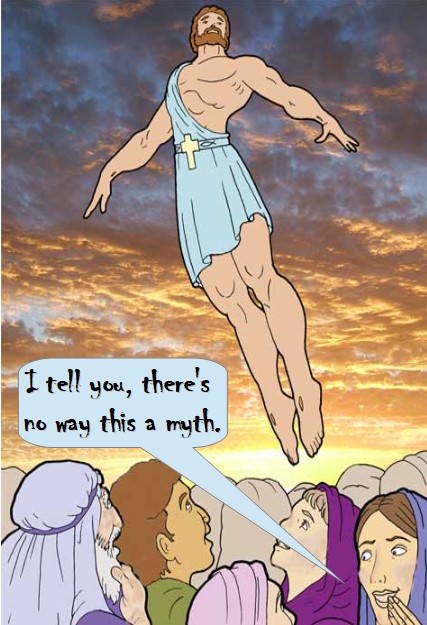
There is meagre evidence there was an historical Jesus who, even if he did exist, is now buried beneath layers of make-believe. The Jesus who has come down to us through the gospels and the rest of the New Testament is fictional. From his fairy-tale origin to his fantasy ascension and beyond, he’s completely imaginary.

I’m conscious I’ve written other posts making this same point. I find that, whatever starting point I take, invariably I end up here. Whether it’s ‘prophecy’, prayer, promises, miracles, the second coming, any aspect of the faith, none has any substance. They’re ineffectual, empty and have no bearing on reality. The character who supposedly embodies and promotes them becomes, as a result, similarly void. Either Jesus was transformed into a fantasy figure soon after he lived or he was imagined, by the likes of Paul, as a magical being to begin with. Whichever it was, from the earliest days of Christianity, there was no way for people to hear of or know about a man who actually walked the Earth.

*See Carrier, On the Historicity of Jesus: Why We Might Have Reason to Doubt, pp 480-81