Two Ways of Knowing

A Christian friend told me recently that there are two ways of knowing: science and faith. I don’t agree with him of course and, while I expressed my scepticism, I didn’t argue. It seemed unlikely he would change his mind.

Faith and science have different, incompatible concepts of reality. The first – and faith was first historically – is that there is an invisible realm beyond this one, populated by powerful beings who influence and manipulate the humans who live here below. This reality, though invisible and largely undetectable, is actually more real than the one we see around us. Glimpses have been had of it, however, by those finely attuned to it, in dreams, visions and messages delivered during heightened emotional states. These visionaries – prophets – then pass on to others what the beings of the hidden realm expect of them. Life is then to be lived according to the instructions so conveyed, which usually consist of attempts to appease these gods by doing their bidding. In return for this obsequience, you’re allowed to believe you will live on after death

The other epistemology – actually the only true epistemology in this instance – is empirical, knowledge-based science. A later arrival, historically speaking, than the gods of the invisible realm. The scientific method is the best tool we have for sifting knowledge from superstition and emotion. These, particularly the latter, often impede us in our pursuit of knowledge, which is why science strives to eliminate them from its investigations, taking an objective approach to evidence. Unfortunately, the findings of science are occasionally contradictory (can a man become a woman or not?) and very often misinterpreted by non-scientists. Politicians and the media frequently over-simplify science’s findings and interpret them in ways that suit their own agendas.

Then there are those who masquerade as scientists but are not. During the pandemic, the UK was locked down for almost two years on the basis of computer predictions of what might happen if certain conditions prevailed. These predictions were taken as a scientific conclusion when in fact they were hypotheses, which by their very nature, could not be tested. Needless to say, they turned out to be drastically wrong. Computer projections are not, in themselves, science.

Science, through its practical offspring, medicine and technology, has undoubtedly been a boon to humankind, in a way religion never has. It has also sometimes been a curse too, inflicting us with, amongst other things, an arsenal of ever deadlier weapons, the means of destroying the environment and Covid itself. Science is a tool and like any tool can be wielded both constructively and destructively.

So, perhaps the gods will save us from our own folly after all. If only they and their invisible realm existed. Alas (or thankfully) they don’t; there is zero evidence for them, and visions, dreams and wishful thinking as reliable means of knowing about them. We’re on our own. Science is the best hope we’ve got, our only sure-fire way of knowing. If only politicians and the media understood it more than they seem to.

You don’t have to imagine: there is no Heaven

From an Anonymous commenter:

How do you know there is no Heaven or an afterlife? I have no proof Heaven or an afterlife exists either, but where is your proof that they don’t? I don’t think I will ever understand how atheists can be so certain of something that they can’t prove any more than I can understand fundamentalist Christians who say if you don’t accept Jesus Christ as savior you’re doomed to hell. You’ve got something in common. 

And my response:

Thanks for the comment, Anonymous. I’ve copied it here from the old post you added it to.

First, it isn’t up to those of us who question the existence of things like Heaven to ‘prove’ they don’t exist. It’s up to those who claim they do exist to demonstrate that this is the case. A negative proposition such as ‘there is no Heaven’ or ‘there’s no such thing as unicorns’, can’t be ‘proven’ as such, simply because its impossible to present evidence for a no-thing. A positive assertion, however, such as ‘there is a Heaven’, is theoretically demonstrable. But this particular claim never has been. No one has demonstrated where Heaven is (it has to exist somewhere, right?) No-one has ever returned from Heaven with empirical evidence of its existence. No-one has ever survived death to experience Heaven. No evangelical seems to understand that Heaven is exclusively God’s abode and no human will be resurrected into eternal life until the Final Judgement. That’s the Final Judgement Paul and Jesus said was just round the corner but which has never arrived.   

The problem is worse than this, however. There is so little evidence that a god exists, and even less the Christian God (see my previous post, as well as here and here). If there’s no God – and it is highly likely there isn’t – then all contingent beliefs are wiped out: there’s no Heaven, Saviour, Resurrection, Final Judgement, Hell or Eternal Life.

So this is how I know there is no Heaven: it all comes down to probability. The probability there is a Heaven is so infinitesimally small – its highly improbable in fact – that it’s to safe to assume there isn’t one.

Despite first impressions suggesting this view has a lot in common with evangelical belief, I think you’ll find it is actually the opposite. While evangelicals accept on faith that Heaven must exist – because the Bible says so – the fact that its existence is both highly improbable and indemonstrable allows for the 99% certainty that it does not.

Finally, Anonymous, no-one other than mathematicians and lawyers deal in proof. Scientists most certainly don’t: they are concerned with evidence and demonstrating something is or is not the case. You’d do best to drop ‘proof’ from your arguments. Unless you can prove something mathematically, you’re not going to provide or find proof, certainly not when contending with religions. Second, how about giving yourself an online name? Commenting as ‘Anonymous’ suggests you don’t have the courage of your convictions and also adds you to the numerous other Anonymous commenters who pop up on blogs. There’s no way of distinguishing between you.  


In which Howard visits Heaven and talks to Jesus

I recently finished reading My Descent Into Death and the Message of Love Which brought Me Back by Howard Storm, in which he recounts events surrounding his serious illness in the 1980s. This, he is convinced, caused his death after which some very dark beings, who at first he mistook for deranged medical staff, attempted to drag him off to a very sinister place. Fortuitously, Jesus and his angels were on hand to intervene and rescued hell-bound Howard.

Perhaps in my Evangelical days I would’ve lapped up stuff like this, but not now. A Christian friend – the same one who lent me the book I wrote about here – bought me. I promised I’d read it but what a struggle it was.

Once rescued by Jesus, Howard felt divested of his ego and overcome by love. He underwent a life review and was ever so gently ticked off for all the times he was less than kind. Instead of enjoying this state of bliss, however, Howard took the opportunity to bombard Jesus and the angels with banal questions, which given Howard’s comatose state they had time to answer at great length over many hours (which is how long it takes to read about them.)

When he came round and discovered he wasn’t actually as dead as he thought he was, Howard was a changed man. Once back on his feet, he joined a succession of churches so he could share his experience. When they didn’t fully appreciate how he’d really spent time with actual Jesus, he trained for the ministry himself. He has been a pastor now for several decades, regaling people with the tale of his encounter with fantasy heavenly beings.

Undoubtedly, Storm’s experience was powerfully real to him, so much so it changed his life on his return to reality. As I read My Descent Into Death, however, I couldn’t help but feel I’d heard it all before: in Paul’s account of his imaginary visits to heaven and his encounters with a resurrected Jesus. These were probably not Near Death Experiences (NDEs) – though who’s to say – but, like Storm’s, brain-induced hallucinations.

As scientist Britt Hartley explains in the video sent by koseighty a while back, we now have a much greater understanding of NDEs; they are culturally determined hallucinations induced by the brain as it begins its shutdown. Hartley is clear that under stress the brain is more than capable of creating reassuring visions for itself.

But like Howard Storm’s, Paul’s ‘revelations’ are more than a mere sighting of Jesus. Paul too has a long discourse with the heavenly being conjured up by and in his own brain. He imagines Jesus explains to him how salvation works (in a mighty complicated way) in the same way Howard does. I’m sure this discourse, like Howard’s, did not take place during the visions but were worked out later, over time, as Paul, and Howard, interpreted what the inner-visions ‘must’ have meant.

Oddly though, given they both encountered the same character, it’s difficult to reconcile the messages each was given by him. Storm’s is of a mushy universal love, devoid of the demands and convoluted theology of Paul’s Jesus. Strange that the Jesus Christ who is, according to Hebrews 13:8, the same yesterday, today and forever, has modified and softened his message in the two thousand years between Paul’s and Howard’s revelations. It couldn’t be because Howard’s is the result of his conditioning by a modern American culture that sees Jesus as a shiny, white-robed figure surrounded by angels who dispenses nothing but all-embracing love and happy-clappiness, could it? It surely could.


The latest, most accurate translation of 2 Corinthians 12:1-5

I met this bloke down the pub, oh, I dunno, 14 years ago maybe, and he was telling me how he’d taken a wild trip to another dimension. Yes, really. I believed him and so should you. I mean, why would he lie? He said it was absolutely fab and totally mind-blowing. The incredible beings he met in this other dimension told him that once he sobered up got back to reality he’d have to keep schtum about what he’d seen and heard. So really he couldn’t say much about it. Now, I mean, why would he make up stuff like this? He wouldn’t, right? Specially when people would say he was a nutter if he did. So it really happened, right?

Anyway, I promised I’d write it up for him if ever I started a blog, so I did, way back here. Honest to God, even after all that time I could remember what he told me word for word.

I might though have claimed it was me who’d tripped out in the other dimension (a spliff or two can do that to ya) so I’m here to set the record straight.

You do believe me, don’t you?

Your best mate,

Paul

A New Kind Of Christian


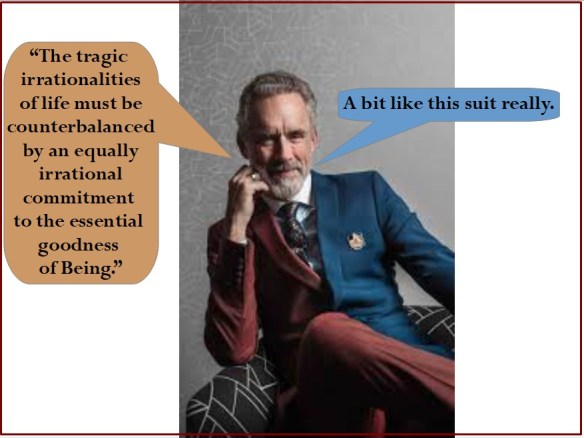
You’ll be overjoyed to hear that Jordan B. Peterson has a new book out. He’s been busy promoting the not at all pretentiously titled We Who Wrestle With God. He was interviewed about it recently in British magazine The Spectator. The interview has to be read to be believed. The introduction can be read here but the rest, alas, is behind a paywall. Don’t worry though, I’ll supply you with the highlights. The article is a goldmine of stupefying statements about God and how Jordan is the only one who really understands the Bible’s stories. They need ‘arranging’, you see, and their underlying ‘hypotheses’ understood:

The Bible presents a series of hypotheses. One is that there’s an underlying unity that brings together all structures of value. The second claim is that there’s a relationship between the human psyche and that unity and each of the main biblical stories casts that unity in a different light, accompanied by the insistence that, despite those differences, what is being pointed to is one animating principle. As far as I can tell, that’s correct.

You got that? As ol’ Jordan humbly admits, this ‘revolutionary realisation’ is his and his alone. Of course, none of this sort of thing is original; the idea that characters, events and stories in the Old Testament prefigure realities in the New is as old as the hills. Typology can be imposed on any set of myths. The gospel writers and Paul did it, seeing Jesus prefigured in Jewish scripture and inventing stories about him so that he complied with these earlier types. There’s nothing ‘revolutionary’ about spotting this, but like so many before him, Peterson gets it back to front and falls, quite literally, for the oldest trick in the Book. Continue reading

What to make of the Supernatural

When I was young, about 8 or 9, I was frightened of creatures that invaded my bedroom in the dark: monsters under the bed, devils in human form lurking in the shadows, that kind of thing. One night when I couldn’t sleep through fear, it came to me that if these creatures were real then so too were the super-heroes I loved: Superman, Batman and the Legion of Super-Heroes! Now, I knew these DC characters didn’t really exist and so I reasoned (I think pretty well for a 9 year old!) that that neither did their evil counterparts, the monsters and devils I was scared of. With this realisation, the horrors were vanquished. Shadows were just shadows. There was nothing scary under the bed.

Somewhere in a recent comment, either here or elsewhere (I can’t remember which nor can I find it), someone informed me that I make the a priori assumption that the supernatural isn’t real.

The term a priori is used with abandon by people who don’t necessarily know what it means so here’s how The Oxford English dictionary defines it:

relating to or denoting reasoning or knowledge which proceeds from theoretical deduction rather than from observation or experience.

I’ll take that. The only way one can assess the supernatural is through reasoning and deduction. There’s no independent evidence for it that can be considered; no external phenomenon to observe and analyse; no science, history or philosophy books that take it seriously or even consider it. I have no personal experience of the beings that supposedly inhabit the supernatural realm; no gods, angels, spirits, demons, ghosts or goblins have manifested themselves in front of me. I’ve never experienced magic, spells or exorcisms, at least not ones that can’t be explained far more convincingly in other ways. So what does that leave in terms of evidence?

Fantasy stories and religious texts. These are the only sources of information about the supernatural, and at least one of them is entirely fictional. Fantasy stories are by definition fiction. They are made up. Similarly, religious works are the products of minds from before the advent of science; explanations of the world and human experience that their creators could construct only in terms of their localised, pre-scientific superstitions. No-one outside of those who’ve chosen to believe in them takes them seriously, which is why their claims are never considered in serious science or history books (Ken Ham’s ‘scientific’ publications are nothing of the sort; they’re religious texts masquerading as science.)

That the supernatural has to be argued for, from an assumption that it does exist, is clear indication it does not; such powerful beings would surely be apparent in the real world, just as they are in Stranger Things (a fiction in case you’re not sure.) No-one has so far demonstrated that the supernatural is real. It is possible to argue it is but only through reliance on the same religious texts, the authority and reliability of which is in dispute on such matters

So, do I make an a priori assumption the supernatural doesn’t exist? Yes, in the sense I take it a priori that it doesn’t. Is this an assumption? No, it is a conclusion arrived at through an assessment of the evidence – there isn’t any: consideration of accounts of the supernatural reveals they’re fictional or prescientific, while personal experience of the apparently supernatural is better explained by rational means. I don’t therefore assume the supernatural doesn’t exist, I deduce it does not.

Actually, I did this when I was 8 or 9.

Back by unpopular demand – it’s the New Year Pop Quiz!

All set? Here we go!

1. Which one of these fantasy figures actually exists?

2. For which one of these ideas is there refutable/verifiable, corroborative scientific evidence?

3. Which one of these events is demonstrably historical?

4. Which one of these phenomena is verified and corroborated by psychology?

5. Applying logic and reasoning, which of the following scenarios is most likely to be true:

6. Which of these statements is verifiably true?

Answers:

Question 1. The answer is none of them, though C, Donald Trump, comes closest. 10 points if you put C, none if you plumped for any of the others: despite the volumes written about them there isn’t an iota of  evidence that they exist.

Question 2. Award yourself 10 points for B, though if you’re a True Believer this is the only one you think isn’t true. There is an abundance of refutable/verifiable, corroborative scientific evidence that it is. You can only wish there were for the other three.

Question 3. A is correct – 10 points. There is a considerable amount of evidence that the moon landing occurred on 20th July 1969. There is absolutely none at all that the other three are historical. For the sake of argument, let’s say they’re mythical. Nul points if you think otherwise.

Question 4. The answer is all of them. Oh no, wait… that’s my cognitive dissonance speaking. D is the only one of those listed recognised by psychologists. My bad and 10 points to you.

Question 5. The answer is of course E. Award yourself another 10 points if you thought outside the box on this one. (You can also have 10 points if you said they’re all equally likely, as in ‘not at all’.)

Question 6. 10 points for D

Scores: 

If you scored 50 or more, congratulations! If you scored nothing at all, you are confirmation that question 6’s answer – D. Human beings are capable of believing just about anything – is true. Well done.

A happy new year to you all.


Encounters with God

I had a couple of encounters with God on a recent trip to the Baltic states of northern Europe. Both were in churches, the first in Helsinki, Finland. The Lutheran Temppeliaukio Kirk (above) is a remarkable structure hewn from solid rock into a stunning enormous cavern. The choir was practising when our tour guide took us there. The singing was sublime, amplified and enhanced by the acoustics of the cave. Listening to the ‘heavenly’ voices was a truly spiritual experience. After the performance, the choir leader dedicated their performance to the glory of God.

The second church was the protestant St Nikolai’s in Kiel, Germany where, local legend has it, a miracle occurred during the second world war. When the town was in danger of being bombed, church officials had all of the church’s historic pews removed and safely stored. The massive suspended crucifix, however, was too big to take down and had to be left in place. Some parishioners quickly became unhappy standing for services and started bringing their own seats, including quite a few sofas. When the town and the church were eventually bombed, the huge crucifix fell from its height and crashed down. While the church itself was all but destroyed, the crucifix survived with only minimal damage, thanks to the sofas on which it landed. A miracle!

The cross suspended again in the restored St Nikolai church

Singing that reflects the glory of God and a miracle in which Christianity’s holy symbol is preserved. Presumably today’s attendees at both churches (St Nikolai’s interior was rebuilt) believe these events to be the work of God. Our tour guide that day expressed his scepticism, as did I, inwardly at least. The singing in the cave church was a tribute not to God but to the human ability to create beauty. It spoke too of the skill of the church’s architects and engineers who provided the building with its stunning acoustics. Human ingenuity, creativity and, I would guess, hours of practice produced the sublime sound.

The crucifix ‘miracle’ was a remarkable convergence of coincidence. A good story to be sure, but not an event that requires any God.

I drew the same conclusion from the two experiences: human beings are prone to give credit to their deities for things they achieve themselves – beautiful singing and stunning architecture included – and to attribute chance events and coincidences to their gods. We should take credit for our achievements (as well as responsibility for our bad behaviour.) The gods have no part to play. There are no gods.

Heretic

Let me recommend a film to you: Heretic starring Hugh Grant, Sophie Thatcher and Chloe East (opens in the US today.) Ostensibly a horror film, it’s actually a dissection of religious faith: what we believe, why we believe it, its origins and how we might break free from it.

While there are a couple of grisly bits in it, it is actually a psychological thriller, with Grant’s character, Mr Reed, intent on breaking down the faith of two Mormon missionaries who have the misfortune to pay him a visit. Despite the hapless women being LatterDay Saints, his arguments apply to all religious belief. The film is a vehicle for this breakdown and demolition of faith. It veers into unpleasantness only in its final quarter, after taking a cynical swipe at the idea of resurrection.

I’m usually averse to horror films and only went to see this one because of the plaudits Hugh Grant’s alternately fatherly and menacing performance received from critics. He really is superb and Sophie Thatcher and Chloe East are excellent as the missionaries, sustaining a Mormon sensibility until it becomes, well, unsustainable. Scott Beck and Bryan Woods’ script is incisive and engaging (if you like your religion ruthlessly dissected and exposed.) Heretic is highly recommended.

God and the Domino Effect

Once free of belief in God, everything that follows collapses.

No God means –

   No divinely inspired scripture, no sin, no salvation, no need of salvation, no repentance or divine forgiveness (and no need of these things either), no grace.

   No supernatural, no heaven or hell, no Satan, angels or demons, no Holy Spirit, no effective prayer, no miracles, no judgement, no eternal life.

  No Son of God, no God Incarnate, no prophecy, no atonement, and, most significantly, no resurrection. 

According to the Bible, God resurrected Jesus (Romans 6:4; Galatians 1:1; Acts 2:22 etc). Therefore, no God = no resurrection.

So, where did all these ideas that, once God ceases to exist, fall like dominoes? Answer: the only place ideas ever come from: the human mind. Everything ever associated with gods, and with YHWH (Old and New versions) is entirely human invention. This is the only logical, rational conclusion.

  Paul’s vision of what he took to be the Risen Christ and his consequent theology: the product of a tortured imagination.

  The resurrection appearances supposedly experienced by Cephas and others: within their own heads (grief-induced hallucinations, dreams, trances, emotional agitation). Or: an emotional response to some natural phenomenon such as bright lights.

  The stories of Jesus that these visions inspired: invented by creative writers imaginatively applying ‘prophecy’ imagined by earlier writers.

  If he existed, Jesus’ Messiah complex: worked up entirely within his own religion-soaked brain.

  His conclusion that the end of the age was nigh and that he would be king of the new order (assuming he really did think this): the result of wishful thinking, all in his imagination.

Subsequent additions to the Christian experience: the Trinity, guesswork about the Messiah’s delayed return, the panoply of saints, heresy, blasphemy, ‘God’s standards’, the inerrancy of scripture, apologetics and, coming full circle, conversion experiences. All creations of the human imagination and emotions.

With no actual God, this is the only viable explanation of the phenomenon that is religion. Human beings did it.