
An experiment in Christian morality

Forget

Time for a little experiment: some data gathering for ourselves that will demonstrate the extent to which Christians are willing to comply, without cynicism or irony, with their Saviour’s peculiar requirements. While the Bible assures us it is wrong to put the Lord God to the test (Deuteronomy 6.16, etc), rest assured the same does not apply to believers themselves.

Our experiment is a cruel one to be sure, but given Jesus’ command in Matthew 5.42, that believers should ‘give to everyone who begs from you, and do not refuse anyone who wants to borrow from you’, we would be within our rights to test their adherence to the principle. After all, Jesus specifies that his followers must oblige ‘everyone’ and ‘anyone’ who asks, which is accommodating enough to include any sceptics conducting an experiment. He doesn’t stipulate either that those doing the asking have to have genuine need; indeed the entire thrust of his teaching in this section of Matthew is about responding sacrificially to unreasonable demands. We won’t be unreasonable – so no slapping of cheeks – and we will do our best to ensure our request is designed to meet as genuine a need as we can create.

For any experiment we need a hypothesis, so I propose that for this particular one we go with something like ‘Christians will not give to those who beg from them nor lend to those who ask to borrow’. If you want to amend this to suit your own circumstances, by all means do. You can choose too whether you’re going to beg, which means you get to keep anything you are given, or to borrow, in which case you won’t and you’ll need to pay it back at a later date.

Next, you’ll need to select your subject: you can choose an individual – they must of course be a card-carding, Spirit-filled Christian – or an institution: a church, say, or Christian organisation like Christian Voice or Focus on the Family. Whichever you opt for, you’ll need to ensure they are capable of meeting your request – we’re not going to pick on Christians of more modest means – and decide what you will ask for. I suggest that if your subject is a renowned evangelist or the pastor of a so-called mega-church you could reasonably ask him or her to lend you the money to pay off your mortgage, for example, or to meet medical expenses. I’m sure he or she will agree that these qualify as truly genuine needs, though you don’t necessarily have to tell them why you want the money, given there’s no mention of the beggars in Jesus’ instructions explaining themselves. On the other hand, if you think it will go some way to help disprove the hypothesis, you can and perhaps should be clear about why you want the cash.

Right. You should be all set. Be sure to let me know how you get on and whether your Christian subject demonstrates the hypothesis or refutes it. I’ll collate the data.

What’s that you say? You’re not going to bother because it’s a foregone conclusion that most Christians, whether prominent individuals, churches, organisations or ordinary believers won’t give to anyone and everyone who asks?

You could well be right, because, although Christians do give generously to causes close to their hearts, they baulk at the idea of giving to just anybody, in spite of what Jesus says. Maybe Christian readers of this blog can explain why; why don’t you do what Jesus tells you in this and many other respects? You cannot be his disciple, he says in Mark 10.25, unless you give away all that you have and he won’t recognise you as a follower unless you obey him entirely (Luke 6.46). So how about it?
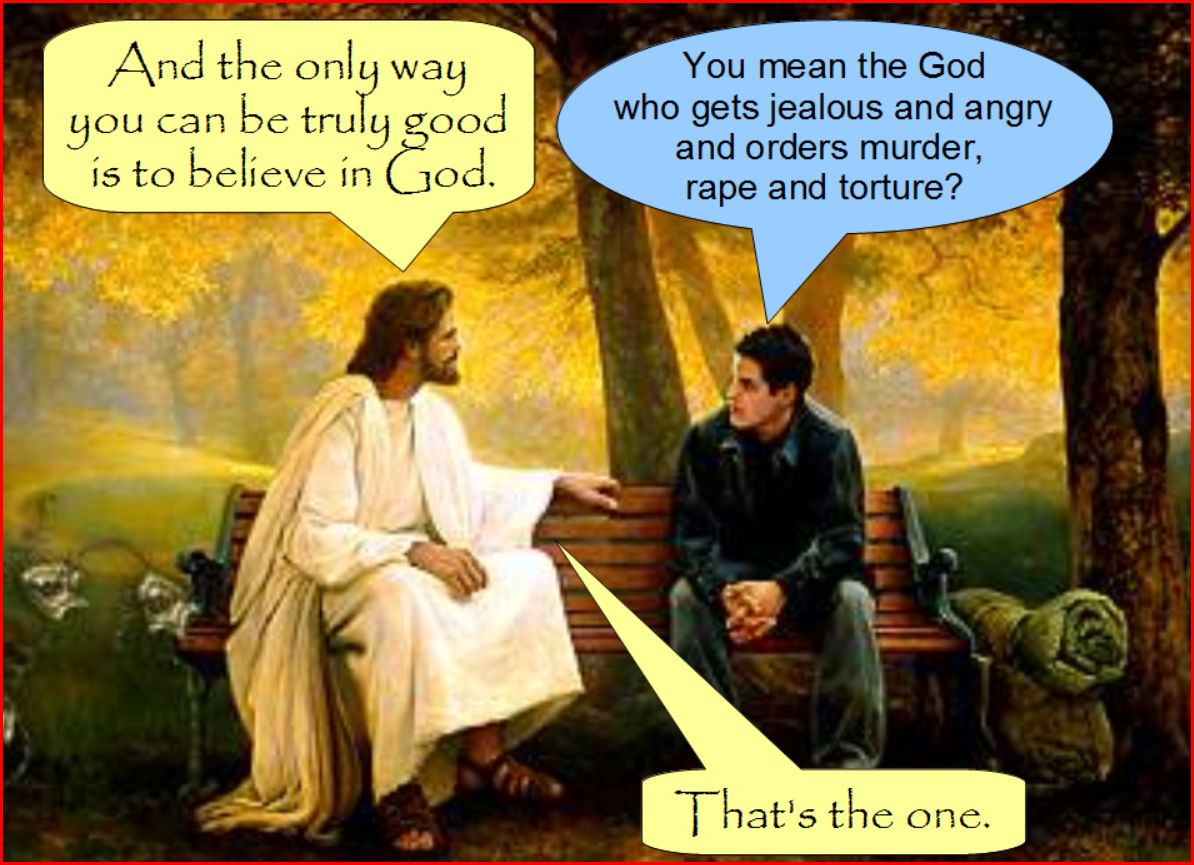
Christians’ Favourite Delusions 8: Atheists can never be moral or happy

moral

Christians regularly exercise these dishonest sound-bytes; here, here and here, for example.

There’s no need to argue with them. All we need to do is look at the evidence:

Good, moral atheists

Immoral Christians

Happy atheists

Miserable Christians

(click all of the above for examples)

If it’s true that only those with a direct line to God can be good and happy, then we shouldn’t see any of these categories. Christians should be supremely happy all, or at least most, of the time – St Paul says that believers are characterised by love, joy, peace, kindness and generosity (Galatians 5.22) – but they’re not. They should be moral and good all the time too – after all, Jesus commands them to be ‘perfect’ and tells them how to achieve it (Matthew 5.43-48) – but they’re not.

According to Christians moral, happy atheists shouldn’t exist. And yet they do. Christians, when they achieve it, are only good and only happy because they think God is watching over their shoulder. When atheists are good and happy it’s because they can be.

Morality Tale

Preaches   A man who believes in the impossible – and it is a man more often than not – appears as a moral authority every morning on national BBC radio. This same man is frequently asked by television networks to give his views on moral issues of the day, be they assisted suicide, pay-day loans, same-sex marriage & adoption, abortion or capitalism. And even when he hasn’t been asked, the views he expresses on these subjects are widely reported, sometimes all around the world. The man can, in one of his roles, sit in the second most important legislative body of the land, again as a moral authority, influencing laws that are binding on everyone else whether they believe in the impossible or not. Indeed, the man has an automatic, unelected right to be part of this august body.

   Where, you might ask, does this man’s moral authority come form? Is he a psychologist with a profound understanding of human behaviour? Or a geneticist with knowledge of the biological bases of our decision making? Maybe a philosopher who has analysed the cognitive processes that lead to moral decisions? An ordinary, educated person, then, who has given much rational thought to how we might best treat one another?

   No, he’s none of these. He’s just a man who believes in the impossible and wears funny clothes to prove it. Invariably, it is true, he has become quite an expert in believing the impossible and he’s even been granted a special place in society that allows him to encourage others to believe the impossible. As a result, he has somehow made the leap into thinking that, because he believes in the impossible, he must therefore be a moral authority.

   Now, we may not object to the man believing in the impossible in the first place – it’s a free country after all – but we don’t accept, surely, that because he does, it means he knows much more than the rest of us about morality?

   Yes, I’m sorry to report that we do. We acquiesce to the man and say ‘because you believe in the impossible, and for no other reason, you must know more about morality than we do.’ And when we are looking for moral guidance, we turn to him – whether we are the BBC, the rest of the media or the government – and we say, ‘what do you say about this? What should we think about it, because, after all, you are the authority here by virtue of the fact that you believe in the impossible?’ And the man, in whatever guise he appears – pope, archbishop, bishop, reverend, imam, rabbi – says, ‘this is what it says in my magic book (even when it doesn’t) and you should follow it, even though you might not believe in either the magic book or in the impossible.

   And we say, ‘Well, you’re the expert and we respect that you should tell us how to behave, if for no other reason than you believe in the impossible.’