Hysteria/Mission Creep/Overreach

When I was head (principal) of a primary (elementary) school in the 1990s, I had a staff member who regarded every small problem as ‘a Major Disaster’ (her words). Everything from a mislaid document to wet weather on sports day was an earth-shattering calamity. She was not the only one to overstate manageable events. Those who wield authority over us, their media lackeys and those with a cause of their own to promote are expert in whipping the populace up into a frenzy disproportionate to the given situation. After a short period in the spotlight, the hysteria and the movements that cause it usually fade, as the media finds something newer and shinier about which to induce panic. Occasionally, the newly out-of-favour movements fight back with renewed vigour, a mission creep extending their influence into new areas.

Looking back over the last 25 years, I and my fellow citizens here in the UK have been expected to be alarmed to an alarming degree about:

The Millennium Bug, when every computer in the world, so the experts said, would crash the instant the year 2000 started. This would, in turn, crash every automated system everywhere, causing chaos and mass fatalities. You all know what actually happened.

Foot & Mouth Disease, when millions of cattle and sheep were slaughtered and burnt. Millions of healthy animals were destroyed in case they contracted the disease.

Weapons of Mass Destruction supposedly amassed by Iraq who, we were told, could unleash them on the West within 45 minutes. That there was no evidence of any WMDs and the fact Iraq did not deploy them (because you can’t deploy something that doesn’t exist) did not deter George W. Bush and Tony Blair from launching their oxymoronic (with the emphasis on the moronic) ‘war on terror’. In so doing, they destabilised the world, creating many of the problems we face today.

Child Abuse Scandals: After either missing or covering up the serial abuse of children and vulnerable people by a BBC celebrity, British authorities went to town on ‘suspected paedophiles’, many of whom were nothing of the sort. (A friend of mine was caught up in this hysteria and spent time in prison for a youthful indiscretion many years earlier.) Unfortunately, this national crisis and the perceived need not to offend Muslims came into conflict when, over 20 years, rape gangs comprised mainly of Pakistani men were able operate in up to 50 UK cities with impunity. Hundreds of thousands of vulnerable, white working-class girls were systematically groomed and raped while the police and authorities turned a blind eye, the consequence of a woke priority taking precedence over the rights and safety of others.     

The Covid Pandemic and Lockdown, when governments the world over (apart from Sweden) panicked about a flu-like virus, closed down entire countries, failed to protect the vulnerable and crashed the very economies needed to fund healthcare and treatment for the infected. Britain was closed down for almost 2 years and still hasn’t recovered from the consequences. Citizens are now paying heavily for actions taken by a government that extended its powers to achieve very little.
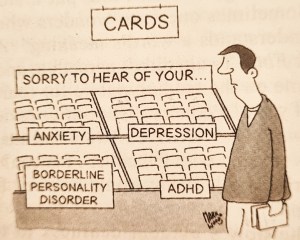
        Cartoon by Mark Woods, Spectator magazine, 7th June '25

Mental Health issues and the medicalised labelling of ordinary human behaviours. We all have mental health issues; this is what it is to be human. Some, it is true, have more than others. Determining an individual has ‘mental health issues’ forces him or her to become his or her issues. Instead of being prone to depression (as I was) or anxiety, the individual who experiences these is now ‘neuro-diverse’. Instead of suffering from a condition the individual could do something about they become that condition. Some people, usually males, used to be diagnosed as autistic. Now that autism is seen as a spectrum, everyone is deemed to be on it somewhere; everyone as a result is autistic. People become trapped in their condition with no way out, lifelong treatment the only recourse.

Black Lives Matter. As Lionel Shriver asks here, do black lives matter any more now than they did before all that righteous indignation and virtual signalling from white people?

Identity Politics in which individuals were told as a matter of urgency to self-identify solely on the basis of their ethnicity, religion, gender or sexuality. Gender dysphoria became a thing from which the trans-movement emerged. While I’ve every sympathy for those who feel they were born in the wrong body, society was unprepared for and incapable of dealing with the consequences. Women became ‘cis-women’, sex became ‘gender’ (a grammatical term), ‘non-binary’ became an option and the abuse of pronouns was politicised. An individual could identify as a plural ‘they’, while others lost their jobs if they declined to play along. Worst of all, children, who were too young to be allowed a tattoo, were given puberty blocking drugs, and in some cases surgery, because they felt they were the wrong sex. Children.

The High Court in the UK recently ruled that a man cannot become a woman, entrenching the views of campaigners and prompting other supporters to claim they knew this all along.

Wokeism; while it’s right and proper to treat each other with kindness, courtesy and consideration, politicising something we were, by and large, already doing was not. Wokeism pushed the boundaries over what could be done or said, or rather could not. Anything that might cause someone else offence was forbidden; commenting or criticising others’ religious beliefs or defending women’s rights became ‘hateful’; having a view on unsustainable immigration numbers made you a fascist. This was the era of cancelling those who did not conform to woke ideals. Toppling statues was popular too on the basis that a long-forgotten figure from 250 years ago may have had a slight connection with the slave trade. Western guilt for actions over which people living today had no part in and demands for reparations to those equally uninvolved ensued.

The ‘necessary’ control of free speech, a panic we’re still mired in. Stupid and inflammatory comments on social media can now earn you a prison sentence longer than that of a paedophile offender, often preceded by a visit from half a dozen policemen who will root through your house looking for evidence that you might have once had a ‘Brexity’ thought. Subjects off limits are; arguing that Covid19 began in a Wuhan laboratory (it might upset the Chinese); Islam, Islamic extremism and the Pro-Palestinian movement (however it’s still okay to criticise and condemn Jewish people for the actions of their government); expressing views different from the UK government’s and whatever the prevailing narrative happens to be. A government agency, ‘Prevent‘, last year redefined terrorism (see below) as ‘vocal support of ideologies that advocate discrimination’ and any expression of what it calls ‘cultural nationalism’. What this means is that those who call out religiously-motivated discrimination, lawlessness and terrorism are to be considered terrorists themselves. Actual terrorism and violence is therefore protected against those who would speak out about it, those who do so being the real terrorists. To put it another way, which I read recently (though can’t remember where): those who say hurty things are far more culpable than those who commit actual hurty things. This Orwellian doublespeak must now be taught in universities and other higher education institutions.  

The Climate Crisis and Net-Zero. You must be alarmed by the climate crisis (see here for how much of it Al Gore got wrong). You must too pay heavily for net-zero, thanks to additional taxes; energy prices in the UK are the highest in the world. You must buy into the government’s attempts to enforce a net-zero energy policy by 2050, despite net-zero being unachievable.

What if, might, could, maybe: the media’s favourite phrases to ramp up hysteria. ‘There might be terrible consequences’; ‘we could be headed for another Major Disaster’; ‘if X happens (though it hasn’t) then Y could possibly follow.’ When did the media stop reporting what has actually happened and take up fortune telling instead?  

* * * * * *

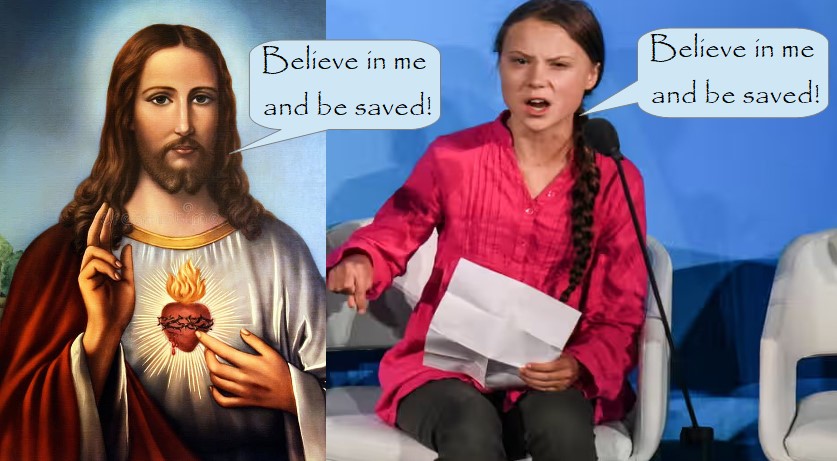
There is some comfort in the fact that the so-called crises and hysteria of the past eventually receded and faded away. So too will many of these current causes. All things, as George Harrison once wisely reminded us, must pass. They will, however, be replaced by others equally irrational and preposterous. Those who create them, be they governments, special interest groups or overwrought Swedish teenagers will expect us to conform to their Chicken-Little levels of hysteria. When they do, don’t be alarmed and be sure to seek out the evidence for yourself.

The More Things Change

What a year it was! The weather went mad! It can only have been climate change. There was heavy snow and hail all over the UK in the first week of January. Shoppers in London collapsed from the cold while a blizzard blanketed the north of England with several inches of snow. Five foot drifts marooned a train in Scotland while in Australia bush fires raged. By the middle of the month ‘killer smog’ had enveloped London and whole communities in Scotland were buried by more blizzards.

Early in February the Hudson River froze from shore to shore for the first time in 37 years. Fresh snow covered Britain again on 20th .

Floods killed 200 people in Australia on March 3rd. A further 44,000 were left homeless and 300,000 animals also drowned.

April saw more unseasonal weather, yet by July temperatures in Scotland reached 80°F (27°C) while Buenos Aires saw its first snow for decades. On July 14th lightning killed a woman and injured 46 racegoers at Royal Ascot. July was the hottest and driest for 86 years in the UK. An earthquake in Turkey killed 4 and left 25 injured. 600 houses were destroyed and 1,000 damaged.

Large parts of the US suffered the worst drought for 46 years and there were water shortages in Britain during August. Towards the end of the month, torrential rain caused serious problems in the south of the country.

By October, 71mph winds caused problems in the north, closing Liverpool’s Speke airport. India’s Punjab meanwhile suffered 12,000 square miles of flooding. 7,000 villages were inundated. Torrential rain and gales hit the south and east coasts of England later in the month. In November the south and west were blanketed in fog and as a result central London was dark by mid-afternoon.

By mid-December dense fog, gales, floods and snow affected all of Britain. In County Durham visibility was reduced to nil while the Orkneys experienced 94mph winds. The area was still suffering from the drought that first affected it in July. Churches took it upon themselves to pray for rain throughout December. Prayers that went unanswered.

The weather was certainly messed up in 1955!

* * * * * *

The weather conditions described are taken from the book, The Year I Was Born: 1955 (I was!) containing newspaper reports from that year. I haven’t included all the variations the book refers to. The world population in 1955 was 2.5 billion (8 billion today), the UK population was 49.5 million (68.4 today) and the USA 166 million (340 today).

Were the extremes of weather in 1955 the result of global warming? No-one has ever said so, not even Greta Thunberg. In fact, no-one mentions how volatile the weather was in the recent past when they’re busy telling us how much more calamitous it is today.

Is it though, really?

On Climate Change

The climate is not having a crisis. I’ve consulted it and it assures me it feels perfectly fine about everything. It explained that every now and then it goes through a few fluctuations, much as we all do in life, and that this isn’t anything new.

I ask the climate whether it is concerned that the changing weather conditions it is imposing on us now are something it has any concern about. It laughs icily and says it couldn’t care less what anyone thinks about what the weather is doing.

It is, it reminds me, only we who are anxious about its recent activities. Frankly, it intones brightly, it doesn’t give a damn. When I put to it that we humans may have contributed to its recent, erratic behaviour it guffaws intemperately and says we’ve merely contributed to the inevitable. It scoffs at our hubris in thinking we can somehow change or even ‘reverse’ the course it has set for itself. It points out that even if the entire world were to stop using oil and fossil fuels right now – which China, Russia, India and the USA aren’t ever going to do – it would make no difference. The weather would continue to do just what it wanted to do.

Maybe I shouldn’t have confused climate and weather as essentially the same thing. After all, scientists tell us they’re not, even as they show us ‘freak’ weather conditions to prove that the climate is indeed having a crisis. Oddly, they don’t seem to accept as evidence environments where the weather is much the same as its always been, only where it’s grown ‘worse’ by human reckoning. They blame events like flash floods and forest fires on climate change when a little research suggests that while these are the consequence of human activity – building on flood planes,  straightening rivers while neglecting to dredge them, failing to clear brush from forest floors to create fire breaks (not to mention the idiots who start fires either deliberately or carelessly) – they are the result of more general stupidity. 

The weather/climate merely chuckles warmly at such folly. It reminds me, it says briskly, of the three hundred years in the Middle Ages when the climate was the same as or even warmer than today’s, and the time in the 14th century when severe storms destroyed large swathes of East Anglia, England. And, it asks coldly, what about the Little Ice Age that affected Europe for 600 years between the 13th and 19th centuries? Remember, it says, when the River Thames froze over on a regular basis so that Frost Fairs could be held on it? All conveniently forgotten now because they occurred before ‘reliable’ records began. The weather reminds me that, despite this, it now kills 95% fewer people with its extremes than it did 100 years ago. And what thanks do I get for it? it demands airily.

The weather storms off, leaving an assortment of climates in its wake. I get the impression it will continue on its own sweet way regardless of anything we can do. It will fluctuate, as it put it, delivering ‘extremes’ of heat and cold, storms, clement and inclement weather (as we might see it) because that is what it has always done, indifferent to those living under its tyranny.

We Need To Talk About Pride

I recently had a letter published in The Spectator, one of the world’s oldest news and politics magazine, first published in 1828. I was responding to an article by Lionel Shriver, an author I like, famous for We Need To Talk About Kevin, and Mania, who was writing about how Pride is now redundant. This may be so, but her argument consisted of a number of fallacies that I felt compelled to address (her original article is behind a firewall, unfortunately.) I thought you might like to read my reply:

Sir: In ‘The War on Normality’, Lionel Shriver does precisely what she accuses gay people of doing. She reduces relationships to mere sex and then equates sex with only reproduction (or lack of it.)

Does she not know that both ‘heteronormative’ and homosexual people have sex for pleasure; most sexual activity in the world is for this hedonistic purpose, not reproduction. She next repeats the fallacy that homosexuals couples cannot reproduce. I can assure her they can, if not with each other, and play their part in advancing human evolution.

More than this, homosexual people value relationships, from which they derive companionship, affection, fulfilment and yes, intimacy, just as much as their heteronormative counterparts. Why Ms Shriver thinks gay people are any different in this respect is a mystery. Perhaps she realised she couldn’t write quite such a condemnatory column unless she did so.

Yours, happily (and proudly) in a same-sex relationship,

Neil Robinson

The intelligentsia’s misrepresentation of gay people makes it easy for more extreme bigots to advocate for their suicide and execution. It’s a small step then for some to take matters into their own hands. Looks like we do still need Gay Pride, after all.

In which Howard visits Heaven and talks to Jesus

I recently finished reading My Descent Into Death and the Message of Love Which brought Me Back by Howard Storm, in which he recounts events surrounding his serious illness in the 1980s. This, he is convinced, caused his death after which some very dark beings, who at first he mistook for deranged medical staff, attempted to drag him off to a very sinister place. Fortuitously, Jesus and his angels were on hand to intervene and rescued hell-bound Howard.

Perhaps in my Evangelical days I would’ve lapped up stuff like this, but not now. A Christian friend – the same one who lent me the book I wrote about here – bought me. I promised I’d read it but what a struggle it was.

Once rescued by Jesus, Howard felt divested of his ego and overcome by love. He underwent a life review and was ever so gently ticked off for all the times he was less than kind. Instead of enjoying this state of bliss, however, Howard took the opportunity to bombard Jesus and the angels with banal questions, which given Howard’s comatose state they had time to answer at great length over many hours (which is how long it takes to read about them.)

When he came round and discovered he wasn’t actually as dead as he thought he was, Howard was a changed man. Once back on his feet, he joined a succession of churches so he could share his experience. When they didn’t fully appreciate how he’d really spent time with actual Jesus, he trained for the ministry himself. He has been a pastor now for several decades, regaling people with the tale of his encounter with fantasy heavenly beings.

Undoubtedly, Storm’s experience was powerfully real to him, so much so it changed his life on his return to reality. As I read My Descent Into Death, however, I couldn’t help but feel I’d heard it all before: in Paul’s account of his imaginary visits to heaven and his encounters with a resurrected Jesus. These were probably not Near Death Experiences (NDEs) – though who’s to say – but, like Storm’s, brain-induced hallucinations.

As scientist Britt Hartley explains in the video sent by koseighty a while back, we now have a much greater understanding of NDEs; they are culturally determined hallucinations induced by the brain as it begins its shutdown. Hartley is clear that under stress the brain is more than capable of creating reassuring visions for itself.

But like Howard Storm’s, Paul’s ‘revelations’ are more than a mere sighting of Jesus. Paul too has a long discourse with the heavenly being conjured up by and in his own brain. He imagines Jesus explains to him how salvation works (in a mighty complicated way) in the same way Howard does. I’m sure this discourse, like Howard’s, did not take place during the visions but were worked out later, over time, as Paul, and Howard, interpreted what the inner-visions ‘must’ have meant.

Oddly though, given they both encountered the same character, it’s difficult to reconcile the messages each was given by him. Storm’s is of a mushy universal love, devoid of the demands and convoluted theology of Paul’s Jesus. Strange that the Jesus Christ who is, according to Hebrews 13:8, the same yesterday, today and forever, has modified and softened his message in the two thousand years between Paul’s and Howard’s revelations. It couldn’t be because Howard’s is the result of his conditioning by a modern American culture that sees Jesus as a shiny, white-robed figure surrounded by angels who dispenses nothing but all-embracing love and happy-clappiness, could it? It surely could.