
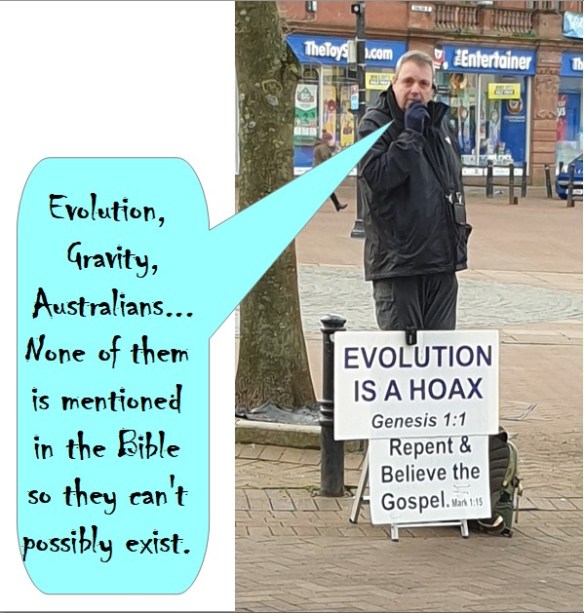
Anti Podeans

In Heresy (p243-248), Catherine Nixey relates how Greek philosopher Plato (b. circa 247BC), aware that the Earth was spherical, speculated there were lands on the other side of it. He ‘posited the idea that if one walked around the world far enough, one would end up in a position where one’s feet (podes, in Greek) would be opposite (anti-) the position you had been in when you first started walking… the notion of Antipodes had been born.’ By the first century AD, ‘Pliny the Elder… was therefore able to observe that all educated men agreed the world was spherical and that there were Antipodes.’ He wrote of the inhabitants of the Antipodes whom, he said, were as unlikely to fall of the world as those who lived in the northern hemisphere.

A thousand years after Plato and we find Christian writers rubbishing the ideas of these clever men. One, Lactantius (b. 240), declared that the idea the Earth was spherical was ridiculous and lampooned the ‘senseless’ notion that there were people on the other side of it ‘whose footsteps are higher than their heads.’ The ‘pagans’ who suggested such things, he argued, needed ‘divine instruction; for that only is wisdom.’ Augustine (b. 354) too argued that there were no Antipodeans in the Bible and as ‘there is no falsehood in scripture’, then Antipodeans could not possibly exist; the very idea was ‘absurd’. And so it continued: ‘Saint’ Jerome (b. circa 342) declared that the notion of Antipodeans was ‘witless’, while Cosmas Indicopleustes (6th century) wrote that ‘pagans’ ‘vomit out fictions and fables’ about the earth and solar system. He set about disproving these fictions from the Bible and did so, to his own satisfaction at least.

Scripture and the teaching to which it gave rise, set human knowledge and learning back a millennium: the so-called Dark Ages, in which, thanks to the church, ignorance and superstition prevailed. It wasn’t until the thirteenth century that Greek ideas began to be rediscovered and revived.

Despite this, there are plenty of people around today who think that the world was created in six literal days, a virgin gave birth, they themselves will live forever and the world will end soon when Jesus comes through the clouds. All because the Bible says so.
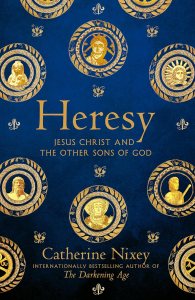
Heresy: Jesus Christ And The Other Sons Of God

I’m reading Catherine Nixey’s new book Heresy: Jesus Christ And The Other Sons Of God (I reviewed her previous one, The Darkening Age, here). Among other things, she demonstrates in Heresy how Christianity is a product of its age,  an age when dime-a-dozen saviours, miracle cures and resurrections were seen as real. Nixey also shows how, from the start, there were many ‘Christianities’, not just one. The set of beliefs that eventually became, by fair means and foul, the orthodoxy, jostled alongside hundreds of others for well over a century. Despite their proliferation, however, early Christianities remained an insignificant cult for almost two centuries.

Those who recognised these early forms of Christian beliefs for what they were, were vociferous in their criticism of them. Much of what they had to say no longer exists, unfortunately, thanks to later Christians who frequently destroyed it. We know of it, however because of what survives in the works of Christian writers who in their refutations quoted from it.

The arguments offered by these early critics still sound remarkably relevant today; the objections of modern sceptics are not really new. The likes of Celsus (b. circa AD140) and Porphyry (b. circa 234) came up with them first. Their early criticism bears repeating:

Celsus:

If these people proclaim Jesus, and others proclaim someone else, and if they all have the common glib slogan, “Believe if you want to be saved, or else away with you – well then, what will those do who really want to be saved? Are they to throw dice in order to divine where they may turn, and whom they are to follow?’ (Heresy, p26)

Those who claimed to have witnessed the resurrection were either ‘deluded by… sorcery, (or through) wishful thinking had an hallucination due to some mistaken notion. (An experience which) has happened to thousands’. (p47)

while he (Jesus) was in the body, and no one believed upon him, he preached to all without intermission; but when he might have produced a powerful belief in himself after rising from the dead, he showed himself secretly only to one woman, and to his own boon companions.(sourced here)

According to Porphyry,

Christian parables were ‘fictitious’… no more than imaginative little stories… replete with stupidity, written in a ‘comical and unconvincing style. (Heresy, p24)

Responding to Christians’ belief in bodily resurrection, Porphyry points out that many ‘have perished in the sea and their bodies eaten by fishes and many have been eaten by wild birds and animals. How then is it possible that these bodies should return?’ (pp47-48)

How indeed.

Critics like these were soon silenced, their work burnt – Celsus’ survives mainly in Origen’s rebuttal – and, as the church assumed greater power, so too were later authors.

As Nixey demonstrates, the word heresy originally meant ‘choice’. For Christians it soon came to mean making the wrong choice, the adoption of beliefs that did not conform to those who, in the ascendancy, came to control ‘Christian Truth’. Whoever chose otherwise, including those of alternate Christianities, were condemned as heretics in the new meaning of the word.

(Edited for sentence drop-out)

Gullibility

On the left, oily evangelical preacher the reverend canon Mike Pilavachi (yes, really. No irony at all in those self-aggrandizing titles.) Pilavachi used his spiritual authority to abuse young men, compelling them to take part in homoerotic wrestling matches and providing them, for his own kinky gratification, with full body massages. Because, you know, it’s what Jesus would’ve wanted. He also bullied and manipulated others in his church and ‘across the world’ in his ‘ministry.’ So far so much par for the course.

What I find incredible is the reaction of one of Pilavachi’s victims, Matt Redman (right), musical partner in Pilavachi’s Soul Survivor church festivals.

Redman had this to say recently:

I think Jesus is an expert at bringing things into the light, and I think that’s what’s happening in this whole process. I think Jesus is doing this. I think Jesus is cleaning up his church and bringing something into the light that needed to be in the light.

What lunacy! Jesus will bring the sordid goings ‘into the light’, which raises more questions than it answers :

Was it Jesus who brought these doings into the open or was it victims who found the courage to speak out? If it really was Jesus, why didn’t he reveal matters much sooner to prevent more young men from falling foul of the deplorable Pilavachi’s abuse? Why, indeed, did Jesus not prevent the abuse in the first place, saving everyone the pain and psychological damage Pilavachi’s actions caused? Why did Jesus not make Pilavachi into a brand new creation, as promised in 2 Corinthians 5:17, when first he imbued him with his Spirit, a creation that lacked the desire to manipulate and abuse others?

I think we know the answer to all these questions.

Believing in Jesus is to believe in a fiction that has no more concern for your well-being than Casper the Friendly Ghost (to whom he is closely related). As much as I empathise with the vulnerable Matt Redman, he needs to be less forgiving of Pilavachi, reassess his reliance on a shadow and face reality. If anything, his belief in Jesus led him into the clutches of a psychopath who used him for his own gratification.

Mike Pilavachi has yet to be questioned by police. I guess Jesus really does look after his friends.

Respect

Even before the events in Israel and Gaza, there were numerous recent examples of the term Islamophobia being used to suppress freedom of expression or shield wrongdoing.

A recent report by an all party group of UK MPs.

I’ve been told before that I should respect people’s religious beliefs. We all should apparently.

I can’t, I confess, summon respect for patent nonsense, nor for those who subscribe to it. I’m not even going to try.

There have, I admit, been a few believers I’ve met in life for whom I have had respect and even admiration, but this has been for the kind of person they were, not because of their religious beliefs per se. And no; their religion is not what made them admirable people. They were admirable irrespective of, or even despite, their irrational beliefs. I still hold to the theory of my own making, that religious conviction is like alcohol: both accentuate the existing characteristics of the individual, making them more of the person they already were, for better or for worse.

Equally, I’ve met many non-believers (I hate it that we have to describe ourselves as what we are not), LGBT people (for many religionists, the antithesis of admirable) and individuals whose views and outlook on life I haven’t necessarily agreed with, for whom I have also had respect and admiration.

It comes down to the old cliche, a truism nonetheless, that respect has to be earned. Just because someone believes in the supernatural or that Jesus died for our sins or that their deity or prophet trumps all others doesn’t mean I have to respect such views, or indeed those who hold them.

But this is where we’re headed, it seems. We’re expected to respect any old make-believe so long as it comes under the banner of religion and still more that doesn’t. It’s becoming ‘hateful’ to criticise religious belief and those who practise it. Because their views are sincerely held, the thinking goes, they merit protected status.

I commented some time ago on a Christian site (something I rarely do except when incensed) that was insisting ‘sodomites’ would burn in hell, because… the Bible. I countered that gay people were not going to hell because, in fact, no-one was. As well as the subsequent ‘loving’ comments from Christians, I was taken to task by a gay person telling me I was disrespecting the original poster’s Christian convictions.

Likewise when I suggest that we should be more wary of Muslim beliefs I’m told I’m being profoundly unfair, racist and Islamophobic, towards a minority – as a minority of one myself – and I should show more respect for an ancient and sacred tradition as well as those who subscribe to it.

I can’t do it. I can’t respect religious belief. It is no more worthy of respect than astrology, palm reading and spiritualism. It flies in the face of rationality. Not only is it insupportable, it is dangerous, a threat to hard-earned freedoms and rights.