
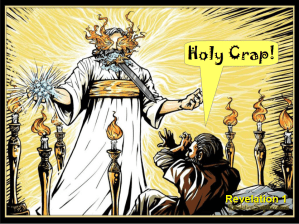
According to Matthew and Luke’s gospels, Jesus was a revolutionary. He wanted to see the world turned around, the very meaning of the word revolution. He preached that the world as it was would be destroyed and remade, this time with the social order reversed. Those who had been first in the old order – the rich, the powerful, the cruel – would be made to be the last, while those who were formerly last – the poor, the downtrodden, the lowly, the compassionate – would find themselves in first place. They’d be best in show, the new top dogs and, in ways that really mattered, rich. Meanwhile, those who had really committed themselves to him, his closest followers, would become the rulers with him of the renewed revolutionised order that he envisaged: his Kingdom of God.
How would all this happen? Jesus’ Father in Heaven would soon be sending the Son of Man to set the revolution in motion. This powerful being, who perhaps Jesus envisaged as being none other than himself, would ensure all the unimaginable but necessary changes would be achieved. There would be some violence of course, because you can’t have a revolution without at least a little violence:
Do not think that I have come to bring peace to the earth; I have not come to bring peace, but a sword. (The Prince of Peace himself in Matthew 10:34)
Even now the axe is lying at the root of the trees; every tree therefore that does not bear good fruit is cut down and thrown into the fire. (Matthew 3:10)
Once the old is done away with and the new order established, there would be something of a socialist utopia on Earth. Everyone would share what they had; each would have his or her needs met by everyone else. Even those who came late to the party would enjoy all the rewards the new Kingdom had to offer (Matthew 20:1-16). There’d have to be some slaughter too of course: the one who advocated loving one’s enemies looked forward to exacting bloody revenge on his:
“But as for these enemies of mine who did not want me to be king over them—bring them here and slaughter them in my presence.” (Luke 19:27. See also Revelation)
Except of course, none of this happened. The Son of Man did not emerge from the clouds when Jesus expected him to. He himself did not become the Son of Man, ready to kick-start the great social revolution. Instead, the rich, the powerful and the cruel put an end to Jesus’ revolutionary ideas; they were gaining too much traction among the poor and downtrodden and needed to be quashed. An uprising couldn’t be ruled out, specially as Jesus recognised the need for force:
From the days of John the Baptist until now the kingdom of heaven has been coming violently and the violent take it by force. (Matthew 11.12)
He predicted too that blood would be spilt, going so far as to recommended his followers arm themselves:
He said to them… ‘the one who has no sword must sell his cloak and buy one. For I tell you, this scripture must be fulfilled in me, “And he was counted among the lawless”; and indeed what is written about me is being fulfilled.’ They said, ‘Lord, look, here are two swords.’ He replied, ‘It is enough.’ (Luke 22:36-38)
According to the gospels, the Jewish religious leaders persuaded the Roman authorities to do away with this dangerous revolutionary and insurrectionist. Once they were made aware of him, the Romans were more than happy to oblige. They mocked Jesus’ aspirations as King of the Jews and crucified him alongside other ‘rebels’ (Matthew 27:38).
His followers however were not yet ready to let go of him or his revolutionary ideas. Perhaps they saw the possibility of their ruling the world slipping from them. They continued to preach that he would appear again, possibly as the Son of Man, to bring about the revolution he had foreseen.
This is, as I say, Matthew and Luke’s version of events. The writers of the fourth gospel would jettison the failed New-World-Order narrative, building their own Superman-Jesus and dispensing entirely with the great social revolution. In their story, the Kingdom of God is ‘not of this world’ (John 18:36) but only in people’s heads.
The four gospels are, of course, make-believe; allegories of the hoped for Messiah. The Kingdom of God, the revolutionary leader, the reversal of the social order are what some of the earliest cultists wished for, looked for, hoped for. It is their aspirations that are reflected and embodied in the earliest gospels. Like the hopes and dreams of every cultist before and since, they came to nothing.
Many of today’s Christians would not, in any case, have cared for the Kingdom of God that Matthew and Luke’s Jesus is made to promote; far too much socialism and the wrong sort of people in charge. Jesus’ new Kings of the World would, in any case, have made a mess of things in much the same way as all those who took control in the revolutions the world did actually experience. Power, as Lord Acton put it, corrupts and absolute power corrupts absolutely. Better for Jesus that he became a personal saviour, confined to the minds of those who think he really existed, a mere revolutionary in the head.

 This is not the scheduled post. I’ve shelved that for the time being for fear of nasty repercussions. I don’t believe it was inflammatory; in fact, it was well researched and perfectly reasonable. However, as all theistic religions are barbaric at heart, with followers and supporters prepared to take radical action in defence of their particular man-made deity, I’m not prepared to take that risk just yet.
 WordPress has changed the way in which blogs are created and posted. They added an alternative way of doing it about two years ago, called Block Editor, which I and many others found difficult to use. There was however the ‘old’ system, which WordPress dubbed ‘Classic Editor’, to fall back on and continue using. This I’ve been doing, occasionally dropping into Block Editor to see if the bugs have been ironed out. No doubt WordPress doesn’t regard these as bugs but missing tabs for adding pictures and hyperlinks, and the absence of a Schedule button for setting the publication date sure seem like it to the user. I can never find them in Block Editor (see the screenshot below for how helpful it looks) and while these same features are inclined to relocate themselves in Classic Editor too, at least they’re there somewhere!
 rejectingjesus,