God and the Domino Effect

Once free of belief in God, everything that follows collapses.

No God means –

   No divinely inspired scripture, no sin, no salvation, no need of salvation, no repentance or divine forgiveness (and no need of these things either), no grace.

   No supernatural, no heaven or hell, no Satan, angels or demons, no Holy Spirit, no effective prayer, no miracles, no judgement, no eternal life.

  No Son of God, no God Incarnate, no prophecy, no atonement, and, most significantly, no resurrection. 

According to the Bible, God resurrected Jesus (Romans 6:4; Galatians 1:1; Acts 2:22 etc). Therefore, no God = no resurrection.

So, where did all these ideas that, once God ceases to exist, fall like dominoes? Answer: the only place ideas ever come from: the human mind. Everything ever associated with gods, and with YHWH (Old and New versions) is entirely human invention. This is the only logical, rational conclusion.

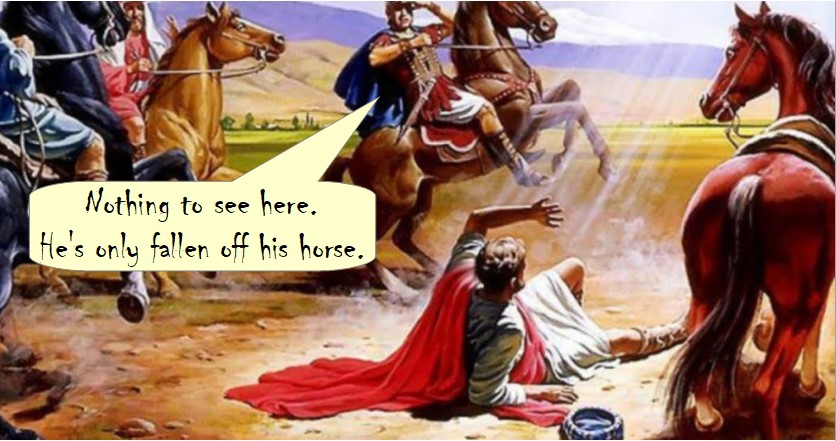
  Paul’s vision of what he took to be the Risen Christ and his consequent theology: the product of a tortured imagination.

  The resurrection appearances supposedly experienced by Cephas and others: within their own heads (grief-induced hallucinations, dreams, trances, emotional agitation). Or: an emotional response to some natural phenomenon such as bright lights.

  The stories of Jesus that these visions inspired: invented by creative writers imaginatively applying ‘prophecy’ imagined by earlier writers.

  If he existed, Jesus’ Messiah complex: worked up entirely within his own religion-soaked brain.

  His conclusion that the end of the age was nigh and that he would be king of the new order (assuming he really did think this): the result of wishful thinking, all in his imagination.

Subsequent additions to the Christian experience: the Trinity, guesswork about the Messiah’s delayed return, the panoply of saints, heresy, blasphemy, ‘God’s standards’, the inerrancy of scripture, apologetics and, coming full circle, conversion experiences. All creations of the human imagination and emotions.

With no actual God, this is the only viable explanation of the phenomenon that is religion. Human beings did it.


Deconversion


In the late 1980s I reach a crisis point in my life. I pray for God’s guidance . I pray for wisdom. I don’t pray to ask him to resolve the situation (not of my making). The heavens, however, are as brass. I begin to entertain the idea that rather than God ignoring me or expecting me to sort the problem (which eventually led to me having a breakdown) he might not – gasp – exist! I had gone from being someone who heard God speaking clearly in my head – telling me I should ‘witness’ to some ‘lost’ soul or other – to someone contemplating whether I’d imagined it all.

What at first seemed like a possibility began over time to feel more like a probability. I borrowed books from my local library written not by evangelical authors but by secular scholars (if bishops can be regarded as such) – John Robinson’s Honest to God, Morton Smith’s Jesus the Magician Resurrection: Myth or Reality? John Shelby Spong’s A Bishop’s Search for the Origins of Christianity, and later still Bart Ehrman’s many books.

I began a journey of discovery, exploring what it was I had believed when a committed Christian. Irrationally perhaps, I clung to a belief in God longer than I did other aspects of Christianity. After all, God is kind of generic and could conceivably exist and operate independently of Christianity. I reasoned that God must, by definition, be superior to the anthropomorphic concepts of the Bible. I held on to this idea of a generic God for another decade or so. It gave me a sort of comfort, I suppose. I was aware he wasn’t compatible with all the Jesus stuff I’d once believed. Would a god who created the universe really require a human sacrifice to make peace with his own creation? It seemed unlikely.

My friendly but distant god sat comfortably in the back of my mind while I got on happily with life without him and without thinking about him very much either. Until one day, walking home from work, I suddenly wondered why I was bothering. Why was I sustaining the idea of a god? Any god: generic, biblical or comfort blanket. I didn’t need to. I didn’t need him (nor, if we pretend he really exists, he me.) Everything about life, the universe and everything was, in any case, more than adequately explained by science, evolution, astronomy, psychology (in which I have a qualification). In something like a revelation, I realised that no God existed. Not the YHWH variations in the Bible and not my nicer version of him. In that instant I stopped believing in God, god and gods. One second I was a believer (of sorts), the next I wasn’t.

It was liberating. I didn’t have to work out what God was really about, didn’t have to please him, ask his forgiveness, seek his grace, or any of the other convoluted nonsense that goes along with ‘him’.

  • Was this revelation as emotional as my original conversion? I don’t think so. It was the culmination of years of thinking, reading and challenging myself. My ultimate deconversion from god-belief was a rational process.

It had repercussions of course, which I’ll deal with next time. In the meantime, how does my deconversion compare with yours, those of you who’ve had the good fortune to have one?


Conversion

I’d be interested to know, of those of you who are no longer Christians, what led you to become one in the first place.

It seems to me there are thousands of websites, books that argue philosophically for the validity of Christianity, present their evidence for the resurrection and generally take an intellectual approach to promoting the faith.

I’d be very surprised if this ‘evidence’, which is poor at best, and Christians’ philosophical arguments lead anyone to Jesus/God/faith.

My own experience is that conversion is an emotional experience. As a teen I listened to speaker after speaker at the YMCA I attended tell me how their sins had been forgiven and how getting to knew Jesus had given them a great sense of peace and purpose. I originally went along to the YM, as we called it, to meet friends, play table–tennis and drink coffee while listening to the juke-box. I had no idea I was a sinner nor that I needed forgiven but I liked the enthusiasm – they said it was ‘joy’ – that the speakers conveyed. I thought too I could maybe do with a sense of purpose though I was, as a fifteen year old, quite happy drifting along relatively aimlessly.

The persistent drip feed of what Jesus could do for me (and others) was persuasive. It sowed the seed, as the Christian cliché has it. It took a lively young American evangelist from Arthur Blessitt ministries to convict me. Jesus had turned his life around and he was on his way to heaven. Denying Jesus, he said, was to crucify him all over again. So I prayed the sinner’s prayer and gave my life to Jesus too.

Nowhere in any of this was there anything philosophical, no ’proof’ of the resurrection, no explanation of how the Bible was the Word of God. All the talks were appeals to emotion – how I could feel forgiven, how I could know love, joy and peace, how I could live forever after I died, up there with God in heaven.

All the rationalisation came later, like it always does. Psychologists tell us that the intuitive part of the brain makes decisions ahead of the rational part, which seeks to catch up afterwards, supply the reasons why the decision we’ve made is a good one. We’ve all done it when we’ve bought that item we don’t really need and have justified it all the way home. Religious conversion follows this pattern.

The thinking mind only becomes involved afterwards, hence ‘post hoc rationalisation’. We then become complicit in our own indoctrination: Bible study (both group and individual), listening to sermons, learning from more mature Christians, worship (all those song and hymn lyrics reinforcing the mumbo jumbo), reading Christian books, immersing ourselves in the complexities of the religion. This is how it’s always been. As Paul puts in 1 Corinthians 3:2, we move from milk to meat as we delve further into ‘the mysteries of Christ’. Or, more accurately, we become more deeply indoctrinated.

But all of this comes later. The emotional experience is first, as it was for Paul, C S. Lewis (who described it as being ‘surprised by joy’), George W. Bush and millions of other converts. In my Christian days, I personally ‘led people to the Lord’, by ‘sharing my testimony’ (I’ve still got the jargon!) and can assure you, those involved felt the Holy Spirit with a profound intensely. Only kidding. They became pretty emotional.

I know of no-one who became a Christian by assessing the evidence for the resurrection, reading Paul’s theobabble or analysing the central claims of Christianity. I suppose there might be some who, like Lee Strobel, insist they ‘came to faith’ this way. But faith and rational analysis are incompatible. When the writer of Hebrews (11:1) says: ‘faith is the substance of things hoped for, the evidence of things not seen,’ he is oblivious to the fact that there isn’t any ‘evidence’ of unseen spiritual ‘things’. There are only our own feelings and emotional confirmation bias.

So that’s how it was it for me. How was it for you?

Next time I’ll take a look at the deconversion process.

Should Sceptics* Comment on Christian Sites?

This post was written for Bruce Gerencser’s blog last month. In case you missed it there (What? You don’t read Bruce’s blog?) here it is again in slightly amended form.

Is it ever reasonable for non-believers to comment on Christian blog sites? I know Bruce compares it with turning up at a church service and arguing with the preacher, and a recent comment on Debunking Christianity described it as ‘bad manners’. But are there circumstances where it’s reasonable to do it?

Can I suggest a couple of scenarios where it might be? I should declare first that I rarely comment on Christian sites – I have a life to live, after all – and have, I’d guess, done so no more than a dozen times in the past three or four years. This hasn’t been to promote atheism, but to counter the ignorance and intolerance of some Evangelical sites.

So here are my thoughts on when it’s okay to stray over to the dark side and engage with its denizens. First is when True Believers arrive on this site and tell me, usually in no uncertain terms, where I’m wrong. This is often for the same few reasons that are directed at other sceptic bloggers: I don’t know the Bible well enough; I misinterpret it; I don’t know Jesus the way they do; I was never really a Christian. Having batted these ad hominems around for a while, some commenters decide there’s nothing for it but to recommend posts of their own. They provide links to their blogsites that will set me and you, my reader, straight. Now and then (but not always) I’ll take a look at and, if appropriate, comment on what they’ve written. After all, they have specifically invited me round to their place; I haven’t gate-crashed, they wanted me to visit so they could enlighten me. I have, as a result, the right to reply, to let them know they haven’t. I don’t, if I can help it, argue theology or push any particular ideology, but I have been moved to point out that the Bible is open to multiple interpretations and theirs (or, I suspect, their minister’s) involves a considerable degree of cherry-picking to make it compatible with their orthodoxy. Of course, they have the right, and the means, not to publish my comment if it upsets them too much.

Second, Facebook’s algorithm – and that of other social media sites presumably — is fond of finding extreme Christian sites to add to my much-neglected page. Invariably I delete these and tell the algorithm I want to see fewer posts of this sort. It complies for a short while before it decides I really do need to know that Jesus is my friend or that I’m headed straight to hell. (Honestly, you write a few articles that mention Jesus and God and the entire Internet thinks you want to be cosy up with JC.) Now and then, and rather more frequently than I’d prefer, the nuttier sites that pop up announce that atheists have no basis for morality and are shaking their collective fist at God who’s feeling mighty wrathful about it. Alternatively, these sites find the need to headline the scourge of homosexuality, which likewise is bringing the Western world, and more specifically America, to the verge of destruction. Now I happen to be both an atheist and a homosexual (I don’t have any trouble with this word despite its use by some as a slur). I feel that, as sites disparaging either atheists, gays, or both have intruded on my FB page, it is again perfectly appropriate for me to respond, which, every few years, I do. Prejudiced, ill-informed, hateful opinions about me and my kind, be they atheist or gay, need to be challenged. These bloggers’ claims that their anti-atheist, anti-LGBT rhetoric is a ‘ministry’ or a demonstration of love are disingenuous. They’re nothing of the sort.

So I suggest to these bloggers that they are wrong. I like, also, to remind them that their Saviour commands them to love their neighbours as themselves and to love and pray for their enemies, to which they invariably reply, ‘even the devil can quote scripture’. I have been known to point out too that Jesus expects them to feed the hungry, help the needy and care for those less fortunate, and that sitting at a computer for hours on end, trashing non-believers and ‘sodomites’ (I do object to that one) isn’t what he had in mind.

Am I wasting my time? Almost certainly, but I can’t stand by as ‘loving’ Christians judge me, and others like me, as fit only for hell – and sometimes for more worrying, tangible fates in the real world.

Commenting on Christian blogs is not always for the faint-hearted, nor is it something I’d advocate. Many don’t even allow comments, so certain are they that they’re right (or perhaps they’re just fearful of contradiction; faith is, after all, a very fragile thing). Occasionally, however – a couple of times a year – I feel compelled to counter their attacks on others.

What do you think?

*British spelling, of course

Whatever Happened To Pontius Pilate?

While indisputably a real person, we know only a little about Pontius Pilate, primarily from Philo, writing circa 41CE, and also Josephus (writing 75-79CE). Pilate was appointed as prefect, or governor, of Judea in 26CE and after ten years of insensitive and brutal control was, according to Philo, recalled to Rome in 36 ‘to stand trial for cruelty and oppression, particularly on the charge that he had executed men without proper trial.’ (On the Embassy to Gaius)

Described by Philo as having ‘an inflexible, stubborn and cruel disposition’, Pilate was not the kind of man who would entertain in his private residence those marked out for crucifixion, nor one who would feel remorse at the execution of thieves, insurrectionists and general trouble makers. It is likely he had hundreds if not thousands of them crucified during his time as prefect.

Would a man known for ‘his venality, his violence, his thievery, his assaults, his abusive behaviour, his frequent executions of untried prisoners and his endless savage ferocity’ (Philo), have a prisoner over for a chat about the nuances of the meaning of Truth? Almost certainly not.

Would he have suffered mental anguish because he might be about to execute an innocent man? Absolutely not.

Would he have symbolically washed his hands to ease his conscience? He would not.

Would he have offered a rabble the chance to free Jesus or the bandit Barabbas? Again, absolutely not. There was no such ‘tradition’ and the episode is clearly symbolic.

If Jesus was crucified ‘under Pontius Pilate’, the Prefect himself would, in all probability, not have been aware of it. Jesus would have been one more seditionist among many. Nor would Pilate have granted a member of the Sanhedrin, unrelated to the crucified criminal, the right to remove his corpse from a cross to give it a decent burial in compliance with Jewish ritual. Pilate was known for his insensitivity to such niceties.

Jesus’ encounters with Pilate in the gospels are so entirely implausible they can only be fictional. The two would never have met. Even if they had, none of the gospel writers would have known the details of their exchanges, different in each gospel. In all of them, the cruel and savage Pilate behaves entirely out of character.

While no records survive of any trials conducted by any prefect of the area (because there were none in the first place?) it is perhaps surprising that details of Jesus’s trial were not preserved, when only a few days later, reports that he had returned from the dead began to circulate. Yet, say apologists, this is one of the few indisputable, ‘minimal’ facts we know about the historical Jesus: ‘he was crucified under Pontius Pilate.’ It’s there in both the Nicene creed (325CE) and the so-called Apostles’ creed (circa 341). Yet Paul, writing close to the time of Pilate’s supposed involvement, doesn’t mention him, ever. When he’s not blaming ‘the Jews’ for Jesus’ death (forgetting he is a Jew himself) Paul is insisting demonic powers are responsible:

Yet among the mature we do speak wisdom, though it is not a wisdom of this age or of the rulers of this age (‘Archons of this Aeon’), who are being destroyed. But we speak God’s wisdom, a hidden mystery, which God decreed before the ages for our glory and which none of the rulers of this age understood, for if they had, they would not have crucified the Lord of glory. (1 Corinthians 2:6-8)

While Paul doesn’t refer to either Pilate or the Romans in his teaching about the crucifixion, he does refer to the latter in his letter to believers in Rome itself. in Romans 13 he tells them they must obey Roman authority because God himself has put it in place. What an incongruous, unreasonable directive if the Romans had indeed been responsible for the execution of the Messiah.

The only other mention of Pilate outside the gospels is in 1 Timothy, which was not written by Paul but forged long after Mark had written the Prefect into his gospel as the embodiment of Paul’s demonic powers. (Mark’s gospel is in fact awash with demons, not to mention Satan himself. It’s essentially an allegory of their defeat at the hands of the Messiah.) 1 Timothy 6:13 merely repeats a tradition developed from Mark’s gospel that Jesus made ‘a good confession’ in front of Pilate. 

The ‘fact’ that Pilate had Jesus executed is therefore poorly attested. Mark is the first to mention it, circa 70CE, and we know Matthew and Luke lifted their timelines and much of their detail from Mark. A growing number of scholars think John also relied on Mark for the general outline of his gospel. It is likely therefore there is only one source for Pilate’s involvement in Jesus’ death: Mark.

Outside the Bible, there is no evidence that Pilate was responsible. Josephus’s Testimonium Flavianum is widely accepted as an interpolation (i.e. later Christian tampering) and Tacitus’ mention of Pilate is far too late (c. 116CE) to be an independent source.* There is therefore no contemporaneous, independent, reliable evidence that Jesus was crucified under Pontius Pilate. That myth came later and then only from Mark.

Legend has it that Pilate either killed himself in 37CE on the orders of Caligula or retired and faded into obscurity. Whichever it was, would he, in his last days, have regretted his excessive cruelty? Would he have suffered remorse for executing an innocent man? Would he even have remembered? It all seems so unlikely.

*See chapter 3 of Michael Alter’s The Resurrection and Its Apologetics, 2024)

Homelander created by Garth Ennis and Darick Robertson. Image of Antony Starr from Amazon Prime’s The Boys.