
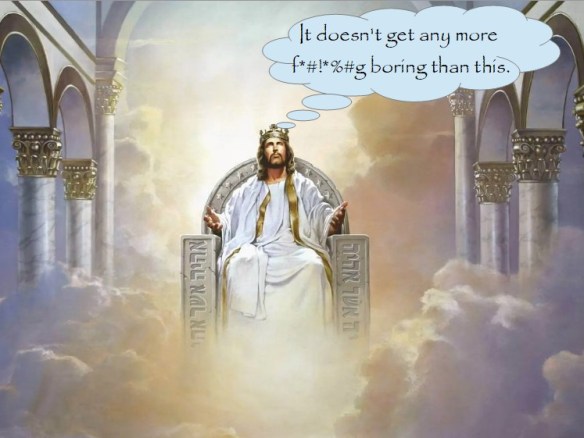
Sadly, we’ve failed to locate Jesus, the celestial super-being who is everything, everywhere, all at once yet nowhere at all. We’ve been presented with some possibilities, specifically that he exists in another dimension, which may or may not exist, from where he whispers directly into the brains of those who, over in this reality, call upon him. He even appears occasionally in visions, when the two dimensions ‘intersect’, which, as everyone knows, they’re capable of doing.
Unfortunately, all of this is undetectable by science but there’s no reason for concern because there is more to reality than that which science can observe. Equally regrettably, there’s no way of verifying this claim either; this is because science is deficient, limited as it is to investigating only ‘dirt and rocks’.
* * * *
It is far more likely that science can’t detect heaven and the eternal Jesus in precisely for the same reason it can’t detect Narnia, Valhalla and all the other fantasy worlds created over the millennia by human minds. Applying Occam’s razor, the imagination accounts for all these other ‘realities’ and the immortals that inhabit them.
No further explanation necessary.
 rejectingjesus,
Human imagination, the creator of all things immaterial. Cheers! GROG
LikeLiked by 2 people
Absolutely right. The human imagination is the source of all ‘revelation’.
LikeLiked by 3 people
There are so many difference between Narnia and Valhalla that I am surprised Neil would place them in the same bin. One big difference is that men and women of intelligence and with the capability of examining the evidence have concluded that there is plenty of reason to believe that God exists. If God exists, It is reasonable to think that he exists somewhere.
BTW a God who exists and who is anything like the God described in the Bible as a creator would not be bored any more than a human creator is bored. There is always more to create.
LikeLike
And yet you’ve consistently failed to present that evidence or to point us to it. In fact, you’ve dismissed the need for evidence. By your own admission then, empirical evidence is not required for belief in God. According to both the Bible and the great sage that is Don Camp, ‘reason’ plays no part either; faith is all that’s needed.
LikeLiked by 2 people
Don:
“One big difference is that men and women of intelligence and with the capability of examining the evidence have concluded that there is plenty of reason to believe that God exists.”
What evidence? You keep talking about evidence and never provide any.
Differences between narnia and Valhalla?
They are similar in that they’re both IMAGINARY!
LikeLiked by 1 person
http://biblicalmusing.blogspot.com/2023/03/evidence.html
There are ten lines of evidence in this essay. I’ve linked it before, but this time just for you.
LikeLike
Ho-hum. Don sent the same link to me. Response updated to insert crucial missing word, ‘not’.
Don, I’m not going to analyse your post but will say that circumstantial ‘evidence’ (which is better explained scientifically, no God required) and people’s subjective experiences are not evidence in an empirical sense.
It’s another fail, Don.
LikeLiked by 2 people
You mean the eyewitness testimony of people like John who says: “We are writing to you about something which has always existed yet which we ourselves actually saw and heard: something which we had an opportunity to observe closely and even to hold in our hands, and yet, as we know now, was something of the very Word of life himself!”
If John were the only eyewitness we have testimony from we might shrug it off as iffy. But there is Peter. You know he was the source of the core of Mark’s Gospel. And he reports what he heard and saw.
But there are others as well. Luker says he collected the information about Jesus from those who says his sources included those who had seen and heard Jesus:
Many have undertaken to draw up an account of the things that have been fulfilled among us, just as they were handed down to us by those who from the first were eyewitnesses and servants of the word. With this in mind, since I myself have carefully investigated everything from the beginning, I too decided to write an orderly account for you, most excellent Theophilus, so that you may know the certainty of the things you have been taught.
Some of this he got from Peter via Mark no doubt. He and Peter and Mark were in Rome at the same time. But there were others as well.
So, eyewitnesses. But empirical evidence? That is the stuff of science. We are talking history here.
LikeLike
And this is evidence of God how? Evidence of Jesus perhaps but not God.
‘John’s’ testimony (he doesn’t claim to be the disciple John) is testimony to his beliefs about Jesus and not of God.
Likewise, Luke’s claim he consulted eye-witnesses is suspect when his gospel is largely a rewrite of Mark’s. Even if he did consult others, these were not eye-witnesses of God but of an itinerant preacher about whom a number of outlandish claims were being made.
Scholars dispute that Mark is based on Peter’s recollections. It is a literary creation that gives life to Jewish ‘prophetic’ scriptures and Paul’s teaching. Even if it weren’t, it is not evidence of God.
None of your supposed eye-witness ‘evidence’ is evidence of God. It’s another fail, I’m afraid.
LikeLiked by 1 person
Neil: “‘John’s’ testimony (he doesn’t claim to be the disciple John) is testimony to his beliefs about Jesus and not of God.”
On the contrary, Jesus claimed to be God, especially in John’s Gospel – which was written to make that very point. And what he did and said was the evidence that convinced the Apostles.
BTW no one who knew John, and there were several whose writings are available to us, would have entertained for a moment the idea that anyone but John the Apostle wrote the Gospel, or was the source even if someone wrote for John.
Neil: Likewise, Luke’s claim he consulted eye-witnesses is suspect when his gospel is largely a rewrite of Mark’s.
It is possible that Mark and Luke met in Rome; they were there at approx. the same time. Luke may have been the proofreader for Marks manuscript, who knows. But even so, most of Mark comes from Peter (according to Papias and Clement of Alexandria). So that part is eyewitness stuff. But even then, really only the organization of the narrative is really similar. And then only broadly speaking. You will find few pericopes that are word for word the same.
See my analysis of Mark here http://biblicalmusing.blogspot.com/2022/11/eyewitness.html?view=timeslide
Most significant, at best Mark/Peter only supplied a small portion of Luke. There is a whole lot in Luke that is not in Mark. That part Luke most likely got from other eyewitnesses while he was in Judah with Paul when Paul was in jail waiting transport to Rome. He certainly had the opportunity.
In any case all the Gospels call Jesus the Son of God. John is clear that meant God present in the flesh. So, Jesus is in fact evidence for God.
LikeLike
Don: So, eyewitnesses. But empirical evidence? That is the stuff of science. We are talking history here.
We know the Bible isn’t history because 1- Much (perhaps most) of its purported history is inaccurate and 2- It contains magic, witches, demons, spirits, talking animals, virgin births, etc.
No. The Bible is clearly fantasy.
Fantasy literature is literature set in an imaginary universe, often but not always without any locations, events, or people from the real world. Magic, the supernatural and magical creatures are common in many of these imaginary worlds. Fantasy literature may be directed at both children and adults.
Fantasy is a subgenre of speculative fiction and is distinguished from the genres of science fiction and horror by the absence of scientific or macabre themes, respectively, though these genres overlap. https://en.wikipedia.org/wiki/Fantasy_literature
Fantasy, of course, can be set in the real world. Dracula is set in 19th century London, for example.
The Bible is a fantasy anthology with most of the stories set in the ancient Middle East. Some of the stories overlap with horror.
To move the Bible from fantasy to history one would have to prove the fantastical bits to be real elements of the real world. No one has been able to do this and most Bible apologists are offended by the very idea. Until then, the Bible is firmly and completely fantasy.
LikeLiked by 1 person
The Bible is written as history. If it contains some of the intersections of supernatural, these were understood by those who experienced them to be a much real history as anything else. Just as those who experience answers to prayer, healing, the appearance of Jesus, and the raising of the dead and many, many situations that are obviously to them God’s providences today understand them to be real history. Or as you say real elements of the real world.
All real events in the real world have consequences. That includes your tripping on a loose shoelace just as much as the Japanese bombing of Pearl Harbor. That is the real test of real history. Consequences.
So, did Babylon attack Judah and take away captives? There are lots of consequences we know about that confirm that as history. Did the Jews return to Judea after that event? There are many consequences that confirm that.
Did Jesus live in the early 1st century in Judah? There are many consequences of his life that confirm that. The fact that he has followers today and that they can trace the lineage of Jeus followers back to the 1st century confirms that.
Did Jesus do miracles? There are reports confirming that from both Jesus’ followers and from those who were his antagonists.
Did Jesus rise from the dead? The whole reason for the church, which exists to this day and which can trace its history back to the early 1st century, rests on that. It is the consequence that confirms the real history of the event.
So, whether or not any or all of these seem fantastic to you makes very little difference. Real history confirms them.
LikeLike
Don:
“There are ten lines of evidence in this essay.”
No, there are not… I read your “essay”:
They are arguments from incredulity and design.
Arguments are not evidence!
What’s your best evidence?
Don:
“Of all the evidence so far considered, Jesus is the best.”
Good grief!
I’m asking for verifiable evidence…not reports of a mythical person.
Another of your evidences:
Answered prayer…are you kidding?
That’s the “evidence” that’s the easiest to disprove…pray for your god to instantly heal every child in the cancer wards of my local hospital. That’ll convince me.
Sorry, but you have not provided sufficient evidence.
LikeLiked by 2 people
Your attempt to debunk the answered prayer evidence is typical and ignores the conditions of God answering prayer.
General promise: Anything you ask in my name and according to my will I will do.
General misunderstanding #1: In Jesus name means in the authority of Jesus and according to what he desires. It is not a tag we place at the end of our prayer. It is like a servant of the king who has the authority to ask in the name of the king – but only for what the king wants. He can’t just ask for anything.
General misunderstanding #2 According to his will requires knowing what his will is. The promise is not a carte Blanc. His will can be determined generally by looking in the Bible for God’s general will. We can begin with the Lord’s prayer in Matthew 6, and there one of the things that is God’s will is that his kingdom come on earth as it is in heaven. I can always pray for that and as I do those prayers are answered, sometimes in truly amazing ways. But sometimes his specific will may require asking him. And the answer will almost always be a deep-seated conviction that this is something I can pray for and expect to receive an answer, or it will be an equally deep-rseated conviction that I should not pray for that. Paul had that experience when he prayed for his own healing.
Prayer is a conversation with God that goes two ways. We ask; we listen as God directs and sometimes redirects our prayer; we keep on asking with perseverance during that two-way conversation until God answers.
Many Christians do not understand those conditions either, so I am not surprised that one who is not a Christian will not understand.
So, does a prayer for the healing of every child in the cancer wards meet those conditions? They do not for me. I do not have God’s confirmation. I may like to have that happen, but that is different from God’s will. I have prayed, however, with conviction about several children with cancer, and they are walking around cancer free today.
Christians who have prayed with that kind of seeking of God’s will before they pray have a fantastic track record (if anyone cares) of answered prayer. Look up Andrew Murray. He was one of the great prayers and had many prayers answered including many prayers for healing.
LikeLike
Don:
“The Bible is written as history. If it contains some of the intersections of supernatural, these were understood by those who experienced them to be a much real history as anything else. “
And they were WRONG!
They also thought lightning was sent by the gods too, and they were WRONG!
Koseighty is correct, the Bible is written as Fantasy!
LikeLiked by 1 person
Don:
“General promise: Anything you ask in my name and according to my will I will do.”
Wrong…you know the scriptures, and you know what they say:
Mark 11:22-24
And Jesus answering saith unto them, Have faith in God.
For verily I say unto you, That whosoever shall say unto this mountain, Be thou removed, and be thou cast into the sea; and shall not doubt in his heart, but shall believe that those things which he saith shall come to pass; he shall have whatsoever he saith.
Therefore I say unto you, What things soever ye desire, when ye pray, believe that ye receive them, and ye shall have them.
Matthew 17:20,
Matthew 17:20,
Matthew 21:21-22,
And all things, whatsoever ye shall ask in prayer, believing, ye shall receive.
Luke 17:6
I’m not going to write them all…you’re adding the “according to my will” to the scriptures, to make them fit reality.
Why do you change the word of god, Don?
LikeLike
Goyo: <Don:
“General promise: Anything you ask in my name and according to my will I will do.”
Wrong…you know the scriptures, and you know what they say:
You apparently do not know the scriptures or what they say. John 14:14 “You may ask me for anything in my name, and I will do it.”
“In my name” assumes you are asking for what the Lord desires. It is not a carte blanche
In addition, the Lord provided us a guide for prayer, the Lord’s prayer.
“‘Our Father in heaven,
hallowed be your name,
your kingdom come,
your will be done,
on earth as it is in heaven.
That instructs us to prayer for God’s will to be done.
More plainly: 1st John 5:14
14 This is the confidence we have in approaching God: that if we ask anything according to his will, he hears us.15 And if we know that he hears us—whatever we ask—we know that we have what we asked of him.
You think God is magic and will do whatever we ask. I know that God is about relationship with us, So, prayer is not rubbing the magic lamp but engaging with God in seeking how we might pray.
LikeLike
You missed Mark 11:24 –
‘Therefore I tell you, whatever you ask for in prayer, believe that you have received it, and it will be yours.’
No mention of ‘in my name’ there. Not that that matters; ‘in my name’ is little more than a magic formula, despite your insistence this mumbo jumbo isn’t magic.
LikeLiked by 1 person
Continue to tell yourself this, Neil. You will not make any headway with people who pray. “In Jesus name” reminds us not only to ask for those things that he desires but that his desire for us is good. So, we ask as a child asks of a father. We know we will not receive all we ask for, but we know our Father hears and cares and will give us what is good, and that when in the whole scheme of things the good thing he gives may at times be trivial, he gives good things. It is about relationship – a father with his child.
LikeLike
You know best as usual.
LikeLike
We know we will not receive all we ask for … Why not? Based on the scriptures, if you ask in Jesus’ name and “believe” you have received it, your prayers will materialize.
But they don’t, do they? And that’s just ONE of the failings of the belief that you so tightly hold onto.
LikeLiked by 1 person
Almost every Christian knows that we cannot ask just anything from God and expect him to answer as we request. When we are not sure what God’s specific will is, we all add to our request, “according to your will.” We do so because we know that God’s will is better than our will.
But that does not keep us from praying. If we persevere, God will change our praying so that it is in line with his will.
When we pray according to God’s will, we all experience some pretty fantastic answers to our prayer.
LikeLike
Again you miss the point. Yes, ‘almost every Christian knows that we cannot ask just anything from God and expect him to answer as we request’, despite what Jesus said. He didn’t qualify his promise that if you ask God for ‘anything’ and ‘whatever you ask for’ he would provide it. That you have to adjust this so radically for the real world shows how he (or whoever wrote his script) talked complete crap.
LikeLiked by 1 person
What evidence do you have to demonstrate that Yahweh exists rather than being the man made Canaanite deity from the Tanakh?
LikeLike
The evidence I’ve provided is for the existence of God. Yahweh is a name distinguishing which God and was used by the Israelites for the God who appeared to Moses. But that is only of interest if we have agreed there is sufficient evidence for God.
LikeLike
Don: ‘But that is only of interest if we have agreed there is sufficient evidence for God.’
We’ve agreed no such thing.
LikeLiked by 1 person
Neil, I seriously doubt you will. But Jesus certainly would be the evidence if you ever reach that point.
LikeLike
I have never read anything from you that was evidence for Yagweh.
Feel free to provide it.
If you consider Yahweh is not the name of your god then you can also include his name along with the evidence of his existence.
Thanks.
LikeLiked by 2 people
Evidence: Israel.
LikeLike
Egypt is evidence for Osiris, Isis, Horus, Seth, Ptah, Re, Hathor, Anubis, Thoth, Bastet, Amon, etc.
India is evidence for Soma, Shiva, Diti, Krishna, Indra, Nandini,Vishnu, Balarâma, Yama Ganesha, etc.
Japan is evidence for Amaterasu, Ame-no-Uzume, Benzaiten, Bishamonten, Daikokuten, Ebisu, Fujin, Fukurokuju, etc.
Mexico is evidence for Ajbit, Bacabs, Cabaguil, Chac, `E’, Gucup Cakix, Hobnil, etc.
We could do this all day.
All people invented gods. The Hebrews adopted Canaanite deities which evolved, merged and adapted over time. The Hebrew god(s) isn’t (aren’t) special. The Christian god is even less special because it isn’t their god. They stole it an adapted it from the Hebrews.
LikeLiked by 2 people
I asked you to present evidence of your god, Yahweh, or provide the name you refer to your god as.
LikeLiked by 2 people
And I offered Israel.
LikeLike
And I offer Wales.
Either one is not evidence of your god, Yahweh.
Have another go.
LikeLike
I don’t need to. Think about it a little.
LikeLike
@Don
Then, perhaps you would like explain further why Israel is evidence of your god, Yahweh?
LikeLike
They owe their very existence to God. That is why story of then exodus and the Passover is so central in their thinking.
They owe their continued existence to God Ther Old Testament and the pages of history tell of numerous times when their existence was threatened and how God rescued them from their enemies.
They own their present existence to God. They would not be reconstituted as a nation today except for God.
They look to God for their future. The whole story of their redemption is not complete and won’t be until the temple is rebuilt. So, Jews have gathered the materials for the rebuilding of the temple. And they see in the present direction of events that hope soon coming to fruition.
And so do I.
LikeLike
Of course this is simply ideological rhetoric.
The reality of the State of Israel is based on politics.
Therefore we are back to my request for evidence of your god Yahweh.
LikeLiked by 2 people
14 This is the confidence we have in approaching God: that if we ask anything according to his will, he hears us. 15 And if we know that he hears us—whatever we ask—we know that we have what we asked of him. (1st John 5)
LikeLike
So 1 John trumps the supposed words of Jesus about God providing everything? Again, you’ve found a verse that contradicts what Jesus is made to say in the gospels. Well done.
However, I raise you Matthew 7:11 –
If you then, who are evil, know how to give good gifts to your children, how much more will your Father who is in heaven give good things to those who ask him!
and James 4:2 –
You do not have, because you do not ask.
The problem here, as ever, is the Bible says whatever you want it to say, depending on where you look (‘oh no,’ you respond, ‘You have to take its message as a whole.’ Not possible when it contradicts itself so much).
It’s excuse after excuse, Don, in your defence of a discredited magic book.
LikeLiked by 2 people
The problem is that you make then Bible speak against itself rather than bringing the truths together in a whole.
Matt. 7 “good gifts.” Luke has “give the Holy Spirit.” In either case the best gift is the Holy Spirit but that does not mean there are not other good gifts. Those, however, are good according to God’s wisdom. They are not necessarily the things we may think “good” in our limited wisdom.
James 4. This is an encouragement to ask and is very much like what Jesus said. But if you’ll read a bit further in that chapter you’ll find that they were asking but not receiving because they were asking for things that would satisfy their desires. AS OPPOSED TO GOD’S DESIRES FOR THEM.
The contradiction is in your mind, Neil. I find none.
Your God or the one you don’t believe in I don’t believe in either. He is a paper mâché creation of your imagination. I believe in a God who is living and personal and cares enough about me not to give me a rock when I ask for an egg.
LikeLike
I don’t make the Bible speak against itself. It’s there for all to see (let he who has eyes etc). You on the other hand, smooth out the many contradictions and inconsistencies. You do it here constantly, adding your own interpretation and speculation about how it all came to be.
The God I believe in? I don’t believe in God. That’s what atheism means. Your God on the other hand is an imaginary being who wouldn’t give you an egg no matter how much you begged ‘him’.
LikeLiked by 2 people
Neil: Your God on the other hand is an imaginary being who wouldn’t give you an egg no matter how much you begged ‘him’.
Honestly, Neil, if you could walk in my shoes you would know differently. God answers pray all the time.
LikeLike
Evidence, please.
LikeLike
The evidence, even on YouTube is plentiful. Search for God’s healing miracles.
LikeLike
But then again … there are times when prayers are NOT answered. But of course, it’s all in “God’s” will, right??? Can’t you see the how weak your defense is, Don?
LikeLiked by 1 person
Nan, prayer is not magic. It is a conversation with God. Sometimes we ask for things that are not in God’s will and not ultimately as good as what God desires to do. In that case a no is the appropriate answer. Sometimes if we persist, as we should, God redirects or refines our praying, and give us what we desire in that redirected prayer.
The more I hear from you and the others the more I think you all are former disappointed Young Earth Creation Literalist Fundamentalists. The faith you all had was simplistic and could not incorporate logic and reason or science; you failed to push through to arrive at a mature faith. Most importantly you failed to remain in Christ and in deep and personal fellowship with him. Those two things doomed you to disappointment. But your disappointment is not really in the true and living God but is some caricature of him. And that is really the sad part.
LikeLike
Let me translate what Don is saying here for you, Nan:
You see, Nan, you and the others here were never really Christians, not like what I am. You were just pretend Christians like all those Texans.
LikeLiked by 2 people
Only you can answer that Neil; it is beyond my pay grade.
LikeLike
Oh go on, Don. Surely you can make something up.
LikeLike
You can think whatever you want about any of us, but speaking personally, I had a VERY deep and personal relationship with your god … and I was very adept at “defending Christ” and all things associated with. That’s why the things you write about “us” not understanding your POV is almost offensive.
You obviously think you have the inside dope on all things Christian, but trust me. Those of us who have been there, done that are more than familiar with the arguments you put forth. You are shouting in the wind, my friend.
LikeLiked by 1 person
It has ALWAYS been a pick and choose exercise for Christians in their attempts to “prove” Christianity. Don is no different. It’s an exercise in futility if any non-believer actually expects to receive solid, verifiable, difficult-to-disprove responses related to Christian beliefs.
LikeLiked by 1 person
It is not a pick and choose. The condition “according to his will” was built in to Jesus’ telling us that we may ask in his name.
And it was understood by generations of Jews who knew quite well that they c9ouold not pray for just anything. The big foofaraw is of your making when you choose to pull out one small piece from the whole the Bible has to say. In doing you go against everything Jews and Christians have understood for millennia.
LikeLike
I very much doubt that getting all apologetic/ biblical is going to win any points here and especially not with an atheist such as me.
Evidence is ALL I am interested in, and it has unfortunate that to date you have not produced a scrap.
Therefore, I ask you once again;
Please present evidence to demonstrate the veracity of your claim for the existence of your god, Yahweh.
Perhaps you could divulge details regarding your own belief? At some point something convinced you, unless you were raised at the knee to believe in Yahweh/ Jesus?
If your conversion was whilst a teen or an adult could you share the specific details and circumstances that caused you to become Christian?
( If you have shared these details before excuse my poor memory…. Perhaps you could provide a link?)
And could you please use the proper name of your god, Yahweh in all your future replies as I find this
easier for me.
Thanks
LikeLiked by 1 person
I’ve linked my story several times. Each is a little different because I am aiming at a specific audience with whom my life has intersected. This one was aimed at an audience with who I shared a philosophy early on.
http://biblicalmusing.blogspot.com/2023/05/hope.html
LikeLike
An earlier personal story http://biblicalmusing.blogspot.com/2017/02/my-christian-conversion-and-faith.html
LikeLike
No, I had not read this before. Very interesting.
However, your story is not that much different from many Christians I have read.
Your initial ‘calling’ if you like, was during an existential crisis, ( your words) something I imagine most teenagers go through in one form or another.
In a Christian environment it is probably inevitable you would raise your hand and answer the invitation.
Two points of interest.
First, you mentioned you struggled with temptation?
Was it substance abuse related or something else?
And second, I noticed evidence did not feature at all in your entire story. Is this why evidence does not feature in anything you post here (and probably elsewhere)?
LikeLiked by 3 people
I too read the “conversion” story … and what I saw was a history somewhat similar to my own — at least the lack of religion growing up. However, my “conversion” didn’t come until I was in my early 20’s. Nevertheless, I too was convinced it was all “real.”
Yet here I am today. What changed .,. ??
LikeLiked by 3 people
You grew up?
I suspect those that cling to their religious belief still have issues.
I am so glad I never had to grapple with this nonsense
over and above the usual cultural things.
For those like Neil and you who spent years tied to this yoke you must look back and wonder what on earth were you thinking?
As Pink Floyd once noted: A Momentary Lapse of Reason
Don mentioned a temptation in his story.
Maybe whatever it is still lingers?
Perhaps this is partly to blame for his continued belief?
LikeLiked by 1 person
The evidence every Christian has is the voice of the Holy Spirit drawing and confirming then truth. No one becomes a Christian on the basis of what you would call objective evidence alone. But objective evidence does confirm the voice of the Holy Spirit.
I think you could ask people whose lives and work are all about objective evidence and they would say the same thing. Look for Hugh Ross’s story on http://archive.100huntley.com/watch?videoID=338940 and Francis Collin’s on biologos.org https://youtu.be/bjboVRLdaoY
LikeLike
In essence then, it is an emotional issue that drives people to convert and not evidence.
Sorry, but there is no evidence for this Holy Spirit.
I have read Collins conversion tale a while back and watched a video of him explaining it.
Again there was a trauma/ emotional issue at the root of his conversion; he suffered a form of death anxiety.
Like many in the scientific field he is able to deal with the conflict that arises between science and this religious belief by compartmentalizing.
It is telling that many of those I have read ( and watched) who have deconverted all include the complete lack of evidence for the claims made by the religion they were in.
The clergyproject.com is an excellent website with numerous examples of testimonials from former professional clergy who agree with this.
Dan Barker is probably one of the more well known deconverts.
You can watch numerous of his videos on YouTube.
LikeLiked by 2 people
As Jesus said, it is the sick who need a physician, not those who are well.
Almost everyone I know who came to the Lord as a teen or adult did so because they understood their need. And the Lord met them and met their need.
If you think you have no need, there is no motivation to seek the Lord’s help for that need.
LikeLike
Wow. You pretty much summed up the entire conversion thingy — it’s NEEDY people who become Christians. Those of us who have self-confidence and assurance in our own abilities have no need to cling to a make-believe character in a ancient old book. Wow again.
LikeLiked by 2 people
Again, Nan, if you go to the statement of Jesus in the book, you’ll note that it was the Pharisees he was talking about who need no physician. In the context of the whole interchange of Jesus and the Pharisees, it is obvious Jesus is speaking in a sardonic way. The Pharisees of all the people were most in need of a physician; they just didn’t know it.
Now, you might think that was Jesus’ personal opinion. But if you read Josephus and the “Wars” you’ll see the outcome of that over confidence in their own righteousness. (Josephus was a Pharisee, as you know.) They brought the whole nation down with their insane wars among themselves and with other Jewish factions. They most of all needed a physician.
LikeLike
Well, at least we agree that it is emotional and/ or trauma related issues and the fact evidence plays no part in those who convert,which includes you.
Now we have established evidence plays no part can we also say that your continued belief is because of faith?
LikeLiked by 2 people
That is a reasonable question.
In one of my stories I think I spoke about a period of doubt that lasted maybe two years. It began when I was challenged by a college professor with the proposition that a theory that cannot be falsified is not a theory about reality (Or something like that). At the same time I was reading a skeptic’s book The Passover Plot. Together they sent me on a quest to test the truthfulness of the Bible and my faith.
It was a low point, but I discovered as I did the work that my faith was well founded on evidence and that the challenges were flawed.
But doubt returned a few years later when I was confronted with the claims of science and evolution as I was reading Richard Dawkins’ The Blind Watch Maker and several books by Stephen Jay Gould, like The Panda’s Thumb. (I really like Gould’s writing.) So I went back to the books, reading people on both sides of the debate. (I have a pretty good library of those books including authors like William Howells’ Getting Here and Kenneth Miller’s Finding Darwin’s God
I finally came to place where I believed that evolution did not conflict with the Bible and really had no impact on faith. That made it possible to integrate more and more science with faith and I have shifted to the position that is represented in Biologos.org. .
And it placed my faith on firmer ground. I no longer believed on the basis of my personal interaction with God and the Holy Spirit though that remains fundamental, but I had the added confirmation from the natural world and logic. I believe in the two book revelation of God first in the Bible and then in the natural world. It has been an “experience” to say the least, but it was one I would not have missed.
LikeLike
A rather long winded reply, but to confirm, you are agreeing that evidence ( of Yahweh in particular ) played no part in your conversion ( and neither does it play a part with anyone’s conversation).
LikeLiked by 1 person
I think that is overstating it. I also don’t think I can speak for everyone. There are some who, like Hugh Ross, found the natural world to be the impetence for thinking about spiritual things.
But both theologically and upon reflection most Christians find that the Holy Spirit moved them toward faith. And that is what the Bible tells us: “By grace are you saved through faith and that not of yourself; it is a gift of God lest any man should boast” Ephesians 2:8. That last phrase means that even faith is a gift. It is not arrived at by reason or evidence, though the evidence may be sufficient to conclude there is a God.
The demand of most atheists for “evidence” implies you all think that if there were enough evidence you would be virtually compelled to believe. The Bible and the experience of Christians and Jews before them is that this is not true. Many who had quite enough evidence to believe that Jesus was the Messiah and who did believe in God, chose not to believe in Jesus. Many others who had enough evidence choose to believe in the pagan gods and to reject the evidence for an almighty personal God. To believe would have shaken their world, and they were unwilling to allow that. I think many atheists are the same. God would shake up their world.
LikeLike
I am open to accepting evidence to demonstrate the veracity of your claims, which in no way obliged me to become a Christian.
Referencing the bible as evidence of a Messiah is assuming the bible tales are historically accurate; an unfounded assertion with no evidence whatsoever to support it.
Therefore, we are back to emotional/ trauma issues as the almost exclusive reason for conversion/belief.
We can be absolutely certain evidence plays no part in conversion and/or belief.
Until you can demonstrate otherwise my assertion stands.
LikeLiked by 2 people
I think the belief that “the bible tales are historically accurate; an unfounded assertion with no evidence whatsoever to support it” is simply false.
There are four documents, the Gospels, that have every indication they are authentically written by eyewitnesses or the reports of eyewitnesses (Luke). Those cannot be dismissed by a wave of the hand. (The eyewitness in Mark is Peter. See https://biblicalmusing.blogspot.com/2022/11/eyewitness.html )
In addition, there are other gospels or fragments of gospels coming from the first and second centuries that are independent of the canonical Gospels but agree in part or whole. See The Gospel of Peter, The Gospel of the Hebrews, The Egerton Gospel, as well as the several Christian writings of people in the first century including The Epistle of Barnabas, 1st Clement and the Didache. All these testify to the reality of Jesus and the reliability of the canonical Gospels. See earlychristianwritings.com
There simply is no reason declare without any evidence or reasoning at all that the “bible tales are historically inaccurate.” And there is every reason to accept them as historical.
LikeLike
We’ve had this discussion, Don. You referencing yourself is not evidence that the gospels were written by eye-witnesses or the associates of eye-witnesses. There is no serious scholar who thinks so.
So no-one is dismissing the gospels ‘with a wave of the hand’; they’re dismissing them because they are largely fiction.
If you’ve nothing new to offer this thread, or indeed any thread, I won’t be publishing your same tired arguments and worn out rhetoric. How’s that for a wave of the hand?
LikeLiked by 2 people
Further, simply because the gospel documents “exist” does not necessarily mean they are “evidence” for anything.
The fact of the matter is the bible in toto is questionable, but some parts of it are simply, to put it frankly, bunk. It’s all a game of pick and choose what sounds the best to each individual. And when there are several individuals who agree … VOILA! We have a denomination/church!
LikeLiked by 2 people
Nan Further, simply because the gospel documents “exist” does not necessarily mean they are “evidence” for anything.
That is silly. They are evidence for an author. They also tell a careful student a lot about the author. They tell us that Matthew was very well versed in the Old Testament and in the method of teaching of the rabbis. They tell us he was a very good Greek writer using sophisticated Greek and that he read Hebrew and could translate into Greek and that he was writing for a Hebrew audience.
They tell us that Mark was an excellent writer in Greek and capable of rather sophisticated literary constructions. They tell us that the source of most of Mark is not Mark but someone who spoke limited Greek and who organized his oral teaching in a form that made it easy to remember (chiasms). Clement of Alexandria tells us that was Peter.
They tell us that Luke was writing for a Gentile audience and because he wrote Acts also that he traveled with Paul for several years (the first person “we” passages).
And that is only the beginning. A good scholar can mine the Gospels for a lot of information.
LikeLike
Whoopie! A “lot of information.” Funny … I was under the impression they were mostly useful for roping in folks to the Christian faith.
LikeLiked by 1 person
Nonsense!
The overwhelming majority of scholars accept the unknown authors of gMatt and gLuke used gMark extensively as the primary source for their gospels, even to the point that some verses are practically verbatim.
For goodness’ sake, do you think you are lecturing to a complete novice on this subject?
The gospels are anonymous and there is absolutely no evidence that anyone called Peter was an eyewitness.
If the character Jesus of Nazareth (another contentious claim) was the preacher he’s is claimed to be then he would have spoken Aramaic, as would his illiterate disciples.The gospels are written in koine Greek!
Not only was the first gospel, gMark written around 40 years after the supposed death of Yeshua they were not written in Palestine either.
LikeLiked by 1 person
Ark: The overwhelming majority of scholars accept the unknown authors of gMatt and gLuke used gMark extensively as the primary source for their gospels, even to the point that some verses are practically verbatim.
Do your own comparison. If you are interested, I did a comparison of one of the well-know passages found in all three Gospels. https://biblicalmusing.blogspot.com/2023/06/the-synoptic-problem-pt-3.html
Though there are limited phrases or sentence that are verbatim, the claim that the few word for word passages argue for dependence on Mark is a tremendous overstatement.
Ark The gospels are anonymous and there is absolutely no evidence that anyone called Peter was an eyewitness.
Thery were not anonymous to the first readers. They were hand delivered in the case of Mark by the author and hand delivered to others by messengers who knew the author.
About Peter:
Eusebius writes quoting Clement:
[B]ut with all sorts of entreaties they besought Mark, a follower of Peter, and the one whose Gospel is extant, that he would leave them a written monument of the doctrine which had been orally communicated to them. Nor did they cease until they had prevailed with the man, and had thus become the occasion of the written Gospel which bears the name of Mark. …And they say that Peter — when he had learned, through a revelation of the Spirit, of that which had been done — was pleased with the zeal of the men, and that the work obtained the sanction of his authority for the purpose of being used in the churches. Clement in the eighth book of his Hypotyposes gives this account, and with him agrees the bishop of Hierapolis named Papias. Ecclesiastical History, Eusebius, 2.15.2-3, 16
Ark Jesus would have spoken Aramaic, as would his illiterate disciples. The gospels are written in koine Greek!
Yes, they spoke Aramaic, but not all were illiterate. Matthew was a tax collector in Galilee a multi-lingual area and would have spoken and written both Aramaic and Greek. Peter, drawing from his contribution to the Gospel of Mark, spoke Greek but poorly, which is why in those portions the language is very limited in grammar and heavily sprinkled with Hebraisms.
And someone with excellent Greek translated the logia (deeds and word) of Jesus into Greek that is superior to all but Matthew. (They are not therefore either the work of Mark or Luke.) Which may be a clue for who did the translation.
But you would know this being no novice.
LikeLike
GMark – the first gospel to be written- has 678 verses, over 600 of them are featured in gMatthew, some verbatim, many use enough exact words to show that the unknown author of gMatthew used gMark as his primary source.
No eyewitness would need to resort to such blatent plagiarism.
There is no evidence that the author of gMatthew was the tax collector featured in the gospel.
It is preposterous to assert that if he were this tax collector he would need to copy someone else when recording his own biographic details.
You chose to cite Eusebius? Oh dear …
And I presume you are aware of what Eusebius thought of Papias, yes?
The rest of your speculation which runs counter to what the vast majority of bible scholars acknowledge is simply unsubstantiated apologetics.
But you probably aren’t aware of this being guided by the Holy Spirit and the fundamentalist school of bible hermeneutics.
LikeLiked by 1 person
Ark: GMark – the first gospel to be written- has 678 verses, over 600 of them are featured in gMatthew, some verbatim
Seriously, Ark, the issue is more complex than this quote implies. Counting verses for example: Look at The Mount of Olive discourse in Matthew 24:5-18, Mark 13:5-16, and Luke 21:8-21. Read in the KJV because the KJV gives you a more accurate picture of the Greek wording. (Or look at my comparison here https://biblicalmusing.blogspot.com/2023/06/the-synoptic-problem-pt-3.html )
There are a few verses that are similar and a few phrases that are verbatim the same in Greek. But well over half the verses are not the same, not even the same detail.
But that is one of the logia (sayings and deeds) of the Lord. When you compare passages that are the words of the Gospel writers, the differences are many more. For example, in Mark 2:1-2 and Matthew 5:17 and Luke 5:17 which are the writers’ introduction to the logia of the healing of the paralytic there is no similarity and no phrases or words the same. And that is repeated in almost every case where the writers’ own words are compared.
That leaves pretty much only the logia where there is similarity. But the logia of Jesus do not come from Mark. They in every case existed prior to Mark’s writing. So, the similarity is not between Mark and the other writers but with the pre-existing logia – which may have actually been the logia that Papias says Matthew wrote prior to Mark’s gospel.
The missing piece in what you are reading is that the gospel and the logia were part of the teaching of the Apostles from the first meetings with new believers days after Pentecost. That teaching became the oral gospel and was what the Apostles taught for thirty years before any Gospel was written. It is not surprising that it shows up in the Gospels; it was their source.
LikeLike
Your logia thesis is pure speculation. You don’t know any of this.
LikeLiked by 3 people
The logia of the Lord in all three of the synoptics stand out from the narration of the author by style and grammar. That is not speculation. They are not in the style or similar in grammar and syntax to the authors’ narration. That is not speculation.
They are of a nature that it is impossible to speculate that the author created them.
They are the parts of the Gospels that are similar, sometimes verbatim, to one another. That is not true of the narrators. Their narration is most varied in contend and language.
Because of the style of the logia and because they are found in more than one Gospel it is a reasonable hypothesis that they existed prior to any of the Gospels. That is the kind of reasoning source critics use.
My speculation has to do with who translated Jesus’ words into Greek. The only reasonable person is Matthew, especially since Papias says Matthew wrote the logia of the Lord before Mark wrote his Gospel. But it would not matter to the observation that there was a lot of material being orally communicated and written before the Gospel writers wrote.
LikeLike
You’ve said all this before. As you concede, it’s all speculation on your part.
LikeLike
Watch the video I posted.It will demonstrate with accurate evidence why your apologetic aporia h is flawed.
LikeLike
I have read both Dr. Daniel B. Wallaces argument for the priority of and that of Dr. Mark Strauss. Both of these men are able and respected professors of Greek at evangelical seminaries. Both provide an extensive argument that goes far beyond your reference to the numbers of verse. But I have this difference with them – after having responded to a number of their arguments.
1) They neglect the part of Mark’s Gospel that is the oral gospel of Peter transcribed. (That is not a new observation and it is not unique.) That means they include the logia of Jesus as part of the narration of Mark and argue that the other Gospels borrow from Mark. That would not be true if there was a pre-existing collection of Jesus’ logia.
2) They do not recognize the unique style and grammatical construction of the logia and so do not identify them as something that is unlike the narration of the Gospel writers.
Fact: It is in the logia that the greatest number of similarities occur. There is rarely similarity in the narrators’ own contribution. That means the comparison of the number of similar words is meaningless if we are interested in the source or interdependence of the Gospels. The fact is that the source for a large part of all three Gospels is that prior collection of logia.
LikeLike
So even evangelical scholars disagree with you on the two principal points of your argument. Surely this should tell you something.
LikeLiked by 2 people
Are you alluding to the hypothetical Q source?
LikeLike
Did you watch the video?
LikeLike
“They were hand delivered” — I keep wondering how you (or anyone) KNOWS this since it happened over 2000 years ago. I don’t recall any verses that validate this, so once again it’s simply speculation on the part of believers and/or apologists.
LikeLiked by 2 people
“They were hand delivered”
This assertion also baffled me.
LikeLiked by 2 people
What do you think? That they were sent by mail? The fact of life in the 1st century was that there was a lot of correspondence going on across the Roman world. It was primarily carried by couriers who carried the letters and news. That was true for all correspondence. There was no post office. And it was hand delivered by those couriers.
There is a lot of evidence for that, and in the New Testament Paul mentions several times the couriers who carried his letters. The Roman roads and the sea lanes provided the routes.
Richard Bauckman in the book The Gospel for All Christians pp. 49-70 provides more of the details.
LikeLike
They were not sent by mail but by courier. Splitting hairs or what.
We are not, in any case, talking about Paul’s letters but the gospels. There is every reason to think some if not all were written in situ, by and for specific communities.
https://www.college.columbia.edu/core/content/new-testament/context
LikeLike
It is always worth pointing out that the supposed letters of Paul did not surface until Marcion ‘found’ them, gathered them together and presented them to the Church.
Of course it is completely unthinkable that any shenanigans went on and these letters were all perfectly legit and gen- you- whine.
Christians…. Sheesh!
🤦♂️
LikeLiked by 1 person
For goodness sake, think and check the historical info.
The couriers were not government couriers except for government documents. They were, for personal correspondence, either someone know and sent by the sender (as Paul did) or given to a person responsible to transport them to their destination, such as a ship captain.
The gospels were written for a particular group. Mark wrote his to leave with the Roman church. It goes without saying they knew him. Otherwise, copies were hand carried by associates to the churches. Bauckham details how that took place and provides documentation and citations.
In any event, until the second generation of copies, they were delivered by people who knew the author and vouched for his work and in many cases, such as Paul’s, they added personal greetings. These first generation Gospels were not anonymous.
LikeLike
Why are your arguing with yourself about this? You introduced the idea the gospels were hand-delivered, then you responded to Nan with a snide comment that they weren’t delivered by mail, followed by an unfounded and hair-splitting assertion that they were delivered by courier (the ancient equivalent of the mail). Now you’re telling me to get my historical facts straight!
Nobody cares how the gospels were delivered, even if they were, and for sure, nobody actually knows, not even your supposed expert. However it was done does not mean the deliverer, even if there was one, knew the authors personally nor that the authors were called what we now call them.
All of this is speculation on your part. Stop passing off your ‘musings’ as gospel truth. They’re not and we’re not taken in by them.
LikeLiked by 2 people
Of course! “There’s a lot of evidence for that.” Just like all the other claims made by believers.
LikeLike
Correction of Richard Bauckham’s name.
LikeLike
You may find this enlightening.
LikeLike
An interesting side note regarding Jesus as a ‘physician’ or the cure for the ‘sick’.( sic)?
I once read that, in times past traditional doctors in certain Asian cultures were paid to ensure people stayed healthy and if they fell ill the doctors were obliged to treat them for free.
This may be anecdotal but I’ve always thought this was an interesting approach to the practice of medicine.
LikeLike
Don: They owe their very existence to God. That is why story of then exodus and the Passover is so central in their thinking.
Sad, isn’t it, that the exodus never happened? It’s not just the magic bits of the Bible that are fantasy, much of the “history” is fantasy as well. Thankfully, the history written in the dirt and stone doesn’t lie.
Don: They owe their continued existence to God Ther Old Testament and the pages of history tell of numerous times when their existence was threatened and how God rescued them from their enemies.
The Hebrews aren’t the only people to give their god credit when things go well and blame themselves or others when things go badly. It’s unsurprising to find this in the Bible.
Christians today (at least the loudest ones) tend to blame all their woes, both personal and national, on the people they think God has told them to hate – gays, transpeople, teachers, etc.
I’ve no reason to think the ancients were any better at knowing what God really wants than today’s many “prophets.” And since no one will provide an objective way of testing either ancient or modern claims, they can all be dismissed equally.
Don: They own their present existence to God. They would not be reconstituted as a nation today except for God.
You seem to be conflating the Jewish people and the state of Israel. But the state of Israel exists because of the anti-semitism of the Christian European nations. They didn’t want to deal with the Jews anymore and shipped them back to the desert. The anti-semitism of Christian Europe stems mainly from the Gospel of John which portrays Jesus as an anti-semite and gave generations of Christians an excuse to hate.
Don: They look to God for their future. The whole story of their redemption is not complete and won’t be until the temple is rebuilt.
Yes. Someday™ the messiah will come, gather the scattered Israelites in, defeat their oppressors, establish a Davidic throne, and the whole world will submit to it.
That means, of course, if the messiah comes today he will have to overthrow the state of Israel.
But that’s the Jewish version of the story. The Jews will get no redemption under the Christian version. In the Christian version all who don’t bow to Jesus will be destroyed. So the Jewish people will not be redeemed, they will be force converted (or killed). Their Jewishness will be annihilated.
Luckily, the Jewish (and Christian) prophecies are as fantasy based as their history. No, there is no messiah coming to kill all the non-Jews or non-Christians (depending on whose version you believe).
LikeLiked by 2 people
Kos: the state of Israel exists because of the anti-semitism of the Christian European nations.
The Jews who returned from exile by the permission of Cyrus owe that to the goodwill of Cyrus who allowed all exiled people to return to their homeland. That doe snot make it any less an ac t of God than if they were magically transport on the wings of angels.
That is exactly what is the problem with almost all the objections I see lately here. If God doesn’t do something that is how you would do it or how you imagine he should have done it, there is no God. That is silly.
Kos if the messiah comes today he will have to overthrow the state of Israel.
Yes, in a way. What the Bible actually says is that they will turn to the Messiah as their hope in a period of great danger from the nations and that it is the world leader who will destroy the nation.
Kos In the Christian version all who don’t bow to Jesus will be destroyed. So the Jewish people will not be redeemed,
On the contrary, they will be redeemed because they will finally recognize their Messiah.
Kos Their Jewishness will be annihilated.
No. They will actually stand out. They will be recognized as people chosen of God and the people through whom the Messiah came. They will receive honor from all the redeemed and have equal place in the eternal kingdom with the redeemed from all the nations.
LikeLike
So much b.s. Look, I was taught all of this in my “church days,” but once you can FINALLY look beyond the rhetoric and get away from the indoctrination (and that IS what it is), I guarantee you’ll be amazed at all the “stuff” you have claimed to be “true” on just this blog alone.
LikeLiked by 2 people
Don: The Jews who returned from exile by the permission of Cyrus owe that to the goodwill of Cyrus who allowed all exiled people to return to their homeland. That doe snot make it any less an ac t of God than if they were magically transport on the wings of angels. That is exactly what is the problem with almost all the objections I see lately here. If God doesn’t do something that is how you would do it or how you imagine he should have done it, there is no God. That is silly.
Don, you have such a small and limited view of the world. No wonder you are so impressed with a small little tribal god from the crossroads of nowhere.
I just checked the world population clock. There are 8,037,661,807 people on the planet today.
About 16,000,000 of them are Jewish – 0.2%
Amazing! Praise god(s)! A small little people group for all of its history remains a small little people group to this day! Quelle surprise! Much wonderment!
Now look at the other 99.8% of the world. Every. Single. Person. Comes from a a people that survived until today.
My ancestors were mostly German. Does the fact that our people survived until today mean the Germanic gods are real? Has Baldr been pulling strings behind the scenes all these millennia to keep the Germanic people alive? It must! The “logic” is bulletproof. All hail Skaði who has preserved her people!
LikeLiked by 3 people
According to ZZ Top, Jesus has been located in the USA.
In fact, he…oops, sorry, He just left Chicago.
LikeLiked by 2 people
LikeLike
I believe it.
LikeLike
I would have posted the video link but for some reason my phone would not allow it…
Great song, all the same.
LikeLike
Hmmm. I wonder if perhaps Jesus is living on the island of Atlantis … ??
LikeLiked by 2 people
You could be onto something, Nan. Atlantis is every bit as likely as his living in another dimension.
LikeLiked by 1 person
Still can’t wrap my head around Don’s dimensions thing.
Very Serious Theologians worked very hard to push the god(s) thingy “outside of space and time.” But Don says God lives in Hawking’s imaginary time – which is a dimension in space NOT time (again, according to Don). Which means that Don is pushing God back into space (if not also time). I can’t imagine that the Very Serious Theologians will be pleased with this development.
LikeLiked by 1 person
Great point Koseighty…from my youth all the way to the 60’s, god and jesus lived in a place called “heaven”, that was “up there in the sky somewhere “
Then, Yuri Gagarin flew into space in 1961, and when he returned to earth, said “I didn’t see any god up there”.
Now the xtians were faced with the reality that things weren’t like they thought.
They had to look elsewhere for their god…maybe some strange radiation from out in space, maybe a black hole…exploring our solar system moved god out farther…it changed their perceptions of god.
Funny how as science progresses, xtians have to change their concept of god…like you said, they usually describe him as “outside of space and time”, but we never had that concept years ago. God was always here, watching over us, and heaven was in the sky above.
So, is god visible in other dimensions?
Do he and jesus just shape-shift between dimensions?
This is Steven King stuff…I’m reminded of The Talisman:
Much of The Talisman takes place in “The Territories,” a parallel reality that’s later mentioned in The Waste Lands (The Dark Tower Book 3) and Lisey’s Story. In establishing that setting, the story introduces “twinners” (identical individuals in parallel worlds)
Sound familiar?
Is this what Don’s referencing?
LikeLiked by 1 person
Your syllogism is sound:
If god dwells in another dimension, which by its nature is natural, god does NOT exist outside of space and time.
LikeLiked by 1 person
I did say, I think, that I did not think Hawking’s imaginary time theory completely solved the heaven issue. But it does imply that other dimensions outside of and beyond this dimension of reality is theoretically possible. BTW I am not sure that Hawking theorized that his imaginary time dimension was material or of the same substance as this dimension.
LikeLike
I don’t need to either
You have still not offered evidence of Yahweh.
Why are you being a coward?
LikeLiked by 1 person
Salt Lake City is evidence of Mormon Jesus.
He who hath ears to hear, let him hear! Verily!
LikeLiked by 2 people