
Again he entered the synagogue, and a man was there with a withered hand. And they watched Jesus, to see whether he would heal him on the Sabbath, so that they might accuse him. And he said to the man with the withered hand, “Come here.” And he said to them, Is it lawful on the Sabbath to do good or to do harm, to save life or to kill?” But they were silent. And he looked around at them with anger, grieved at their hardness of heart, and said to the man, “Stretch out your hand.” He stretched it out, and his hand was restored. The Pharisees went out and immediately held counsel with the Herodians against him, how to destroy him. (Mark 3:1-6)
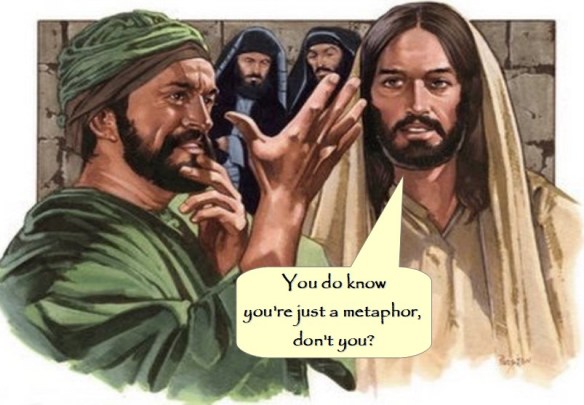
Greetings, my beloved Brethren. Today we are going to look at God’s Holy Word as revealed to our dear brother in the Lord, the one who will one day be called ‘Mark’. We’re looking specifically at the passage above, because some of you have expressed difficulty in discerning the full import of the text. I have to say I’m surprised at this. You only have to bear in mind Mark’s rule of thumb that everything in his gospel is a metaphor, which, when looked at with discernment, reveals a previously hidden mystery:
To you has been given the secret of the kingdom of God, but for those outside everything is in parables, so that “‘they may indeed see but not perceive, and may indeed hear but not understand, lest they should turn and be forgiven’” (Mark 4:11-12, referencing Isaiah 6:9)
Our passage today begins with the Lord healing a man with a withered hand, which should straight away alert us to the fact we are dealing with metaphor. All of the healings in the gospels are. They stand for something more significant than any actual healing.
Some of you might already have made the connection between the use of ‘withered’ here, with its use in another story (Mark 11-12-14), where Jesus withers an unfruitful fig tree. Of course, no actual fig trees were harmed during this miracle. The fig tree and its withering are metaphors.
The tree, you see, is a metaphor for the Jewish system of worship, the old Covenant of the Law. This had reached the end of its life. It was fruitless and God was done with it. He was in the process of replacing it with salvation through Grace. All of this is represented metaphorically by Jesus cursing the fig tree and causing it to wither.
So it is in our passage today, except this time, God offers healing to the Jewish nation. He is nothing if not gracious, reaching out and offering acceptance into the new Covenant, expressed here as the healing of a withered hand. You won’t have missed the fact – again symbolic – that the healing occurs in the synagogue, the Jews’ place of worship. We might also remember Deuteronomy (6:8) where the Lord God instructs the Jews to wear his Law on their foreheads and, more significantly, to tie them to the backs of their hands. But now their hands have, metaphorically speaking, withered away, just as the fig tree will.
God knows of course that few will accept his proffered healing, insisting instead of labouring blindly under the old Covenant. The rest of the story reflects this stubbornness and the incalcitrant attitude as the Pharisees – metaphors for the Jews as a whole – round on Jesus and castigate him for breaking the Sabbath laws in healing the man – in spiritual reality the Jews themselves. That Jesus heals on the Jews’ sacred day is metaphorical too, demonstrating as it does that all the old laws are now surpassed. Jesus, and more importantly his followers – you, my dear brethren – are no longer under the yoke of that law but have new freedom serving Jesus under his new yoke, which is easy to bear. At the end of the story, the Pharisees – the Jewish leaders of our own time, lest we forget – leave to plot against the Lord; in reality against us. With his help we will of course bear this persecution stoically.
So you see my brothers, this story was written for you, to remind you that you are saved. You are the New Covenant. The Old has passed away. You can follow Jesus’ example and do good, yea, even on the Sabbath. You need not fear the Jews or others who might persecute you because the Lord is with us. The Jews, on the other hand, will soon be cast into outer darkness when he comes in person. Even so, Lord Jesus, come quickly.
I hope this has made clear to you the mystery hidden in this part of Mark. I know there will be some of you who are not sufficiently advanced in their understanding of the mysteries, being still babes in Christ, and may yet object to this exposition of the deeper secrets of the Lord. So be it. But don’t say you haven’t been made aware of the Truth.
Next time, if there are those who need to know more of the mysteries hidden in God’s new revelation, we can look at the next part of Mark, though I trust that you are, by now, developing sufficient spiritual insight to discern for yourselves the hidden mysteries embodied by the gospel’s metaphors.
 rejectingjesus,
I suppose that the Roman destruction of Jerusalem and the temple are metaphors as well. The Jews will be glad to hear that.
LikeLike
What a silly man you are. You know that both of these are ‘prophecy’ written after the events they ‘prophesy’. If you’ve nothing new or intelligent to say, you’d be better saying nothing at all.
LikeLiked by 2 people
Don, how do you discern between an actual event/ physical miracle occurrence as claimed in the gospels and a metaphor?
LikeLiked by 1 person
Therefore, the mention of the destruction of the temple in Mark 13, Matthew 24, and Luke 21 are not metaphors, right?
LikeLike
As I’ve told you, your dispute is with Mark who says everything in his gospel is metaphor. His predictions of the destruction were written either as it was happening or just after. Call that metaphor or call it cheating, I don’t care.
End of discussion.
LikeLike
Where does Mark say EVERYTHING is metaphor?
LikeLike
I have referenced it several times in posts and comments. Please do me the courtesy of reading the posts before commenting and requesting information already provided.
LikeLiked by 1 person
I asked how you discerned between a real event / miracle and a metaphor.
LikeLiked by 1 person
Maybe it has all been a miracle. I’ve been reading in Exodus https://www.drcpublishing.us/blog and like Moses as I look back there have been many, many places where God has provided what I needed and protected me from my stupidity and led me along a path that has led to wonderful fellowship with him and productivity in the Kingdom.
If I were to try, I could find lessons in all that, just as we can in the scriptures, but I doubt that those were intentional metaphors. We do that with the scripture too. We create metaphors as we try to make sense of our lives, but the intended metaphors in scripture are usually more clearly marked than that. Like, “he told them a parable.”
LikeLike
‘God has… protected me from my stupidity.’ You sure about this?
LikeLiked by 1 person
Absolutely. More than once.
LikeLike
🤭
LikeLike
So in essence you simply read the bible and if it seems like a real event you think: “Okay, that sounds real to me,” or…. if something sounds a wee bit too far fetched even for you, you think: “Hmmm, now that just has to be a metaphor!”
In short , to paraphrase the Life of Brian, you just make it up as you go along.
Do you not consider you owe it to yourself to be a little more scrupulous or are you content with remaining ostensibly so thoroughly Indoctrinated/ credulous that you simply couldn’t care less about things like, facts, truth and honesty ?
LikeLiked by 1 person
I read the Bible as a description of actual events unless there is reason not to. Capable readers do this when reading other kinds of literature too. Most readers can tell literal from metaphoric, and yes, one clue is that it cannot be literal or does not make sense literally.
But – this may be over your head (itself a metaphor) – human beings are metaphor making creatures. We do so in everyday life – at least, those who are not limited to concrete thinking and unable to think abstractly.
A rock is a rock. The Lake of Galilee is a lake. The temple is a temple. A sheep is a sheep. The crucifixion of Jesus was a crucifixion. Even though sometimes we give these things metaphoric-like connotations or symbolic meaning. You do it. I do it. We all do it.
You should ask Neil these questions. He is the one who would turn everything in the Gospels into a metaphor. But don’t expect much. He hasn’t answered my questions on the subject.
LikeLike
What questions are those? I’ve looked back though your recent comments and can’t find any questions I have not addressed. You sure you’re not just being dishonest again?
I repeat, I do not make everything in the gospels a metaphor. Mark tells us it is so. However, if we apply your principle that if something ‘does not make sense literally’ then it is metaphoric – for example a character in an ahistorical story controlling the elements, turning one substance into another, healing strange illnesses and deformities (that cry out ‘metaphor’) and rising from the dead after 36 hours – we are indeed dealing with events that ‘do not make sense literally’. They are, therefore, by your own criteria, metaphor.
LikeLiked by 1 person
Neil: “for example a character in an ahistorical story controlling the elements, turning one substance into another, healing strange illnesses and deformities (that cry out ‘metaphor’)”
Only in your world and really only by the sleight of hand that brands miracles as unreal by the fallacy of begging the question.
It is proper, if one is intellectually honest, to take up the question of whether miracles can and do happen. If you recall from deductive reasoning, all swans are white – until you see a black one.
Wait!! What?? Is that a metaphor?
LikeLike
Only in my world? No, Don, in the real world where empiricism and rationality prevail. Miracles of the kind you want to happen, don’t. That you have imagined them or have interpreted natural events as miracles does not make them so.
LikeLiked by 1 person
Okay. Have it your way, Neil. If you wish it to be all fantasy and metaphor that are undecipherable, God will let you.
LikeLike
And where do I say it’s all indecipherable? There have been several posts recently, the most recent at your request, ‘deciphering’ metaphor.
LikeLike
@Don.
And what would be a reason to consider something in the bible would not be a real event?
Can you give me an example or three?
LikeLiked by 1 person
Living in reality.
LikeLike
Ark:
“Don, how do you discern between an actual event/ physical miracle occurrence as claimed in the gospels and a metaphor?”
Excellent question!
Please answer instead of evading!
LikeLike
How about both and – a actual event and a metaphor of something greater? Physical healing is a best temporary. The one healed will one day die. But the physical healing does promise that the God who heals can and will heal completely one day.
I personally have seen people healed and have experienced healing myself. It is pretty awesome, but it is not everything. I am still nearly eighty years old. Healing did not turn the clock back sixty years. It doesn’t for anyone. We all know that it is appointed that we die once and then the judgement. And I am perfectly okay with that.
LikeLike
Are you struggling to understand my question or simply determined to tip toe around it by not answering it?
If it makes you feel uncomfortable or you simply don’t know how you discern between an actual historical event and a metaphor as featured in the bible then please have the integrity to say so.
LikeLiked by 1 person
A actual event is something that takes place in the real world. A metaphor is a literary device.
LikeLike
And yet you say they can be both at the same time. As usual you evade the question.
LikeLiked by 1 person
Correct. Now explain how you tell the difference between real and metaphor in a biblical context.
For example : we know tales such as the Noachian global flood and the Exodus, while not exactly metaphor( as far as I am aware), are most certainly mythological, and hard evidence confirms this.
In the case of the Exodus, this is a geopolitical foundation myth.
This is nothing new and these facts have been known for a considerable time.
So why not simply offer a couple of examples of what you consider are real events and what you consider are metaphor, and what you believe they mean?
LikeLike
Ark: ” Now explain how you tell the difference between real and metaphor in a biblical context.”
Many are found in types of literature that typically employ poetic or figurative language. Others are introduced by the author or speaker as figurative (parables, for example.) Others are recognized by those who hear them as figurative. Actual events are presented in simple, clear language like we would use in reporting an events.
Ark: “For example : we know tales such as the Noachian global flood and the Exodus, while not exactly metaphor( as far as I am aware), are most certainly mythological, and hard evidence confirms this.”
The flood story is one of the stories found in what is known as primeval stories. That may be understood as a genre or type of story. They were oral and stylized stories of events long before writing was developed. They bear the marks of oral stories in their almost poetic language. They use literary tropes such as hyperbole.
The exodus is by genre a epic hero story a lot like the hero stories written about the Egyptian Pharaohs. It is but it is, again, in a style of literature that is different from what we are acquainted with in modern literature.
That does not mean they are fiction or myths. It means they are stylized. Hard evidence confirms that the place where these events happened and which are remembered in the stories did in fact experience epic floods and was in fact the scene of a migration of Hebrews from Egypt to Canaan.
Ark: “So why not simply offer a couple of examples of what you consider are real events and what you consider are metaphor,”
Haven’t I done that already?
But once again: the primeval and foundational stories of Genesis 1-11 are actual events stylized for oral transmission. They take the form in some cases of allegory or symbolic stories that describe real events. The parables of Jesus are by genre “parables.” In other words, they are not real event but are stories created to illustrate a truth.
The description of God in many of the Psalms are anthropomorphism in which God is described in terms of human characteristics.
Ark:”and what you believe they mean?”
That is too big a task for this reply. They need to ne taken one at a time because they mean different things.
LikeLike
Don/Anonymous:
You’ve been asked 4 times what mechanism you use to discern the difference between an actual event, and a metaphor…the process!
In other words, what mechanism can we BOTH use to determine which is which.
Here’s an idea:
Pray to your god that he would give you the exact words to say.
Surely, that would be convincing!
LikeLike
One question I asked, Neil, is where Mark said “everything? was a metaphor. Why not start there?
JESUS said that he used parables, but his parables are not everything. They are not even everything Jesus said. You cannot discern the difference?
LikeLike
I am tired – very tired – of you coming back repeatedly to the same points and implying I and others have not addressed them. You should bear in mind none of us is under any obligation to respond to you – this is not your blog, it’s mine – but nevertheless we do. You then give it a few weeks and start all over again with the same demands.
Case in point, you’re asking again where Mark says everything is metaphor. Here’s Mark 4:11,12, which I’ve now quoted several times in posts and comments: ‘To you has been given the secret of the kingdom of God, but for those outside everything is in parables, so that “‘they may indeed see but not perceive, and may indeed hear but not understand, lest they should turn and be forgiven”’
There’s also Mark 4:22,23: ‘For whatever is hidden is meant to be disclosed, and whatever is concealed is meant to be brought out into the open. If anyone has ears to hear, let them hear.’
I know you want to confine these and other statements to the parables but Mark clearly says they apply to ‘everything’; that’s everything he’s writing. The words are his incidentally, not Jesus’s.
Then there’s the entire post I wrote on the matter in November last year: https://rejectingjesus.com/2023/11/22/the-bible-as-metaphor-again/ and the lengthy discussion that followed. I’m not going to reiterate all of that here. Go back and read the post (and others) and the comments that followed.
I’m not going to give you the answer you want me to, Don, so it is futile to keep raising the same point over and over again.
LikeLiked by 2 people