
The Bible contains:
113 appearances of angels, usually interacting with human beings;
50+ visions, on which all of Christianity hangs: those of Daniel; Cephas and others who ‘saw’ the risen Christ; Paul and John the Elder in Revelation.
21 supernatural dreams, including those experienced by Jacob, Technicolor Joseph, NT Joseph, the Magi, Pilate’s wife and Paul.
Numerous apparitions and ghostly appearances, including that of the resurrected Jesus as well as Moses and Elijah and, in the Old Testament, the spirit of Samuel, conjured up from the grave by the witch of Endor.
Innumerable resurrections: not only that of Jesus but several Old Testament characters, and, in the New, Lazarus, Jairus’ daughter, the young man of Nain and the hordes who rose from their graves at the time of the crucifixion.
Multiple impossible astronomical events, ranging from the sun stopping in its orbit(!); a star wandering and hovering over a small house; a solar eclipse lasting several hours; stars that one day will fall from the sky; a God who lives just above the clouds and a ‘firmament’ between the Earth and the heavens that holds back water;
Several events in which nature is magically controlled: the parting of the Red Sea; Moses’ magician’s staff becoming a snake; the Nile turning to blood; Jonah being swallowed but not digested by a ‘great fish’ and Jesus calming a storm.
An abundance of fantastic beasts and fairy tale creatures: Giants (Genesis 6:1-4, Numbers 13:33); Leviathan the sea monster (Isaiah 27:1 etc); the Behemoth (Job 40:15-24); the Cherubim monsters (Ezekiel 1:4-21); the dragon and other beasts from Revelation
Many characters who are clearly legendary, from Adam & Eve, Noah, Lot and Abraham to Moses, Job, Daniel and gospel Jesus. Some of the Bible’s fictional characters lived to a literally incredible age: Adam 930 years, Seth 912, Methuselah 969, Noah 950, Abraham 175, Moses a pitiful 120. Jesus holds the record being now either 2,000 years old or eternal, depending on how you count it.
5 mythical places: Eden at the beginning of the book; New Jerusalem at the end; Heaven, the abode of God; Sheol the Old Testament place of the dead; Hades (Sheol mark II?) which Jesus visited while supposedly dead in his tomb (Acts 2:27, 31; Matt 16:18).
2 sentient ‘pillars’: one of cloud, one of fire (Exodus 13).
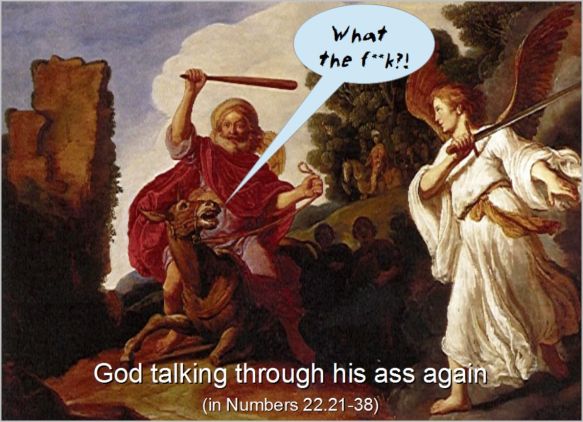
2 talking animals: the serpent in Eden and Balaam’s ass.
1 talking plant (Exodus 3:3).
0 science. No understanding whatsoever of what we now call astronomy, meteorology, germ theory, genetics, evolution, psychology… you name it.
So how do we read all of this? As the ancients themselves would, with an understanding of the world that regarded the supernatural, magic, miracles and monsters as real? We’re told often enough that this is how we should interpret scripture, not from a modern perspective. Perhaps we might credit the creators of the many books of the bible with greater skill, however, and interpret the inclusion of magic and miracle as allegorical or metaphorical; literary pieces, if you will. But then we have to decide which far-fetched stories are myth and which are historical accounts,. There really is no way to do this. A New Testament story awash with impossible events, implausible characters and symbolic tropes is every bit as allegorical or metaphorical as the same kind of story in the Old Testament (or, indeed, in Egyptian, Greek and Roman myth.) The reader who wants to see stories in the Old Testament as carefully crafted allegories has to concede that the Jesus narratives are of the same order.
It looks like we have to read the Bible as 21st century readers, because that is what we are. After all the Bible is supposedly a book for all time. We can, however, recognise the way in which its many creators saw the world – populated with fantasy creatures and subject to impossible events – and accept that they were wrong. Reality is not as they perceived it. What we cannot do is claim that the Jesus story is an oasis of truth in the midst of all this fantasy .
 rejectingjesus,
Someone once told me there are three kinds of doubt. 1) intellectual doubt. 2) emotional doubt 3) willful doubt.
Intellectual doubt is something everyone has at some time. It is satisfied by the facts.
Emotional doubt is a passing thing for most emotionally healthy people. We are up one day and down the next. But we usually find an emotional equilibrium and do not expect that our emotions tell us anything about what is true.
Willful doubt is the choice not to believe something. Usually that is because belief is uncomfortable. It requires we change not only our minds but our lives.
LikeLike
Someone told you? Was it Jesus?
I can’t guess which sort of doubt you are attributing to me. If I had to guess, I’d plump for doubt mark one on account of there being no persuasive evidence for anything the Bible claims.
LikeLike
I am not attributing anything. I thought you might identify the kind of doubt you’ve experienced.
LikeLike
Sure you didn’t. In fact I have no doubt at all about the existence of the supernatural. It doesn’t.
LikeLike
That is faith, not doubt.
LikeLike
You’ll find it’s the absence of evidence for anything supernatural.
Faith on the other hand is belief despite the absence of evidence. The magic book itself says so.
LikeLiked by 1 person
You’ll have to argue that with the disciples. No one had more evidence than they. It was in fact that evidence that caused them to believe.
LikeLike
It wasn’t the disciples who said faith is hope without evidence. It was the anonymous author of Hebrews. He’d never met Jesus.
Jesus, you’re good at this bait and switch malarkey.
LikeLiked by 1 person
It is not bait and switch. It is synthesizing the different declarations in scripture on a topic. It is my conviction that the proper exegesis of scripture requires that we consider all the teaching on a particular topic. That is probably not your approach. You tend to fragment the scripture even to the point of lifting a passage out of its immediate context to say something the author did not have in mind.
So, in this case of Hebrews 11:1 ” Now faith is being sure of what we hope for, being convinced of what we do not see ” faith is better understood as trust. That is what fits in the chapter and all the many illustrations.
But trust in what? Trust in what God said to them. It is not just free floating “faith in faith” or faith in what they hoped for; it is faith in what God promised. Now, I know you don’t think God speaks, but the writer of Hebrews knows differently. The people he used as examples knew differently. So, God’s message or instructions to them were the evidence that what God said would happen.
The same is true of the disciples, except that what they heard was from Jesus. They saw him do things no man could do and had come to understand that as evidence he was the Son of God. Being the Son of God, they were convinced they could trust him.
Faith is trust.
LikeLike
‘Synthesising’ away all the magical thinking, inconsistencies and contradictions till your left with something the Bible doesn’t actually say? You’re right, it’s not my approach.
And then there’s playing with semantics, pretending you’ve explained something by switching words like trust for faith, when really you’re still in the same place you started from.
As for the disciples, we know nothing of what they saw or heard as they neglected to write any of it down. Not surprising really when they themselves are characters in stories. Metaphors, if you will.
LikeLiked by 1 person
… to say something the author did not have in mind
And bow do YOU know what the author had in mind, Don? You don’t. You are no different than anyone else who reads the bible. You make your own assumptions and claims based on your personal perspective and the oh-so-subtle teachings of various church leaders/pastors/preachers/evangelists — all of whom have persuaded you that they have an inside track.
Seriously. If you were to pick up a bible and read the stories WITHOUT outside influence (coaching), I feel quite certain you would see things much, much differently.
LikeLiked by 1 person
And bow do YOU know what the author had in mind, Don?
Ny reading the passage in the context. That is how every piece of writing is read with comprehension. It is not that hard. 5th graders learn how to do it.
LikeLike
Of course the assistance of Christian leaders has absolutely NOTHING to do with how you interpret the “context,” right? Like I said, if a person read the bible without outside “help,” I feel certain most people would go “Whaaat??? Is this for real?” IOW, they would see it in the same light as children’s fairy tales. At the most, they would probably consider it a great adventure book.
LikeLiked by 2 people
the assistance of Christian leaders has absolutely NOTHING to do with how you interpret the “context,”
The assistance with context comes from my education and experience i n literature. It matters there as well.
if a person read the bible without outside “help,” I feel certain most people would go “Whaaat??? Is this for real?”
It is ancient literature, for goodness’s sake. It took me a while and some education to read the ancient lit I ran into in college lit classes.
they would see it in the same light as children’s fairy tales
Maybe, but educated people know better.
LikeLike
In the face of no evidence whatsoever for the foundational claims of Christianity, and plenty of evidence that refutes most of these claims what term do you reserve for yourself?
LikeLiked by 1 person
Realist.
LikeLike
You have no evidence whatsoever for a single foundational claim for your religious beliefs and yet you consider yourself to be a realist?
Interesting.
What would call a Young Earth Creationist who expressed a similar sentiment about their beliefs?
LikeLike
Actually, for many of my “religious beliefs”, at least those that deal with the natural world, the evidence is very much the same as most naturalists. I think that process in the development of life on the earth as well as the development of the universe is accurate both from a naturalist point of view and from a biblical point of view.
The origin of the universe and of life and of man (understood in a biblical sense as a being having spirit, soul, and body) is another thing. I think that God as creator and designer is a better answer and a more well evidenced answer than any natural explanation.
What would call a Young Earth Creationist who expressed a similar sentiment about their beliefs?
I would say they are not connected with reality as far as those particular young earth beliefs are concerned. Their beliefs regarding the heavenly realm and of the Creator and Designer are in line with mine.
LikeLike
You ask … So how do we read all of this?
And then you answer with: [W]e have to decide which far-fetched stories are myth and which are historical accounts.
And then you give the most definitive answer possible: There really is no way to do this..
Yet as demonstrated repeatedly on your blog, some people continue to try. 🙄
LikeLiked by 1 person
LikeLike
A few years ago I had an online discussion with a self-appointed Christian apologist.
I don’t remember how we got on the topic, but it was very important to this guy that the Big Bang was a literal explosion.
I tried explaining that “explosion” was an allegory to explain that the expansion of the universe had all the stuff in the universe racing apart as new space is added between all the stuff.
This guy simply ignored any references that explained the expansion while pointing to questionable sources that conveniently omitted the word “like” when explaining the Big Bang was like an explosion.
This guy had an agenda to which the expansion being an explosion was somehow vital. I never did find out why. This guy simply ignored data that disproved his opinion and embraced any source, no matter how sketchy, that agreed with him.
This little encounter shows why science is rarely, if ever, explained in metaphor. Without some guide to what is metaphor and what is literal, metaphor is useless.
When something is real, it’s best to describe it literally to avoid confusion. Better yet, it’s best to describe it mathematically to eliminate all error.
But when something isn’t real, it’s best to use metaphor and simile, allegory and symbolism. That way your flood that never happened can be imagined to be global, regional, or local. It may have happened in the recent past, the ancient past, or in prehistory. The ark may have saved a few farm animals and a pet lizard or all the animals on Earth. By placing your story in fantasy, it can be all things to all people. And never, ever be falsified.
Oh, and that guy who couldn’t wrap his head around the fact that “explosion” was a metaphor for the expansion was Don Camp, Apostle to the Internet. lol. What a maroon.
LikeLiked by 1 person
Hey, look!
Dr.Dan McClellan has a short video on how omnipotence, omniscience, and omnipresence in the Bible are hyperbolic rhetoric and never meant to be taken literally.
Thank goodness such things are obvious across cultures, languages, and time to even the most casual reader! A misunderstanding could have led to some ridiculous misrepresentations of God.
LikeLiked by 1 person
I thought you might find this article interesting. https://www.msn.com/en-us/news/world/former-atheist-of-20-years-flees-from-unbelief-turns-to-christianity/ar-AA1jSjmP?ocid=msedgntp&pc=LCTS&cvid=7bc47923b73a484a90496e8cb18a8a0c&ei=16
Note G. K. Chesterton’s quote.
LikeLike
Yes, I was aware of this. Ali has gone from devout Muslim to staunch Atheist to cultural Christian. It’ll be interesting to see what she chooses next.
LikeLiked by 1 person
Maybe then you’d like this NOVA episode. Stick it out to the end where the discussion of the probability of us is discussed. https://www.kcts9.org/show/nova/episode/ancient-earth-humans-gy4rdh
LikeLike
This is rather as if you imagine a puddle waking up one morning and thinking, ‘This is an interesting world I find myself in — an interesting hole I find myself in — fits me rather neatly, doesn’t it? In fact it fits me staggeringly well, must have been made to have me in it!’
(Douglas Adams)
LikeLiked by 1 person
The thing is, we are more than a puddle. We, as the video says very well, are self-aware. We are the only self-aware creatures of all the creatures we know of. We are the only creatures who have knowledge of our being and our place in the cosmos. In that way, even if it is that way alone, makes us unusual if not special.
We look for life on other worlds. Maybe there is life, but nothing we have found, or really can imagine (Adams notwithstanding), is anything like us. We grasp at straws hoping to discover we are only puddles. (It would take a load off, wouldn’t it?) But it seems inescapable that we are more than puddles and that we are in some way unique. The question should be, why?
LikeLike
Or why not?
Douglas Adams’ sentient puddle is what we call a metaphor. It serves an analogy. I thought you’d know this.
LikeLike