
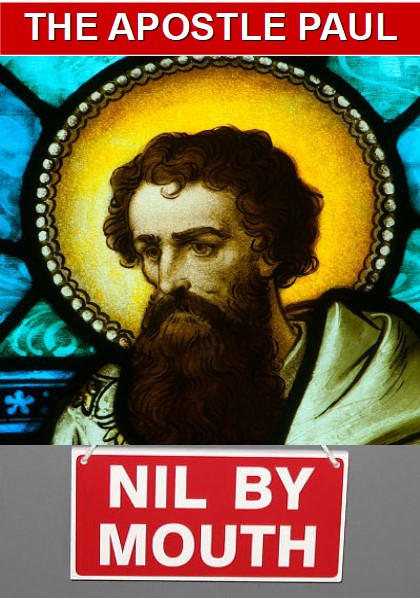
Much is made of the oral tradition that it is said informs the material in the synoptic gospels, and possibly John too. The tradition of conveying the events of Jesus’ life and the things he said goes back to Jesus’ original followers – the disciples and the apostles (the terms are not necessarily interchangeable) – and continues with a high degree of accuracy, at least until AD70 when the first gospel was written.
Which must be why we find so much detail about Jesus’ life in the letters of Paul, from his first letter, 1 Thessalonians, written circa AD55 to his last, Philippians (now an amalgam of several letters), written about 62. Paul was aware of the stories about Jesus – as all converts were – and affirms so many of the details of his life in his letters, passing on the vital stories and the traditions associated with him, in written form.
But not in our reality. Our Paul knows nothing of the details of Jesus’ life. Not once does he quote him or refer to the events of his life before the resurrection. There is nothing of the oral tradition. Nowhere in his letters does he draw from it; never does he say he knows for a fact that Jesus said or did a specific thing while on Earth.
Even after his meeting with Cephas and James, a full three years after his conversion, Paul relays not a single thing he learnt from them. After the encounter, he continues to promote only his own revelations and says nothing of what he learnt about Jesus from the man who supposedly spent three eventful years with him.
Fourteen years later, Paul meets again with Cephas and encounters other apostles for the first time. On this occasion, he and Cephas argue about justification and Paul comes away grumbling that ‘those leaders added nothing to me’ (Galatians 2:6) What? Not even stories about their time with the Master? Apparently these weren’t as important as disputes about soteriology.
Later still, Acts tells us that immediately after his conversion, Paul stayed with ‘disciple’ Ananias and other ‘disciples’ for several days. Did Ananias not know any of the oral tradition that he could pass on to Paul? Details about Jesus’ life, a saying or two or an account of a miracle? Apparently not. (This might be because the story is pure fabrication. Paul tells us himself, in Galatians 1: 16, that immediately after his conversion he ‘did not rush to consult with flesh and blood’).
Surely, though, he must have heard some of the Jesus story from those he persecuted prior to his dramatic conversion. If he did, he didn’t see fit to include any of it in his letters. Likewise, Paul had contact with cult communities he didn’t himself establish, such as that in Rome. Surely they conveyed some of the stories about Jesus that they had had passed on to them. He appears too to have known at least one other evangelist: Apollos. If these other believers did pass on stories of Jesus from an ultra-reliable oral tradition, why didn’t Paul see fit to include any of them in his letters?
So what were Paul’s sources? Certainly not the oral tradition, nor Q, the hypothetical sayings gospel, which he likewise ignores. If the gospel was being spread orally from the time Jesus lived, by the apostles and other preachers, and was being passed around the fledgling cult communities, why did Paul know nothing of it? If in fact he did, why did he choose to ignore it in favour of his own inner-visions? Did he consider it of such little value?
These questions matter, as we’ll see next time when Mark decides he’ll set the Jesus story down on paper.
 rejectingjesus,
I like this one, Neil: “Did Ananias not know any of the oral tradition that he could pass on to Paul? Details about Jesus’ life, a saying or two or an account of a miracle? Apparently not. ”
You mean of course except for the miracle that Paul himself experienced.
At best your argument is an argument from silence, though you say it all even if in a sideways manner. What do you think Paul and Peter talked about during then fortnight Paul had with the Apostles in Jerusalem? The Sunday afternoon football game?
What do you suppose was the reason Paul was so determined to wipe out the Christians before he himself became one? They didn’t smell good?
I will say once more that Paul did not need to use up papyrus to say again what he had said at length about Jesus’ life to the churches where he had preached. To think otherwise is to ignore the foundation for their faith that he laid and suppose it was his magnetic and charismatic personality that made him loved by the people whom he led to the Lord. That is patently silly.
Nevertheless, when necessary, he did quote Jesus.
1 Cor. 10: 23 For I received from the Lord what I also passed on to you, that the Lord Jesus on the night in which he was betrayed took bread, 24 and after he had given thanks he broke it and said, “This is my body, which is for you. Do this in remembrance of me.” 25 In the same way, he also took the cup after supper, saying, “This cup is the new covenant in my blood. Do this, every time you drink it, in remembrance of me.” 26 For every time you eat this bread and drink the cup, you proclaim the Lord’s death until he comes.
Now think a little. That Communion meal and memorial of the Lord’s death for them would have been nonsense if Jesus had not in fact died. And it along with baptism was one of the earliest ceremonies the church had and the central one – even before Paul became a believer. Paul did not make it up. He received it. As did every one of the other Apostles.
LikeLike
Of course you completely miss the point in all your comments.
Don: I like this one, Neil: “Did Ananias not know any of the oral tradition that he could pass on to Paul? Details about Jesus’ life, a saying or two or an account of a miracle? Apparently not.” You mean of course except for the miracle that Paul himself experienced.
No, I don’t mean that. Paul’s
miraclepsychotic episode had nothing to do with the oral tradition. As usual you raise an irrelevancy.Don: At best your argument is an argument from silence, though you say it all even if in a sideways manner.
No, it’s not. It’s a survey of what Paul knew of the stories about Jesus that you say were being passed on orally. Turns out he knew nothing.
Don: What do you think Paul and Peter talked about during then fortnight Paul had with the Apostles in Jerusalem? The Sunday afternoon football game?
Covered in the post. Obviously you weren’t paying attention. He tells us what they talked about: justification. He also says he came away with nothing from the envounter. I quoted him.
Don: What do you suppose was the reason Paul was so determined to wipe out the Christians before he himself became one? They didn’t smell good?
He tells us they were heretics decrying the Law and perverting Judaism with tales of a celestial saviour seen in visions. That was the ‘gospel’ being passed around prior to Mark.
Don: I will say once more that Paul did not need to use up papyrus to say again what he had said at length about Jesus’ life to the churches where he had preached. To think otherwise is to ignore the foundation for their faith that he laid and suppose it was his magnetic and charismatic personality that made him loved by the people whom he led to the Lord. That is patently silly
Yes, you have said this before and it is patently silly. Of course he would quote the Saviour if or when he’d said or done something relevant to Paul’s argument. He doesn’t, ever.
Don: Nevertheless, when necessary, he did quote Jesus.
1 Cor. 10: 23 For I received from the Lord what I also passed on to you, that the Lord Jesus on the night in which he was betrayed took bread, 24 and after he had given thanks he broke it and said, “This is my body, which is for you. Do this in remembrance of me.” 25 In the same way, he also took the cup after supper, saying, “This cup is the new covenant in my blood. Do this, every time you drink it, in remembrance of me.” 26 For every time you eat this bread and drink the cup, you proclaim the Lord’s death until he comes.
Paul says clearly – you even quote it – he received instructions for the ritual directly from the Lord. It was part of one of his visions or revelations. He did not get it from any oral tradition. How do we know? Because he’s equally clear he learnt nothing regarding his Christ from any other human being (as mentioned in the current post). Oh, and the verse you quote isn’t 1 Corinthians 10:23. It’s 1 Corinthians 11: 23-26.
Don: Now think a little. That Communion meal and memorial of the Lord’s death for them would have been nonsense if Jesus had not in fact died. And it along with baptism was one of the earliest ceremonies the church had and the central one – even before Paul became a believer. Paul did not make it up. He received it. As did every one of the other Apostles.
Now think a little? You think I’m one of your hapless Sunday school students?
1. Celestial saviours die too. It’s one of the things they have in common.
2. Betrayed is a mistranslation. In Greek, the word means ‘given up’.
3. Where is your evidence the Eucharist was in use before Paul came up with it? (Don’t tell me it was part of the oral tradition! )
4. Paul did indeed make it up (a.k.a. ‘received it in a revelation from the Lord’).
LikeLiked by 2 people
When one is aware of the chronology, based on the writings of Paul ( or Marcion or whoever) one comes away thinking the gospels are nothing but fiction. An entire story crafted to put flesh on the bones of the celestial being or imaginary deity concocted by Paul or whoever…
To paraphrase Life of Brian:
“They made it up as they went along!”
LikeLiked by 2 people
I was prompted by a recent discussion with Neil to think through his claim that Paul made it all up. Here’s my thoughts Thanks for the Nudge | Biblical Musing
LikeLike
I’ll allow it this time, Don, but remember, this blog is not a billboard for yours.
I’ve read your article. You make the mistake of reversing the chronology to reach an insupportable conclusion. Ark will be able to explain it to you if you can’t see it for yourself.
LikeLiked by 1 person
You lost me with the ” psychotic episode” comment. It is easy for you to dismiss a man who had everything to lose in a heatstroke induced trance. It is a fringe view to say the least.
LikeLike
What was it then if not a psychotic incident; a disturbance in Paul’s own head (as he suggests in Galatians 1:16)?
LikeLike