
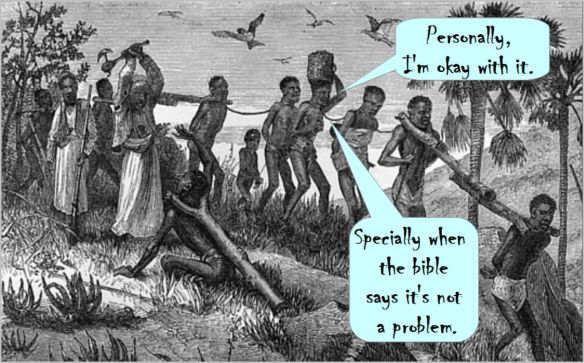
I’ve discovered this new gizmo that lets me look stuff up on the Interweb. Goober or somesuch. I used it to find the meaning of ‘doulos’ that the absence of dictionary prevented you from doing. All of the results Goober brought up described doulos thusly:
Doulos (Ancient Greek: δοῦλος, Greek: δούλος, Linear B: do-e-ro) is a Greek masculine noun meaning “slave”. Wikipedia
Doulos (a masculine noun of uncertain derivation) – properly, someone who belongs to another; a bond-slave, without any ownership rights of their own. Biblehub (Christian site)
…anyone could become a slave, in a sense. However, once someone was sold into slavery, they remained a slave for life, and all of their offspring automatically became slaves as well. The only standard way of obtaining freedom was to earn enough money to pay your owner back as much as he had paid for you in the first place. This was a nearly impossible task to accomplish because slave owners did not often facilitate their slaves ability to earn money on the side. As such, most slaves, and their offspring remained slaves for the totality of their lives. Slavesandsons (Christian site)
Doulos is a Greek word in the Bible that has only one true historical option for accurate translation into English, which is slave. It literally means to be owned by someone for a lifetime. This word is found at least 127 times in 119 verses in the New Testament scriptures. It is used in the context of human slavery, which, sadly, was very common throughout the ancient Roman Empire for hundreds of years. Recorder.com (Christian site)
You’ll see none of them say what you say, Don. None think slavery was a nice amicable arrangement. Christian sites especially emphasise how slavery was a downright awful thing so’s they can sermonise about how Jesus saves us from slavery to sin.
If you’re going to reduce real world, God-approved slavery to something akin to a nice comfortable arrangement, you diminish the metaphor of Christ’s redemptive work to… not much at all. (Which of course it isn’t.) I noticed you didn’t comment on this point when I mentioned it in an earlier post and here you are digging yourself in deeper with your ‘slavery wasn’t really all that bad’. Good work, Don!
You’re certainly enslaved to all this Christian mumbo-jumbo. To Christ though, not really. There’s no such being and you certainly don’t give the impression of being a slave in any real world sense. Perhaps that’s because you have no understanding of what slavery was and is.
 rejectingjesus,
From Paul, a slave of Christ Jesus, called to be an apostle, set apart for the gospel of God. (Romans 1:1)
Now this matter arose because of the false brothers with false pretenses who slipped in unnoticed to spy on our freedom that we have in Christ Jesus, to make us slaves. (Galatians 2:4)
Gosh! You don’t suppose there could a figurative meaning for the word?
LikeLike
You mean figurative as in ‘metaphor’, Which is how I have repeatedly referred to it? So, despite claiming in one of your recent comments that you are ‘a slave of the Lord’, you’re now saying the term is meant only figuratively. So which is it?
You are an exasperation, Don, with your ducking and diving, shifting your position as the mood takes you.
LikeLike
And you a literature instructor would say something like that. “Figurative” covers more than simply “metaphor.” But it does include metaphor.
Paul considered himself under orders to the Lord. He was not a slave in the usual sense, such as having been bought with money and being held against his will. Paul meant that his relationship to the Lord was like that of a bond slave. (a slave by choice.) “Like” indicates a simile. But it is figurative. As you know quite well.
LikeLike
You’re arguing with yourself here, Don. I’ve said all along, and drawn your attention to the fact, that being a slave of the Lord is figurative, a metaphor in fact. (A simile is merely a specialised metaphor; you’re splitting hairs again with this one. That’s a metaphor too.)
It’s you who claimed you were a slave of Christ’s. Literally or figuratively? My guess is figuratively. It’s always figurative when you Christians don’t want to do what Jesus and his mouthpieces demand of you.
I don’t blame you for not wanting to be a slave, not even of Jesus. I guess though he’d class this as a fail.
LikeLiked by 1 person
Neil:
“If you’re going to reduce real world, God-approved slavery to something akin to a nice comfortable arrangement, you diminish the metaphor of Christ’s redemptive work to… not much at all. (Which of course it isn’t.)”
Excellent point, Neil!
Through his comments, Don has revealed that he is a “liberal” xtian…he always interprets the bible through modern-day knowledge of the world, and can’t defend a literal interpretation of scripture, because it is obviously “indefensible”!
He wouldn’t fit in any church around this East Texas area…they’d run him off.
Article from
TrendyMatter:
“Christians are Disturbed When They Discover Jesus Was Woke”
In my opinion, the slavery issue of the bible is just as problematic for the xtian as the problem of evil.
They KNOW it’s screwed up, but they have to defend it somehow.
LikeLike